Limestone, Sun, Salt Wind
Water & Climate
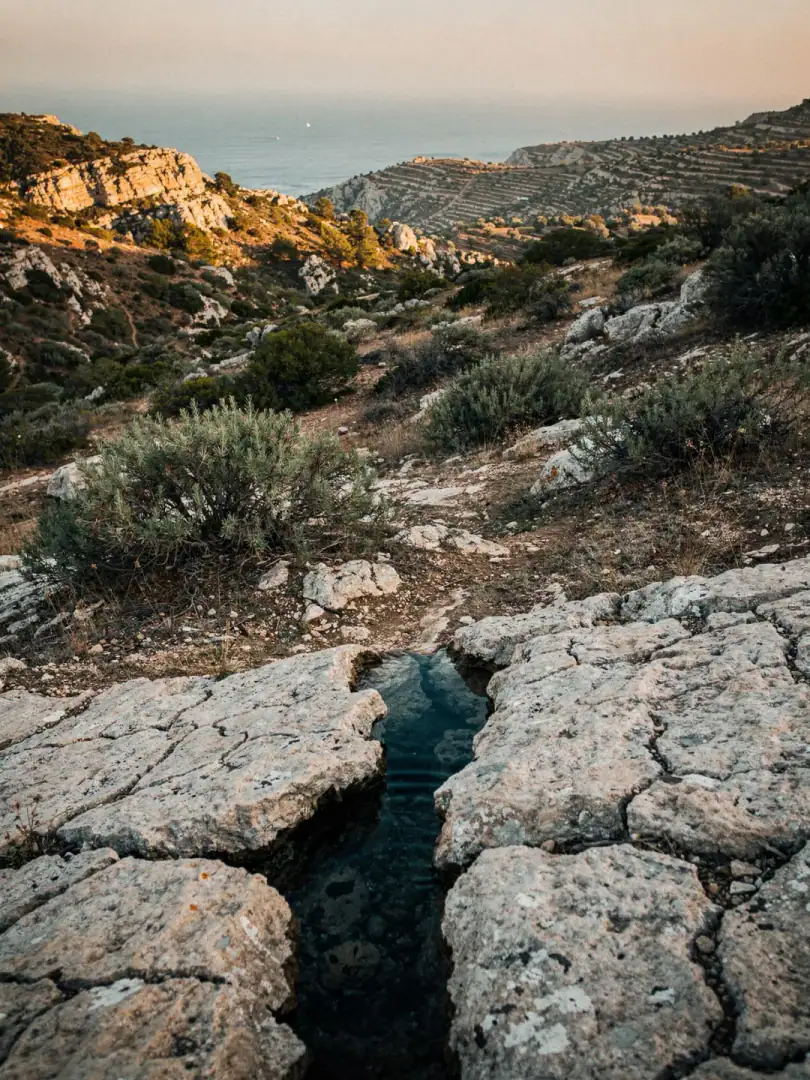
Vilanova i la Geltrú lies at the foot of the Massís del Garraf, a limestone massif that runs alongside the coast south of Barcelona like a wall. The rock is porous and karstic, rainwater seeps away quickly and collects in underground fissures instead of running off the surface. It's through this very rock that the water eventually used to bring the gin down to drinking strength also filters.
Limestone filters water in a particular way: it picks up calcium and magnesium, becoming harder but also clearer, free of the organic residues that would bring their own flavor. When cutting the distillate down to drinking strength, the water itself must not add any aromas, it should carry the botanicals, not mask them. Hard, mineral limestone water does exactly that.
The climate around Vilanova i la Geltrú is classically Mediterranean, hot, dry summers alternating with mild, wetter winters. Add to that the constant sea wind, carrying salt across the slopes. It's precisely this climate that allows rosemary, thyme, and wild juniper to thrive in the first place, plants of dry, poor soils, not greenhouse produce.
For the olive trees further inland, in Les Garrigues, the same rule applies, only more intensely, since the climate there is even drier. Summers grow hotter and winters colder than on the coast, and it's exactly this stress that draws out the Arbequina olive's concentrated, slightly bitter aroma. A moister climate would produce milder, more watery fruit.
In this way, the water connects two landscapes that at first glance seem to have little in common. There's the limestone coastal rock through which the water is filtered. There are the dry inland hills that supply the botanicals. Both share the same limestone substrate and the same Mediterranean climate that shapes the entire gin of Vilanova i la Geltrú.