Local character
Regional botanicals
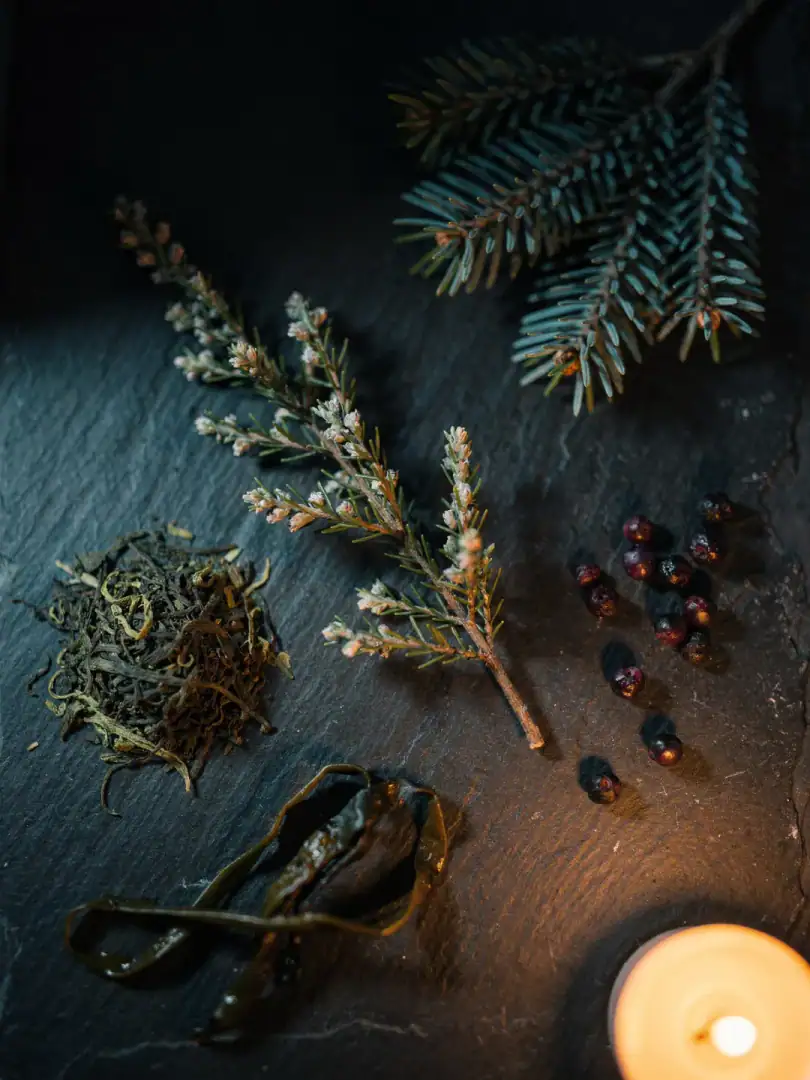
Fynbos from South Africa, tea from Asia, seaweed from Scottish coasts, spruce tips from the Alps and Australian bush herbs show just how regional gin has become today. Distilleries increasingly turn to plants from their own surroundings to set themselves apart from globally available botanicals.
What is fynbos, and why does it appear in South African gin?
Fynbos doesn't refer to a single plant, but to an entire vegetation type from South Africa's Cape region, home to hundreds of native species. For gin, the most commonly used are buchu leaves, which have an intense aroma reminiscent of blackcurrant and mint, along with other Cape herbs with spicy-resinous notes barely known in Europe and found in no European recipe.
South African distilleries use fynbos deliberately to give their gins a sense of place that sets them apart from European classics. A fynbos gin often tastes greener and more herbal than a classic London Dry, with a clearly recognizable regional fingerprint that's nearly impossible to replicate without importing the plants themselves — which makes fynbos gin practically out of reach for distilleries outside South Africa.
How does tea change a gin?
Tea leaves, whether green tea, black tea or the hōjicha common in Japan, bring tannins and a mild, slightly earthy aroma to a recipe. Unlike most botanical ingredients, tea is sometimes added only after distillation as a cold infusion, preserving its delicate notes, which heating in the still would often destroy — leaving the recipe missing its most subtle nuance.
This practice has become especially established in Japan, where gin distilleries frequently use local green tea varieties to create a connection to their own tea culture. The result is a gin with a slightly grassy, sometimes subtly bitter undertone that stands clearly apart from European gins.
What do seaweed and spruce tips bring to a recipe?
On Scottish coasts, some distilleries gather edible seaweed and kelp, which contribute a salty, slightly iodine-like note that evokes the sea the ingredient came from. This mineral undertone is unusual for a spirit and makes such gins easily recognizable, even to inexperienced drinkers, who usually notice the salty note immediately as something unusual for a spirit.
Spruce tips, the young, light-green shoots of the spruce tree, provide a resinous, fresh forest note that pairs well with juniper, since both plants contain chemically related essential oils. Distilleries in the Black Forest or the Alps use spruce tips deliberately to make their origin audible in the flavor, often complemented by wild herbs from the same landscape.
Which bush herbs do Australian distilleries use?
Australian gin distilleries increasingly turn to native bush ingredients such as pepperberry, lemon myrtle or finger lime. These plants grow wild in the Australian bush and were used by Indigenous peoples long before they found their way into modern spirits production, where they are now firmly established.
Pepperberry provides a woody heat, while lemon myrtle offers a more intense citrus flavor than classic lemon peel. Such botanicals give Australian gin an unmistakable, distinctive character and show that regional recipes are no longer a phenomenon confined to individual countries in Europe, but are found across every continent.
Buchu leaves grow only in a small area of South Africa's Cape region. Outside Africa, the plant barely thrives. Green tea for gin often comes from Kyoto or Shizuoka in Japan. Scottish seaweed gins usually use species that grow along the North Sea coast. Spruce tips are harvested in spring, while the shoots are still soft. Only a few weeks each year suit this purpose. Australian pepperberry, by contrast, ripens in summer on wild shrubs. To this day it's still mostly hand-picked. Such narrow time windows make regional botanicals rare and valuable.