Mandatory in gin
Juniper
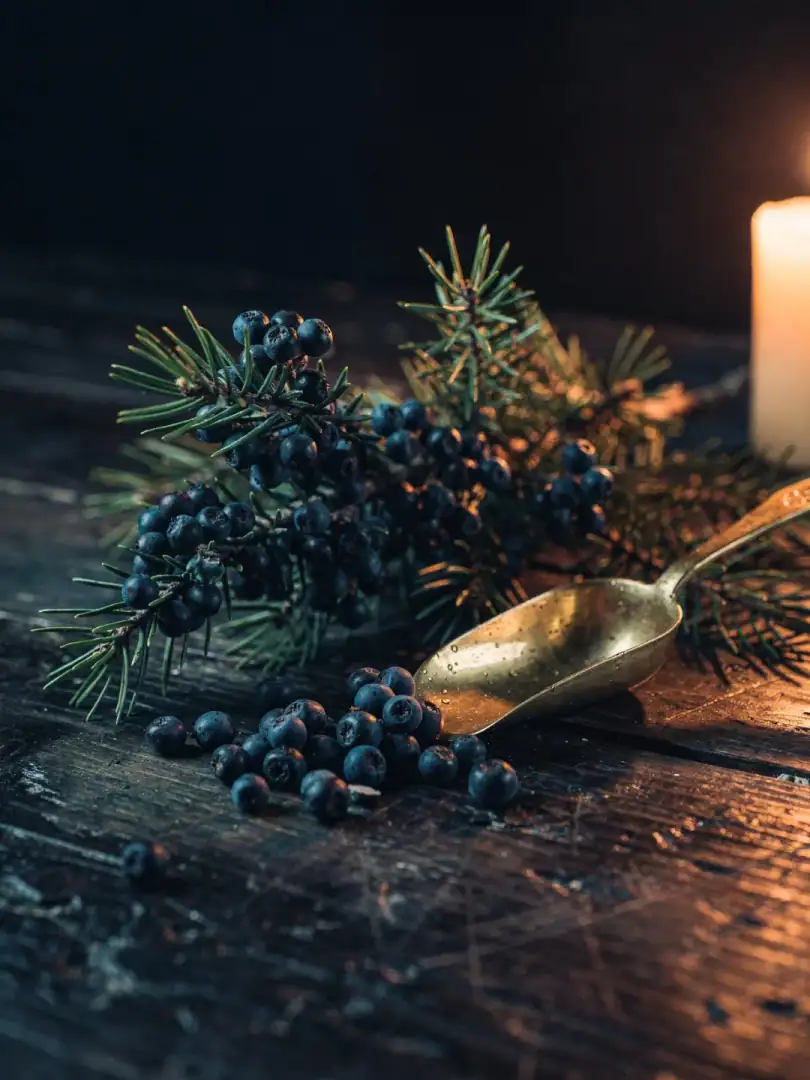
Without juniper, gin isn't gin. The blue-black berry of the juniper shrub Juniperus communis gives the spirit both its name and its resinous, spicy backbone. EU law requires that juniper remain recognizable in flavor — everything else is simply built around it.
What is the juniper berry, botanically speaking?
Juniper isn't actually a true berry at all, but a female cone, botanically related to pine and spruce. The shrub Juniperus communis grows wild across large parts of Europe, Northern Asia and North America, often on barren slopes and heathland where little else thrives. It takes two to three years for the green cones to ripen into the dark blue fruit that distillers use for gin. This long ripening cycle explains why a single shrub carries both ripe and unripe fruit at the same time — a fact that makes harvesting laborious and keeps hand-picking essential to this day.
At the heart of the berry sits essential oil, with pinene and sabinene as its main components. These compounds give juniper its resinous, slightly cool aroma, reminiscent of pine forest and juniper schnapps alike. Depending on origin and ripeness, oil content varies noticeably, which is why distillers often blend berries from several suppliers to achieve a consistent base note. Some varieties also grow at higher altitudes, where cooler nights further alter the oil content, giving a region's harvest its own distinct signature.
Where does the juniper in gin come from?
Most of the juniper traded worldwide for spirits comes from North Macedonia, supplemented by harvests from Italy, Albania and Croatia. Unlike many agricultural commodities, there are hardly any large-scale plantations: the juniper shrub grows wild, and families have gathered the berries from the same slopes for generations. This makes harvesting regional and season-dependent, but also hard to scale up when demand rises, since new shrubs take years before they even bear fruit.
For distillers, the vintage matters just as much as the origin. A dry summer produces smaller, oil-rich berries, while a rainy summer yields larger, milder ones. Anyone wanting a gin recipe to taste consistent year after year must compensate for these fluctuations — by blending multiple batches or adjusting quantities in the recipe. Some distilleries therefore test every new delivery in a small trial batch before it goes into full production.
How is juniper harvested and processed?
Harvesting is done by hand, usually in late summer and autumn, when the ripe berries are dark and the unripe ones still green. Pickers beat the branches over stretched cloths or nets so the fruit falls off, rather than picking each berry individually. The berries are then dried and separated from needles, twigs and unripe fruit, often still sorted by hand, because machines can barely detect the subtle differences between good and bad berries.
Dried juniper berries keep for several years, though they slowly lose essential oil over time. That's why many distilleries prefer fresh harvests from the current or previous year and store the berries cool and dark, away from light and warmth that would accelerate oil loss. Before distillation, they are often crushed coarsely so the oil can be released more easily on contact with the alcohol vapor.
Why does the EU legally require juniper?
Under EU Spirit Drinks Regulation (EU) 2019/787, a spirit may only be called gin if juniper dominates the flavor and the alcohol content is at least 37.5 percent. For the simplest category, the juniper-flavored spirit drink, a minimum alcohol content of 30 percent is enough, but it lacks the finesse of a distilled gin, since it's often simply flavored rather than carefully distilled.
This rule protects a centuries-old tradition: gin originated as a medicinal juniper spirit and has remained true to the berry ever since, even as hundreds of other botanicals were added along the way. A gin without recognizable juniper would legally no longer be gin at all, but a different spirits category — no matter how many other flavors the recipe otherwise carries. For distillers, this means that however much they experiment with new botanicals, juniper remains the one ingredient no one can bypass.