Neutral alcohol as the foundation
The base alcohol
Every gin begins with an almost flavorless alcohol. Only once it's clean and neutral can juniper truly work its magic.
What is neutral alcohol made from?
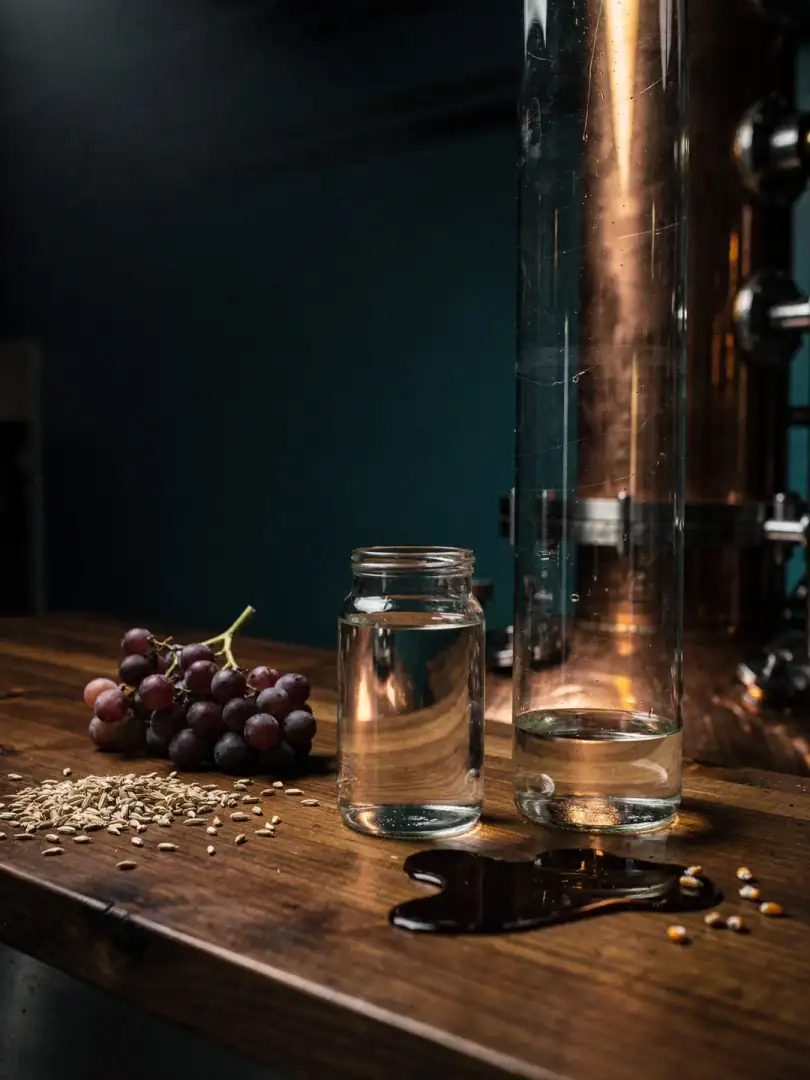
The base material for gin is called neutral alcohol, and it rarely comes from juniper itself. Distilleries usually buy it ready-made, derived from grains such as wheat or barley, from grapes as the base for brandy, or from molasses, a thick byproduct of sugar production. All three raw materials yield an alcohol after fermentation that still strongly tastes of its origin.
Only repeated distillation in tall columns removes this inherent flavor almost completely. What remains is an alcohol at around 96% ABV that barely reveals whether it once was potato, wheat, or sugarcane. That's exactly the point: juniper is meant to take the leading role later, not the raw material behind it.
What requirements does the EU set for the alcohol?
EU Spirit Drinks Regulation (EU) 2019/787 requires a minimum of 37.5% ABV for gin in the finished product, while the simpler category, juniper-flavored spirit drink, only needs 30%. Anyone wanting to call their product "Distilled Gin" or "London Gin" must meet additional rules: the alcohol used must be of agricultural origin, meaning it must come from grain, grapes, or similar plants, not from synthetic production.
London Gin comes with a further restriction. After distillation, only water and ethanol of the same quality may be added, along with at most 0.1 grams of sugar per liter. This rules out any subsequent sweetening or flavoring with extracts. In the US, a different minimum applies under 27 CFR 5: gin there must have at least 40% ABV, notably higher than the EU minimum.
Why does purity matter so much here?
An alcohol with off-flavors would mask or distort the juniper. That's why distilleries test their neutral alcohol before actual gin production begins, often with a simple sniff test straight from the barrel. If the alcohol smells of grain, fruit, or smoke, it's not suited for a clean gin.
Small distilleries often source their neutral alcohol from specialized suppliers, since running your own multiple rectification requires expensive equipment. Larger houses, on the other hand, often produce it themselves and thus control the entire chain from raw material to finished bottle. Both paths lead to the same goal: an alcohol that serves as a blank canvas for juniper and the other botanicals.
Why do grain, grapes, and molasses differ as raw materials?
Even though the finished neutral alcohol ends up tasting almost identical, the three raw materials differ in reputation and cost. Grain such as wheat or rye is considered the standard in many countries because it's abundantly available and delivers a very clean, mild base character. Grape alcohol, often obtained from surplus wine production, is regarded by some distilleries as especially refined and is happily mentioned on the label, as with certain well-known French gins.
Molasses, on the other hand, a viscous residue from processing sugarcane or sugar beet, is usually the cheapest option and is often used on an industrial scale, including for rum. For the finished gin, this makes barely any perceptible difference, since rectification removes the origin almost entirely, yet marketing departments still like to highlight it to tell a fitting story.
Some craft distilleries even advertise the exact raw material on the label, such as "made from grape alcohol" or "made from organic wheat," to set themselves apart from the crowd. In the end, this plays a smaller role for the flavor in the glass than the botanicals themselves, but as a story for an audience keen to know exactly where their gin comes from, the origin claim works well.