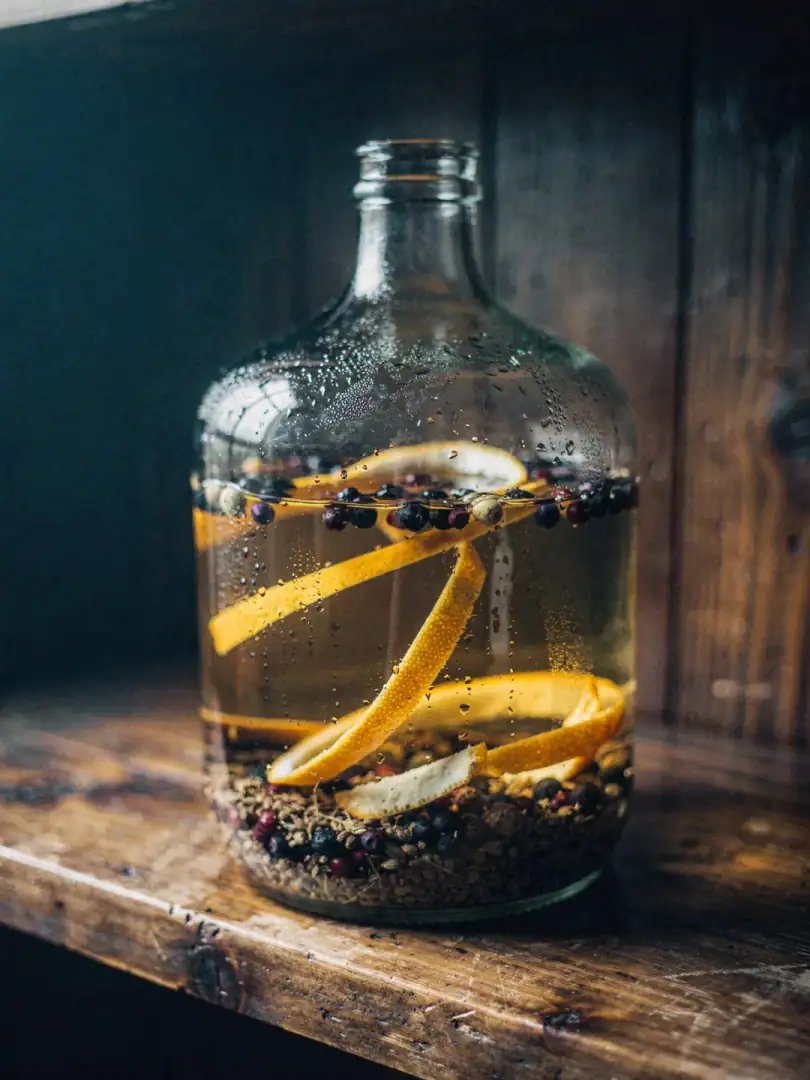
Botanicals steep in
Maceration
Before the still runs, juniper and other botanicals often rest in the alcohol for hours. This waiting period is called maceration, and it shapes much of the later flavor.
What happens when the botanicals are steeped?
Maceration means the distillery adds juniper berries, coriander, citrus peel, and other plant matter directly into the diluted neutral alcohol, usually reduced to around 45 to 60% ABV. The alcohol acts like a solvent here: it draws essential oils, bitter compounds, and aromas out of the solid botanicals, similar to how hot water extracts flavor from tea leaves, only slower and at room temperature.
The longer the botanicals sit in the alcohol, the more substance they release. Some compounds dissolve quickly, such as light citrus oils, while others need considerably more time, such as resinous components from juniper berries or angelica root. Master distillers deliberately use this varying pace to steer the balance in the finished gin.
How long does maceration usually take?
Most distilleries leave their botanicals to steep for between twelve and twenty-four hours, often overnight. During this time, a balance forms between alcohol and plant matter that suits the intended recipe. Some houses macerate individual botanicals separately, to control each ingredient independently before combining everything in the still.
Other producers go further and let certain roots or barks steep for up to forty-eight hours, since their aromas only release slowly. Still others skip maceration almost entirely and distill the botanicals immediately alongside the alcohol, which gives the character a fresher, less full-bodied feel. Both approaches are considered legitimate, they simply lead to different styles.
What role does temperature play?
Warmth speeds up extraction, but it carries a risk: too much heat also draws out unwanted bitter compounds from skins and seeds, which can make the gin taste harsh later on. Most distilleries therefore macerate at room temperature or even slightly chilled, to keep control over the outcome.
At the end of maceration stands a flavored alcohol, which the distillery then pours directly into the still. The actual separation of aroma from unwanted compounds only happens during the subsequent distillation. Maceration thus only provides the raw material base, while the still's heat handles the fine work in the next step.
How does maceration differ from simple flavoring?
Maceration should not be confused with simply adding flavorings, as happens with so-called compound gin. In maceration, real plant matter sits in the alcohol, and the subsequent distillation ultimately separates only the desired aromas from the solid residues and unwanted compounds.
This intermediate step makes the difference between a full-bodied, layered gin and a rather flat, one-dimensional product. Anyone holding a bottle can't see this step directly, but the label often reveals it already: the term "distilled gin" indicates that real botanicals were macerated and then distilled again.
In practice, maceration also differs depending on whether a distillery combines all botanicals together or macerates each ingredient separately and only brings them together shortly before distillation. The separate approach requires more vessels and more effort, but allows for finer control, since each component can be dosed independently of the others. Anyone who has tasted two batches of the same recipe with different maceration times often notices the difference clearly: batches steeped a little longer taste rounder, shorter ones fresher and sharper. This fine-tuning explains why even two distilleries with nearly identical recipes end up bottling two noticeably different gins. It's precisely these small adjustments, alongside the ingredient list itself, that ultimately make the difference between an interchangeable gin and a truly distinctive one.