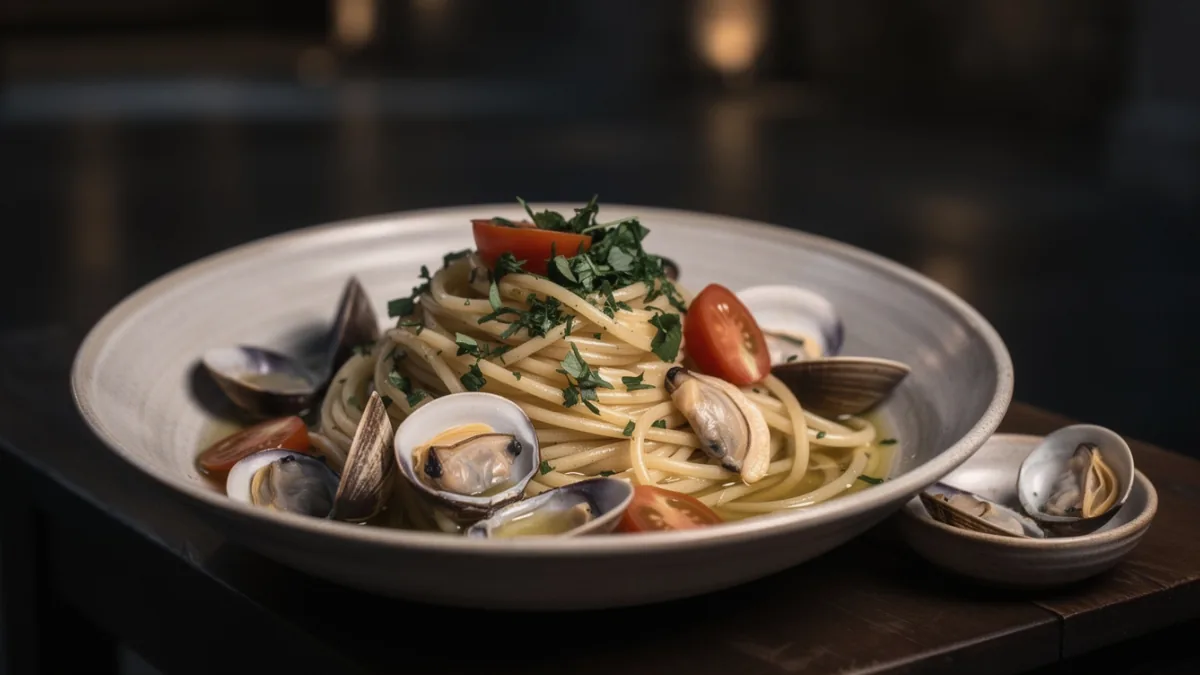
Preparation
- Sort through the clams and discard any with damaged or open shells. Rinse under running water and soak in cold water with a little coarse salt for about 2 hours so they release their sand. Then rinse thoroughly again.
- Bring plenty of water to the boil for the pasta. Slice the garlic, finely chop the parsley and halve the tomatoes.
- Add the spaghetti to the salted water. Heat the oil in a large, deep frying pan or a wide pot and gently fry the garlic (and chilli). If using tomatoes, add them now for about 2 minutes.
- Add the clams, pour in the wine, put the lid on straight away and cook over high heat for about 5 minutes until they have opened, shaking the pan now and then. Discard any clams that stay closed.
- Lift out the clams with a slotted spoon, pour the liquid back into the pan through a fine sieve and bring briefly to the boil. Take some of the clams out of their shells, leaving a few in the shell for serving.
- Drain the spaghetti 1 to 2 minutes before the end of the packet time and add to the broth while still dripping wet. Toss over high heat for 1 to 2 minutes until the sauce clings creamily to the pasta, adding a splash of pasta water if needed.
- Fold in the clams and parsley, season with pepper and add salt only after tasting. Serve straight away without cheese, with a plate for the empty shells.
Drink with it
White wine · excellent match
Vermentino, Verdicchio or Falanghina, well chilled
The salty clam broth with garlic finds an echo in the mineral, dry freshness of these coastal wines, and the acidity keeps the olive oil light.
Which wine pairs with food? A simple approach to choosingJunmai sake · excellent match
Junmai, lightly chilled or at room temperature
Sake lovers count shellfish among the best partners of all - in Japan, clams are even steamed in sake: the succinic acid of the clams and the umami of the rice reinforce each other, and the soft character carries the salty garlic broth.
Junmai, Ginjo, Daiginjo: What do these mean for sake?Sparkling wine · good match
Franciacorta or Prosecco, brut
Bubbles and acidity clear the garlic oil from the palate, and the lean fruit keeps the clams in the foreground.
Sparkling wine, Champagne, and Prosecco: what's the difference?Pale lager · good match
Italian lager or pilsner, cold
Carbonation and light bitterness refresh after the salty broth and let the briny note of the clams stand out.
Pils or Helles: What's the Difference?
Why it pairs well
Sake is not an Italian companion, but it matches the umami of the clams; in Japan, clams are even cooked in sake.