Engenhos and Seals
Region & History
What is Cachaça and where does it come from? The trail leads to São Vicente on the coast, where the Portuguese planted sugarcane in the 16th century. Historian Luís da Câmara Cascudo dates the first distillate to 1532; the written evidence is considered thin, so it remains a tradition rather than a fact. If true, Cachaça would be older than the word rum, which only emerged in the 17th century on Barbados.
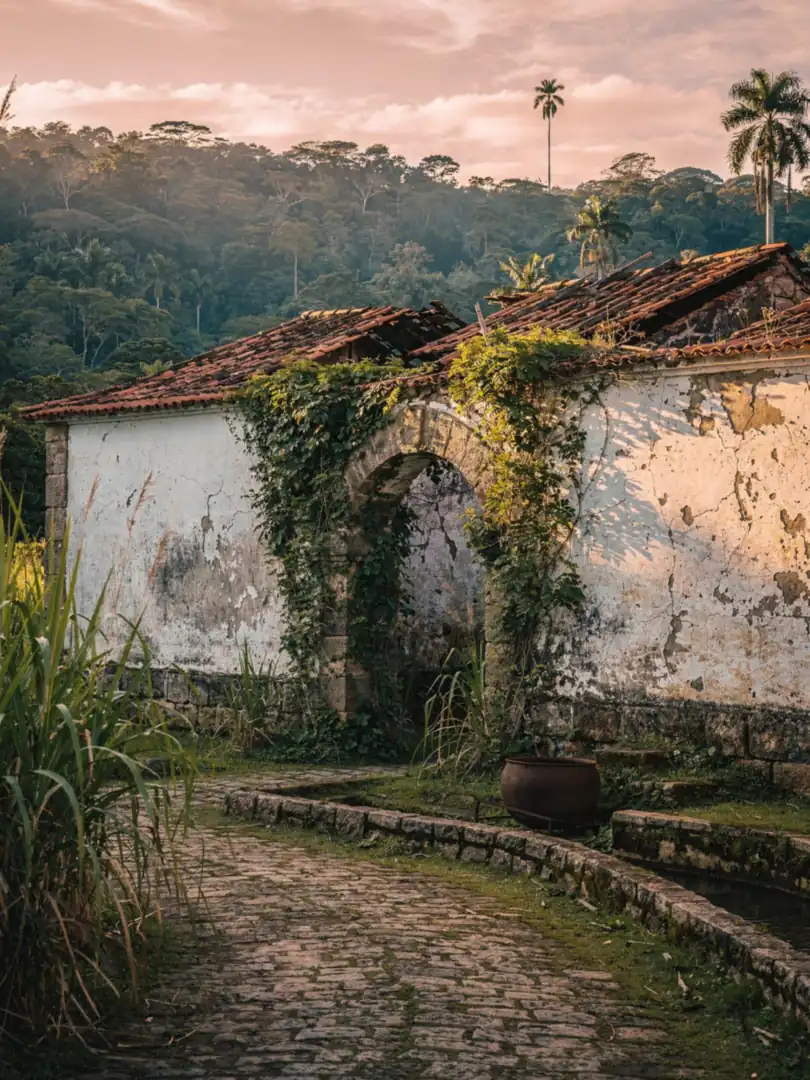
The work took place in the sugar mills, the engenhos. There, enslaved people from Africa cut, pressed, and cooked the cane; slavery in Brazil did not end until 1888, with the Golden Law, the Lei Áurea. One explanation for the name Cachaça holds that enslaved workers skimmed off the foam that rose while the juice was being cooked and let it ferment. Whether this is true remains unconfirmed.
Today, Decree 6.871 of June 4, 2009, regulates the market. It implements Law 8.918 of 1994, and its Article 53 declares Cachaça the "typical and exclusive" designation for sugarcane aguardente from Brazil. The name thus belongs to the country and is not a subtype of rum.
Certain places protect their origin further still. Paraty, in the state of Rio de Janeiro, received an Indicação de Procedência, a geographical indication, from the patent office INPI on July 10, 2007; this has since been upgraded to the stricter Denominação de Origem. Salinas, in Minas Gerais, followed in 2012 with its own Indicação de Procedência.
Exactly how many distilleries exist is counted differently by every source. The industry association IBRAC cites nearly 2,000 registered producers with around 4,000 brands. Depending on the source, 70 to 75 percent of the volume comes from industrial operations, with the rest from small copper distilleries, the alembiques. In the EU, Cachaça appears on the list of Brazilian names protected under the agreement with Mercosur.