Juice, not molasses
Sugarcane & Molasses
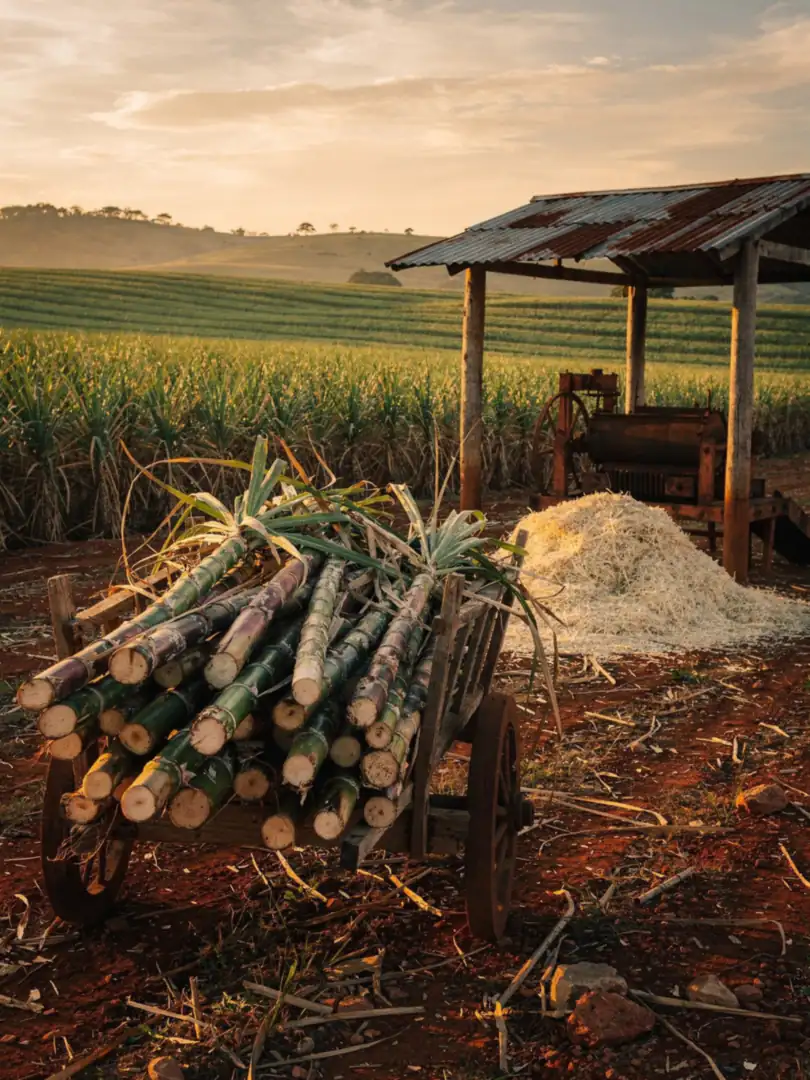
The difference from rum begins in the field. Cachaça is distilled from sugarcane juice, caldo de cana in Portuguese, not from molasses. The decree spells it out: Cachaça is produced by distilling the fermented must from sugarcane juice. Molasses, the dark byproduct of sugar refining, is therefore excluded as a base material for Cachaça.
Sugarcane grows across many Brazilian states, from the northeast down to the south, including Minas Gerais and the hinterland of Paraty. In the southeast and south, the harvest, the safra, runs roughly from April to November. The juice is fragile: as soon as the cane is cut, it starts losing sugar, and the pressed juice begins to ferment quickly. That's why the cane goes to the mill shortly after cutting.
At the mill, rollers crush the juice out of the stalks. The spent fibers, called bagaço, serve as fuel on many farms to fire the still. The juice is filtered and diluted to the right sugar level for fermentation.
Brazilian law has its own terms for molasses. Under Article 54, rum in Brazil is a spirit made from molasses or from a blend of molasses and cane-juice distillate, at 35 to 54 percent ABV, aged wholly or partly in oak or equivalent wood. Cachaça, by contrast, needs neither cask nor molasses. It shares its raw material, cane juice, with rhum agricole, but not the name, the rules, or the style.
One quirk is the adoçada. Cachaça may contain up to six grams of sugar per liter; above that, and below 30 grams, it's called cachaça adoçada. The EU allows rum up to 20 grams per liter, more than triple Brazil's limit. The word adoçada on the label isn't a sign of a liqueur, but a legally defined category.