Limestone, mills, factories
Region & History
Rum from Guadeloupe has two faces, and Grande-Terre shows the flat one. The twin island consists of two parts separated by a narrow strait. Basse-Terre in the west is volcanic and mountainous, while Grande-Terre in the east rests on limestone and lies so low that the trade wind sweeps unchecked across the fields.
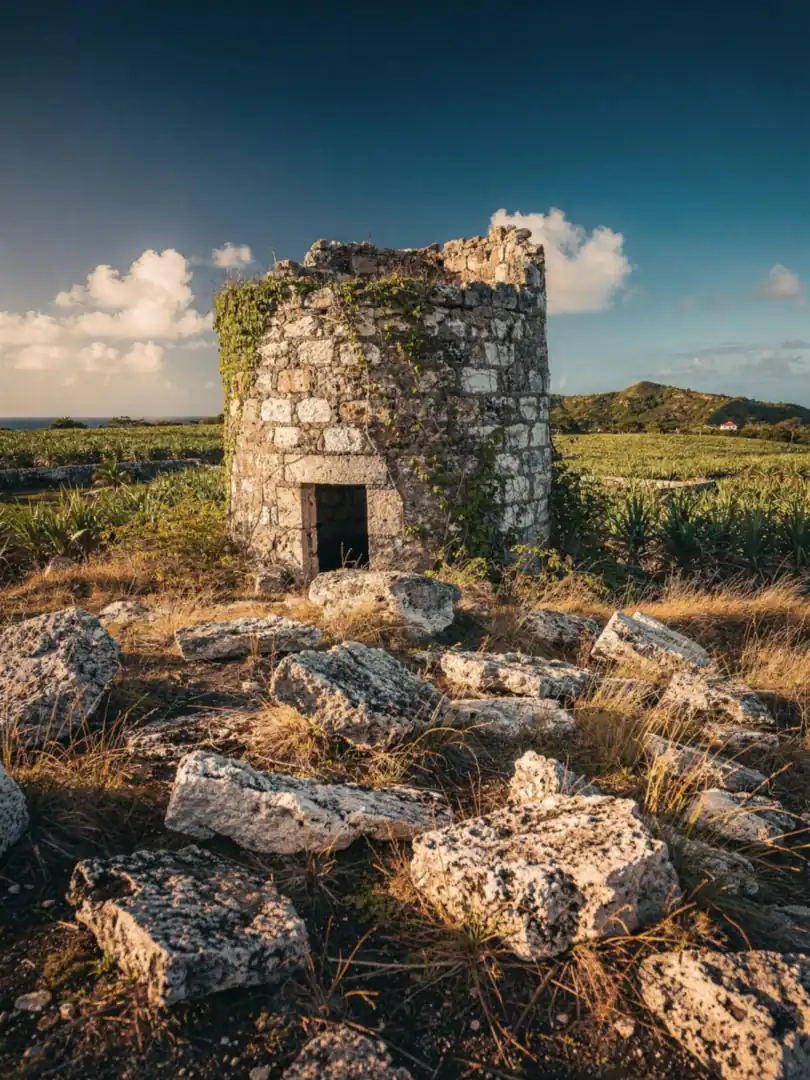
The French began settling Guadeloupe in 1635. Large sugar plantations soon took hold on Grande-Terre, worked by enslaved people who had been forcibly brought from West Africa. They cut the cane, drove the mills, and boiled down the juice. Ruins of windmills and sugar houses still stand among the fields today. From the molasses left over after boiling the sugar, rum was distilled.
Slavery was abolished by the Convention in Paris in 1794, reinstated under Napoleon in 1802, and finally ended for good by the decree of April 27, 1848. Afterward, planters brought in indentured laborers, mainly from India. The small plantation mills gave way to large sugar factories. The Gardel factory in Le Moule is said to have been founded in 1870 and still operates today. The Darboussier factory in Pointe-à-Pitre closed in 1980; on its grounds, the Mémorial ACTe has stood since 2015, a museum dedicated to the history of slavery.
Today, only one distillery still produces rum on Grande-Terre: Damoiseau in Le Moule. The Bellevue estate was a sugar plantation belonging to the Rimbaud family of Martinique in the late 19th century. Roger Damoiseau bought it in 1942 and converted it into a distillery. According to the house, his family still runs the operation today.
The name "Rhum de la Guadeloupe" is a protected geographical indication in the EU, registered since 1989. There is no AOC as on Martinique. The label may state "agricole" if only cane juice was fermented, or "de sucrerie" if syrup or molasses formed the base.