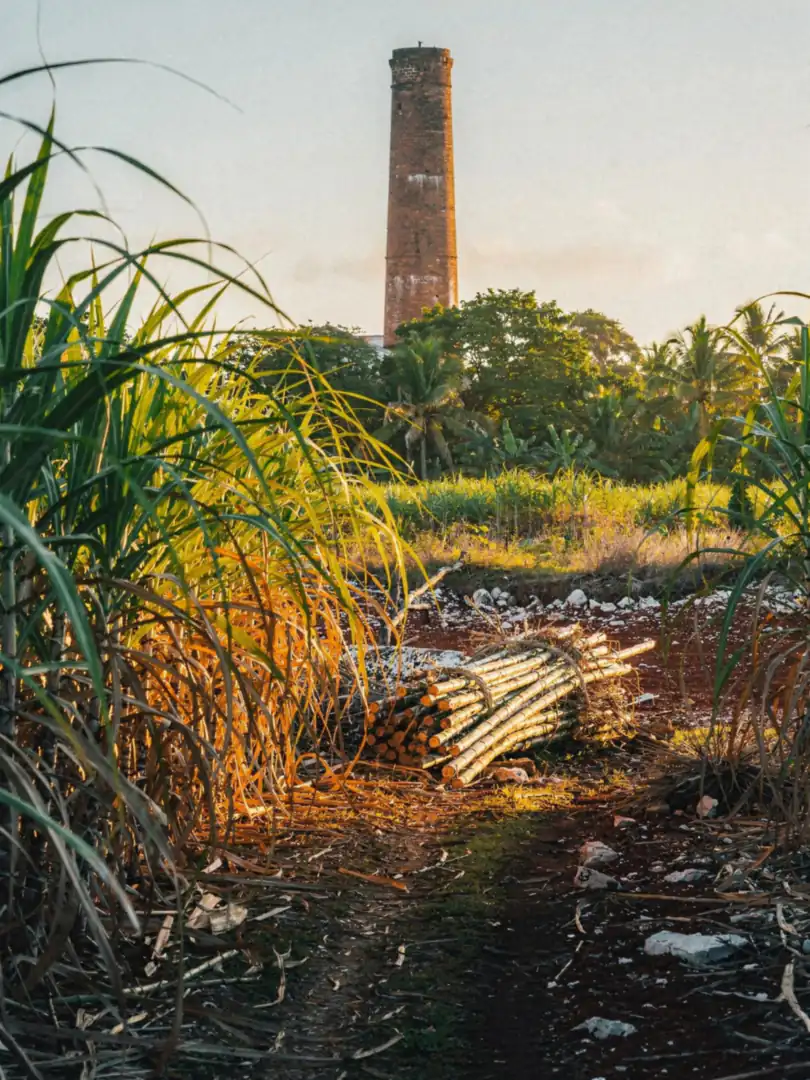
Cane, factory, molasses
Sugarcane & Molasses
When the sugar has crystallized out at the Gardel factory near Le Moule, a dark, sticky mass remains. This is molasses, and it still contains enough sugar to turn into alcohol. What molasses means for rum can be said briefly: it is the raw material of rhum de sucrerie.
The cane grows on limestone soils. Limestone is porous, rain drains away quickly, and the trade wind dries out the flat land. Sugarcane copes well with this, since it stores more sugar in the stalk during drier weeks. In Guadeloupe, the harvest runs roughly from February to June, and during this time the Damoiseau distillery also runs at full capacity.
According to industry sources, Gardel processes cane from both Grande-Terre and Basse-Terre, while the factory on Marie-Galante operates independently. The campaign begins in February. Rollers then press the juice from the stalks, the factory boils it down, the sugar is spun off, and molasses remains as a byproduct.
Distillers can choose from three raw materials. Fresh cane juice begins fermenting on its own within hours and spoils quickly, so it is only processed during harvest. Syrup is cane juice that has been reduced. Molasses can be stored in tanks, which means molasses rum can be made year-round, even when nothing is being cut in the fields.
The law draws a strict line between the two paths. Under the "agricole" designation, syrup, molasses, and sugar are banned as additives; under "de sucrerie," only syrup or molasses is allowed. If a rum is to be sweetened, an EU-wide limit of 20 grams per liter applies, calculated as invert sugar. How much that actually is is explained in the article on sugar in rum.