Days, Not Weeks
Fermentation
Two days are enough at Bielle, while Père Labat states five days for its white rum made from organic cane. This refers to the fermentation of the sugarcane juice, and both figures come from the houses themselves. They show that even two distilleries on an island just fifteen kilometers wide can take different approaches.
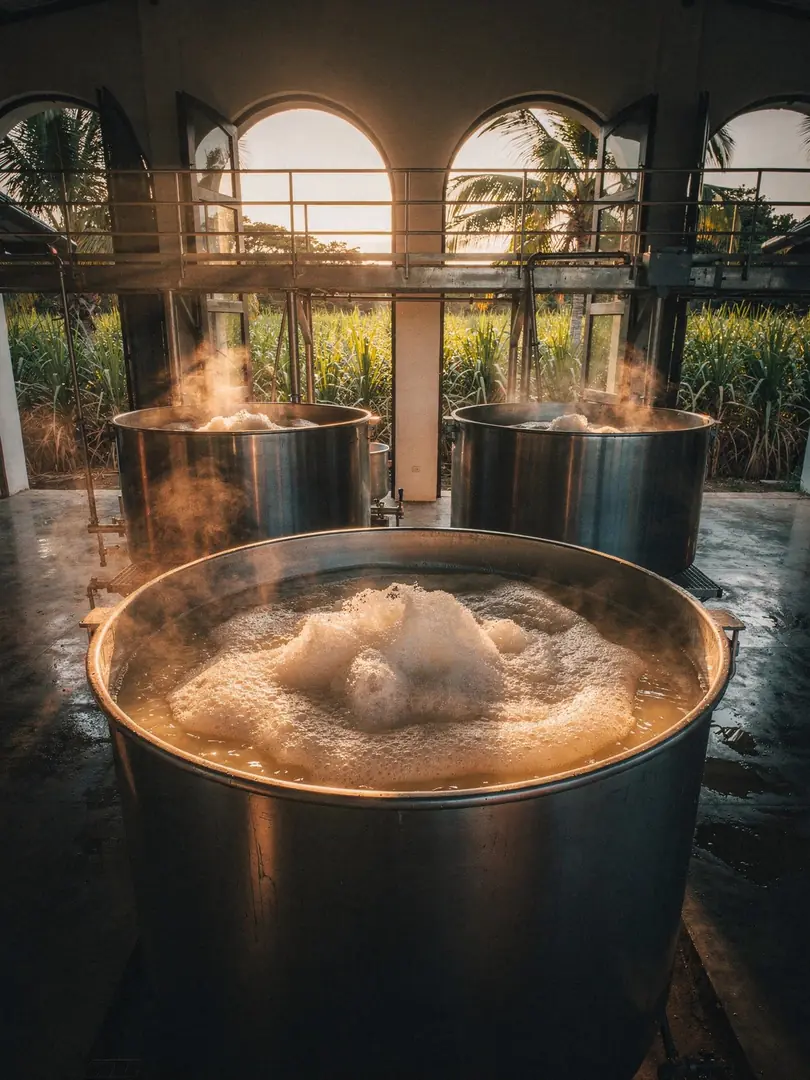
During fermentation, yeasts consume the sugar in the juice and convert it into alcohol and carbon dioxide. The vat foams and warms up, and the result is a liquid called sugarcane wine. It has only a few percent alcohol by volume and only becomes rum once it passes through the still.
This rum needs nothing more than juice and yeast. That makes it sensitive: what is in the cane determines the rum, and any weakness in the harvest carries through all the way to the glass.
Why duration matters: over time, yeasts and accompanying bacteria form byproducts, including esters—fragrant compounds reminiscent of fruit and blossoms. A short fermentation tends to stay lean and grassy, while a longer one gains fruitiness. Which timing leads to which rum is a decision each house makes for itself. The figures from Bielle and Père Labat are therefore not a shortcoming on either side, but a signature style.
At Bellevue, visitors can view the fermentation vats, and the tour is said by the house to be free of charge. At Père Labat, a visit is especially worthwhile during the harvest campaign. Then the facility is in full operation, and the tour shows how the juice travels from the mill to the vat and becomes there what will later flow into the column.