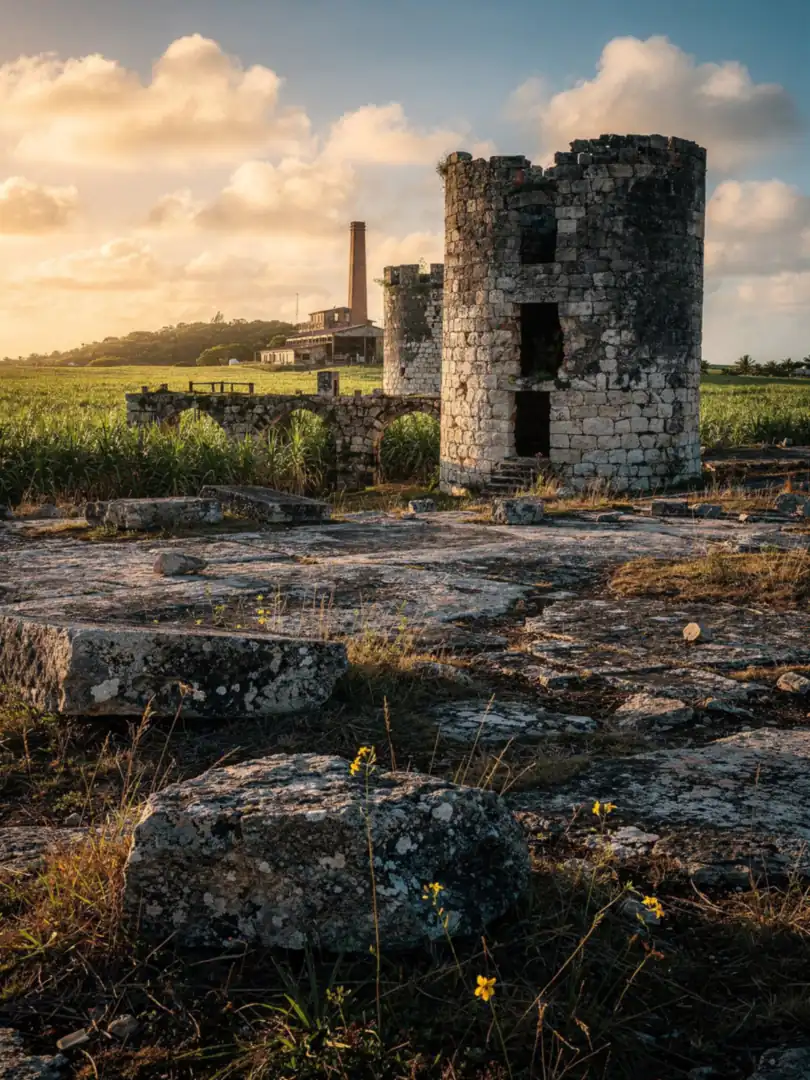
Windmills, Three Distilleries
Region & History
Rum from Marie-Galante comes from an island that owes its name to a ship. Christopher Columbus reached it in 1493 on his second voyage and named it after the Marigalante, one of his ships. The round limestone island lies south of Grande-Terre, measures only about fifteen kilometers in diameter, and belongs to the Guadeloupe department.
French settlers arrived on the island from 1648 onward, bringing sugarcane with them. As on all the Antillean islands, the planters' wealth rested on the labor of enslaved people abducted from West Africa. They cut the cane, fed the mills, and kept the boiling kettles running. When a count was taken in 1830, 106 windmills were turning on Marie-Galante.
This is the origin of the nickname Île aux cent moulins, Island of a Hundred Mills. It is no exaggeration but an actual count, now nearly two centuries old. About seventy of the stone mill towers still stand today, one of them right next to the Bellevue distillery.
Today's distilleries have different roots. The house of Bielle traces back to Jean-Pierre Bielle, who grew coffee on the island in 1769. In 1826, his sons founded a sugar factory with refinery on 53 hectares. According to the house, distilling has taken place there since the early 20th century. Poisson, the distillery behind the Père Labat brand, is located near Grand-Bourg, like Bielle. Bellevue operates near Capesterre as an independent family business.
There is no separate appellation just for the island. Its rums fall under the protected designation Rhum de la Guadeloupe, which explicitly includes Marie-Galante. There is no AOC as there is on Martinique. The label may only state "agricole" if exclusively sugarcane juice was fermented—and that is exactly what all three houses do.