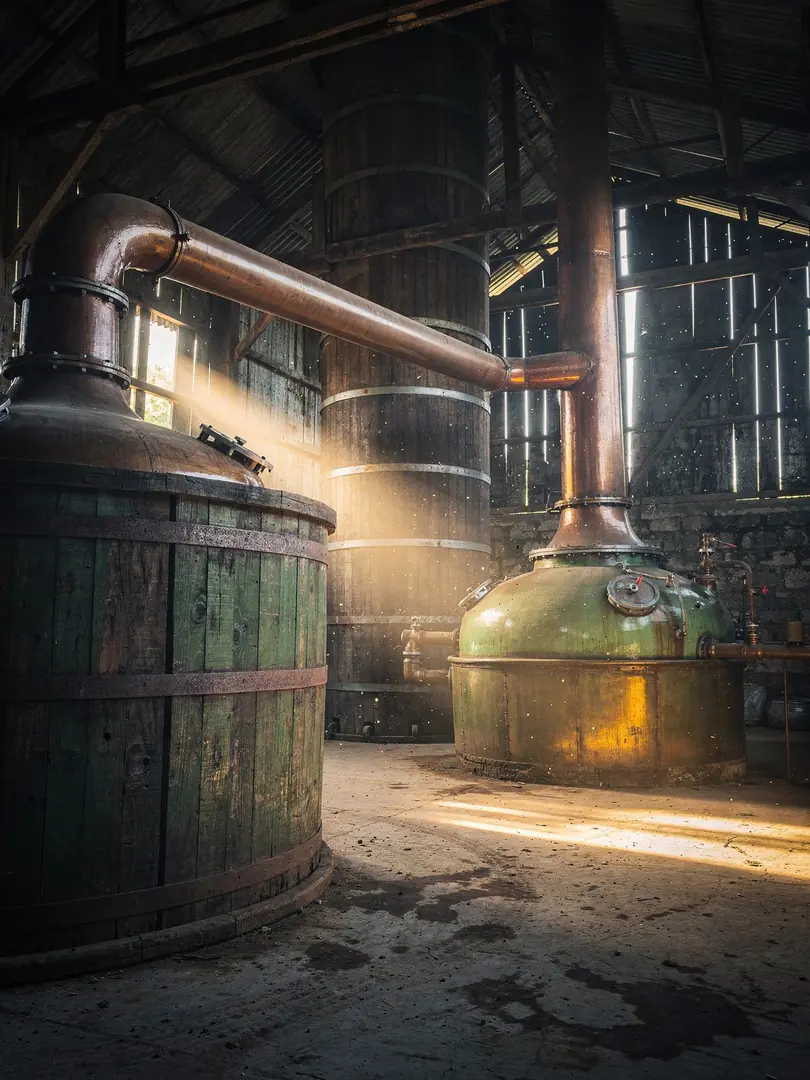
Greenheart Instead of Copper
Distillation
A still made of wood sounds wrong until you learn what kind of wood it is. Greenheart, a hardwood from Guyana's forests, is so dense and water-resistant that it's used to build harbour piers that stand permanently in water. A commonly cited explanation is that the wood, like copper, absorbs sulphur compounds from the vapour. The geographical indication specification permits wood, copper, or steel.
Port Mourant is the double wooden pot still, two kettles in sequence. It comes from the estate of the same name in Berbice. The estate is commonly dated to 1732 and closed in 1955. The still then moved to Albion, later to Uitvlugt, and finally to Diamond. The letter code PM denotes its rum.
Versailles is a single wooden pot still from the west bank of the Demerara, carrying the code VSG. The estate closed in the early 1970s. The still moved to Enmore in 1977, to Uitvlugt in 1993, and to Diamond around the turn of the millennium. It changed location three times in thirty years, with no one ever considering scrapping it.
Enmore, on the east bank of the Demerara, has two wooden Coffey stills dating from the 1880s. A Coffey still is a column: it runs continuously rather than batch by batch, following the design of the Irishman Aeneas Coffey. Its rum carries the marque EHP and comes out lighter than the rum from the pot stills.
Uitvlugt on the west bank originally had double wooden pots. In the early 1920s these were replaced by a Savalle, a French apparatus with four columns. This rum was correspondingly lighter. When the operation closed around the turn of the millennium, the Savalle also moved to Diamond. Each of these stills yields its own marque, whose code later appears on the casks.