Blending, Not Just Distilling
Distillation
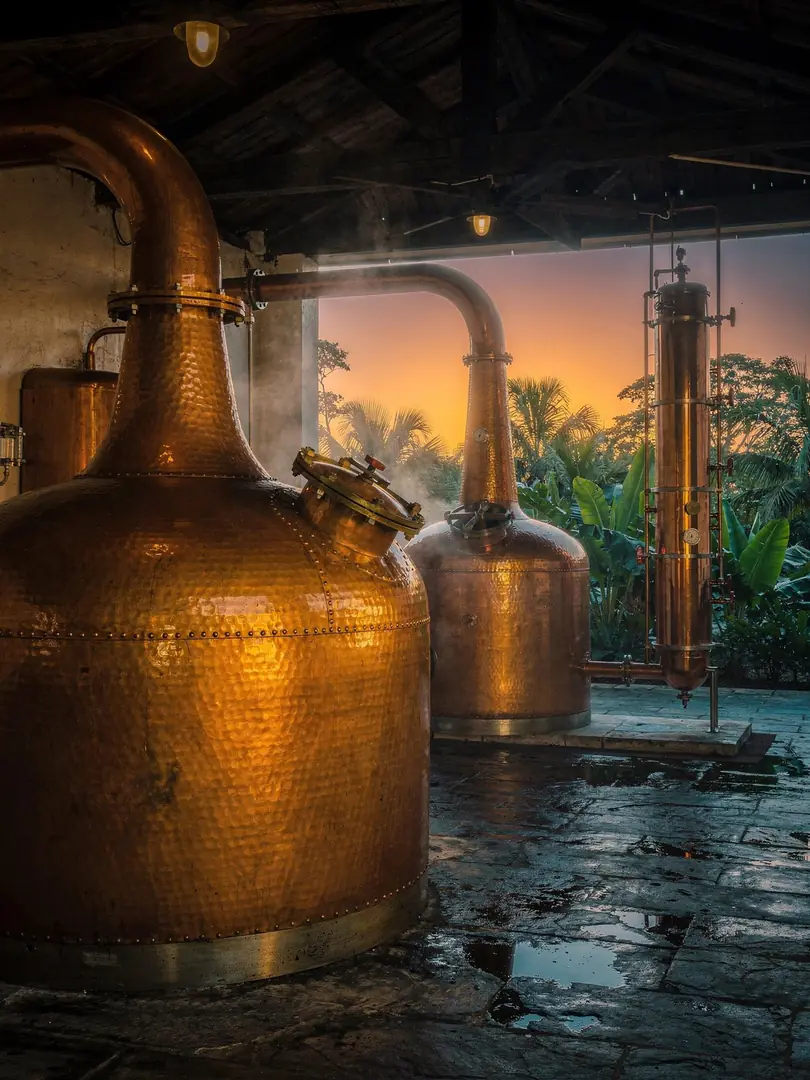
How is Wray & Nephew White Overproof distilled? According to the house, it's a blend of pot-still and column-still distillates, bottled at 63% ABV.
A pot still is a copper kettle still that works batch by batch. It leaves plenty of aromatic compounds in the distillate, which explains the fruity core. A column still, by contrast, distils continuously, separates more sharply, and yields a cleaner, lighter spirit. Jamaica's geographical indication allows both methods, including blends of the two.
Overproof means the rum is stronger than the old 'proof' measure specifies. In the British system, 100 degrees proof equals 57.15% ABV, and a rum at 63% sits above that mark. Overproof, however, is not a legal term.
The same logic applies to the Navy ration. Toward the end, it was issued at 95.5 proof, equivalent to 54.6% ABV, in an eighth-of-a-pint measure of around 71 millilitres.
The Navy blend lives on as a brand. In 1979, Charles Tobias obtained naming rights and the blending specifications for the Admiralty Blend, a mix of five West Indian rums, from the Admiralty. His company, Pusser's, is based on Tortola. 'Navy Strength' colloquially refers to around 57% ABV, an industry convention rather than a formal standard.
Blending serves a practical purpose. A blend can be adjusted so that the brand tastes consistent batch after batch, even when individual distillates vary. A single cask, by contrast, represents just one barrel and can differ considerably from bottling to bottling.