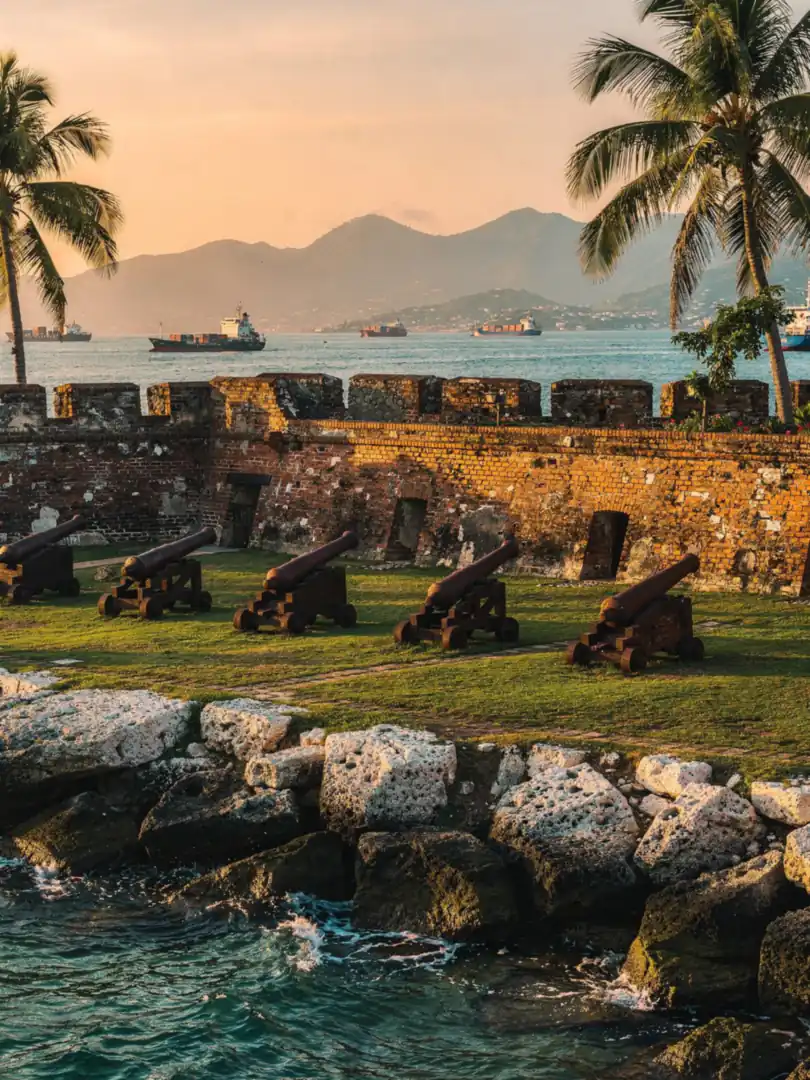
Harbour, Navy, Tavern
Region & History
Where did the Royal Navy get its rum? The trail leads to Port Royal, a narrow spit of land off Kingston Harbour. In 1655, English ships under Vice-Admiral William Penn took Jamaica from the Spanish, and the sailors found an island where rum had long since been distilled.
Rum kept better on board than beer. Gradually, it replaced beer and brandy, at first without any official order. By the 18th century it had become a fixed ration, and in 1740 Admiral Edward Vernon ordered it diluted with water. The mixture became known as grog. The Navy issued its last ration on 31 July 1970, a day that went down in history as 'Black Tot Day.'
In the 17th century, Port Royal was home port to English privateers and one of the wealthiest port cities in the Americas. Much of what's told about it as a pirate story is largely folklore. On 7 June 1692, a magnitude 7.5 earthquake destroyed most of the town, which sank into the sea. About 2,000 people died instantly, and roughly 3,000 more died from injuries and disease in the days that followed. Across the bay, on its northern shore, Kingston grew into the new port city.
Sugar and rum were shipped to Europe through these ports, as was the trade in enslaved people brought to the island by force. Jamaica's sugar and molasses were built on the labour of enslaved people.
In the 19th century, John Wray ran a tavern in Kingston called the Shakespeare Tavern. His nephew Charles James Ward later joined the business, giving rise to J. Wray & Nephew. The company, headquartered in Kingston, has been part of the Italian Campari Group since 2012.
The island's distilleries are united under the Spirits Pool Association. Its roots go back to 1931, when the sugar manufacturers' association decided to set up a rum pool and sought legislation ensuring that no producer would distil more than half of their average output in the 1932 harvest.