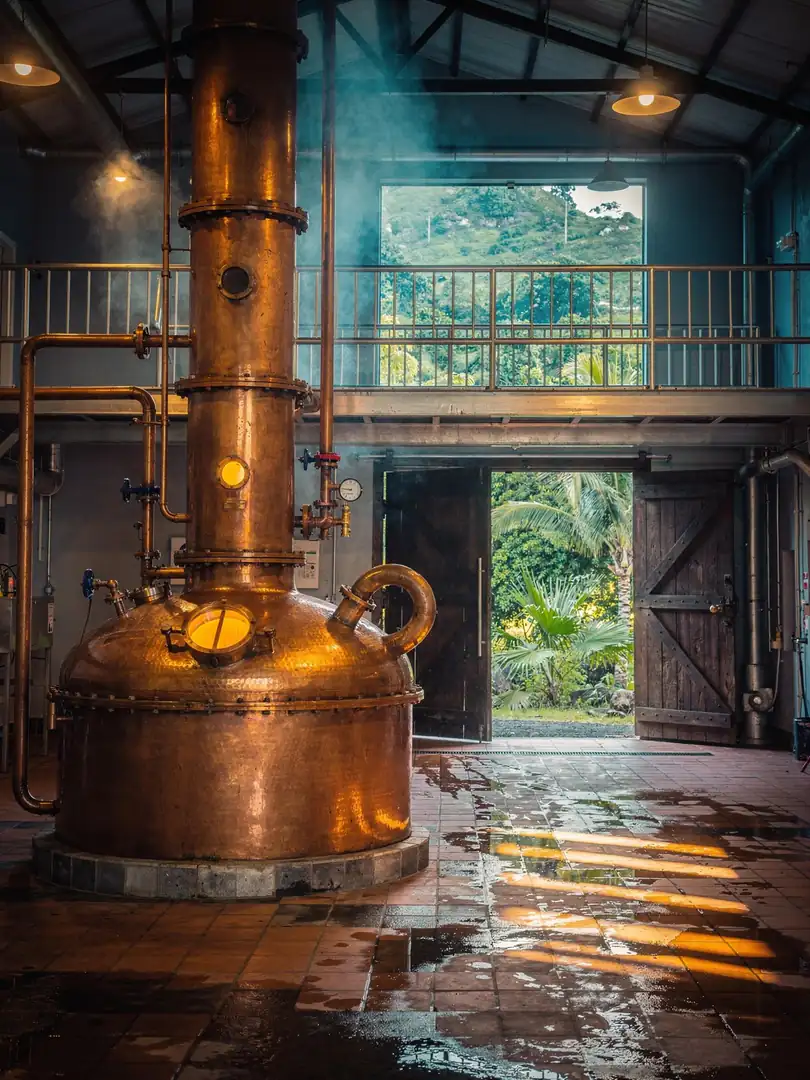
The Creole column
Distillation
How is Rhum agricole distilled? In a Creole column, a continuously running column still. The AOC prescribes its construction: the lower section has at least 15 plates of stainless steel or copper, the upper rectifying section is entirely copper and has five to nine plates. The diameter ranges between 0.7 and 2 meters.
The fermented juice enters at the top, steam rises from below. On each plate, alcohol and water separate a little further, until a distillate of 65 to 75% ABV flows off at the top. Distilling is permitted from 2 January to 5 September, so slightly longer than the harvest.
The Creole column harks back to the technique France used to distill alcohol from beets. Unlike a pot still, which works batch by batch, it runs without pause as long as juice keeps coming.
JM distills, according to its own statements, in two copper Creole columns and does not go above 72% ABV, in order to preserve the cane's aroma. The water later used to dilute to drinking strength comes, according to the house, from springs on Montagne Pelée. In Sainte-Marie, Saint-James distills not only its own rums but also those of the J. Bally brand.
The AOC measures how much aroma remains in the rum. The minimum content of volatile compounds is 225 grams per hectoliter of pure alcohol for blanc, 250 for élevé sous bois and 325 for vieux. Bottling is at a minimum of 40% ABV, two and a half points above the EU minimum of 37.5%.