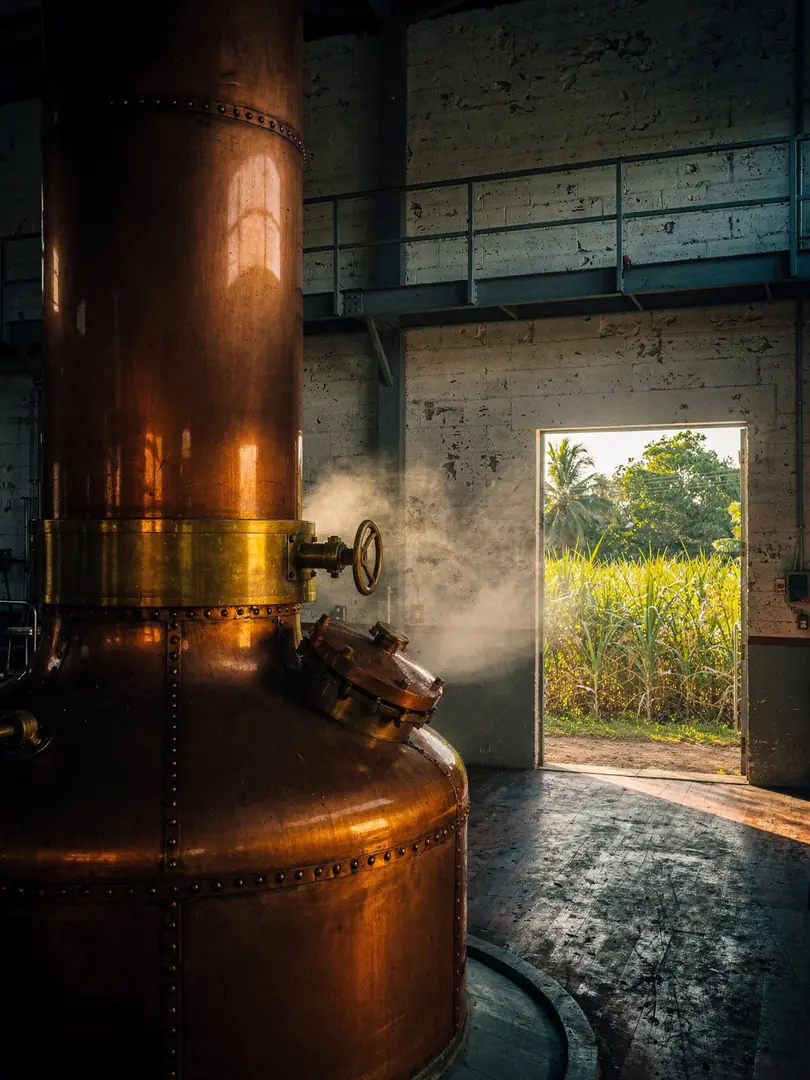
Copper Column, 70 Percent
Distillation
How is rhum agricole distilled in Saint-Pierre and Le Carbet? In a creole column, known in French as "colonne créole": a continuously running copper column fitted with plates, down which the sugarcane wine trickles while steam rises from below.
The AOC mandates this type of still. The stripping section must have at least 15 plates, the copper rectifying section five to nine, and the resulting spirit in the daily collection tank must measure between 65 and 75% ABV. The column design derives from the technology France once used to distill alcohol from sugar beets.
At Neisson stands a copper column built by Savalle in 1952, filled to about two-thirds with juice, according to French industry sources. At Depaz, the distillate reaches around 70% ABV, according to trade press reports.
Distillation happens only during the harvest season: the AOC permits distilling from January 2 to September 5, since the juice is processed fresh. Outside this window, the column sits idle. The distillate must contain at least 225 grams of congeners per hectoliter of pure alcohol in the blanc, and 325 grams in the vieux—these are the aromatic compounds that remain in the spirit alongside the ethanol.
A pot still, as used in Jamaica or Barbados, distills batch by batch and preserves plenty of body. The column, by contrast, separates more cleanly and produces a lighter, aromatically clearer distillate in which the cane character remains pronounced.
From this distillate come the various bottlings: unaged blancs, bottled after at least six weeks of tank rest, and distillates destined for the barrel. Neisson bottles an organic blanc at 52.5% ABV, while Depaz offers a white rhum from its Plantation Montagne Pelée range at 55% ABV.