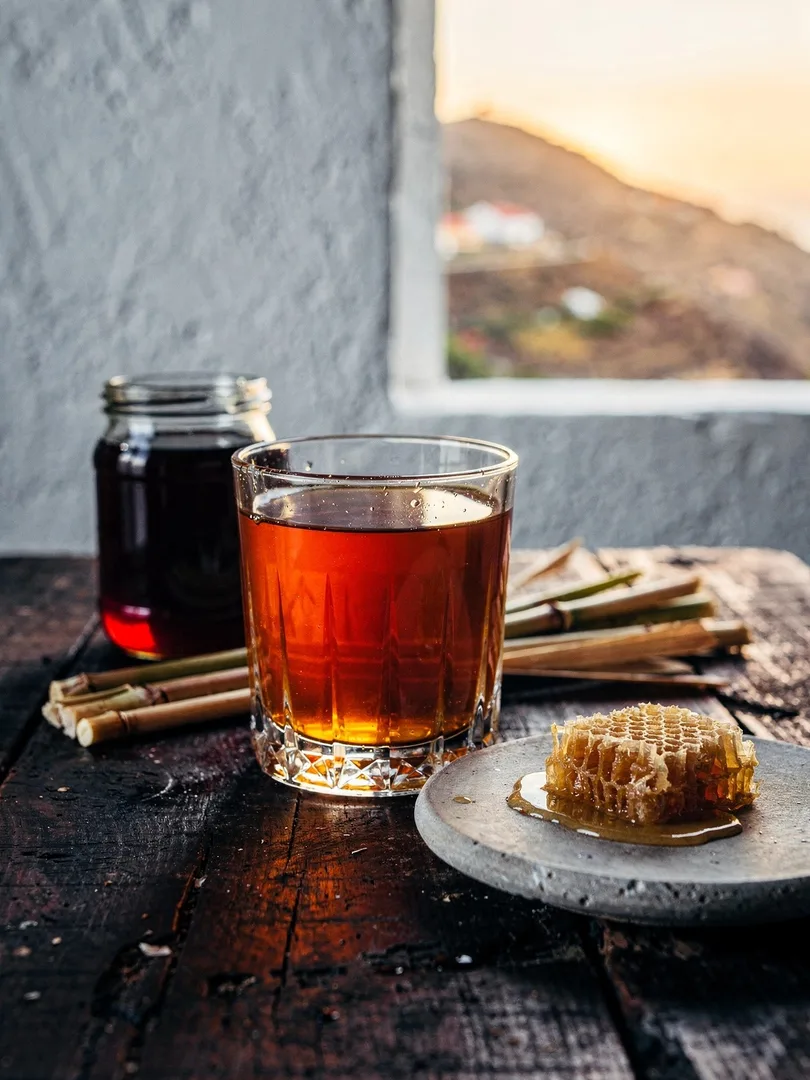
Honey and juice
Rum style
Canarian rum can't be pinned down to a single style, because each island goes its own way. There's the classic cane spirit from the old sugar factories, which Arehucas bottles as Carta Blanca and Carta Oro, plus the fresh-juice rum made on La Palma by Ron Aldea. But the style that truly defines the region is Ronmiel de Canarias, a rum-based drink that isn't legally rum at all.
Ronmiel is the real flagship style here, as it's the only one with a protected designation of origin. The specification describes it as clear, ranging from golden yellow to deep mahogany brown. On the nose, honey dominates, backed by notes of rum. On the palate it's sweet and smoothly oily. The finish echoes honey and rum. The label may say "dulce" if it contains more than 150 grams of sugar per liter, and "semidulce" at 150 grams or less.
The term "selecto" may be used only by producers who use honey from the Canary Islands along with rum made on the islands. Without this word, a Ronmiel may include ingredients sourced from elsewhere, as long as it's blended within the archipelago.
What sets it apart from spiced rum is the sweetness from honey and its own origin rules; flavorings may be added, but honey sets the tone. What sets it apart from La Palma's juice rum is more fundamental. Ron Aldea is made from freshly pressed cane juice, which tends to taste grassier and fresher than molasses-based rum. Ronmiel, by contrast, remains a sweet, lower-proof liqueur.
There are historical reasons why Ronmiel became such a distinct style. As the application states, it stems from the tradition of households, tascas, and ventas, simple taverns and country inns. It wasn't produced industrially and sold in its own bottles until tourism began growing after 1950.
Ronmiel de CanariasMolasses and juice · Pot still and column still
- Alcohol
- 20–30 % vol
- Cask ageing
- 0 Years
Honey upfront, rum behind, sweet and smoothly oily; golden yellow to mahogany brown.