The chemistry of funk
What does 'funk' mean in rum?
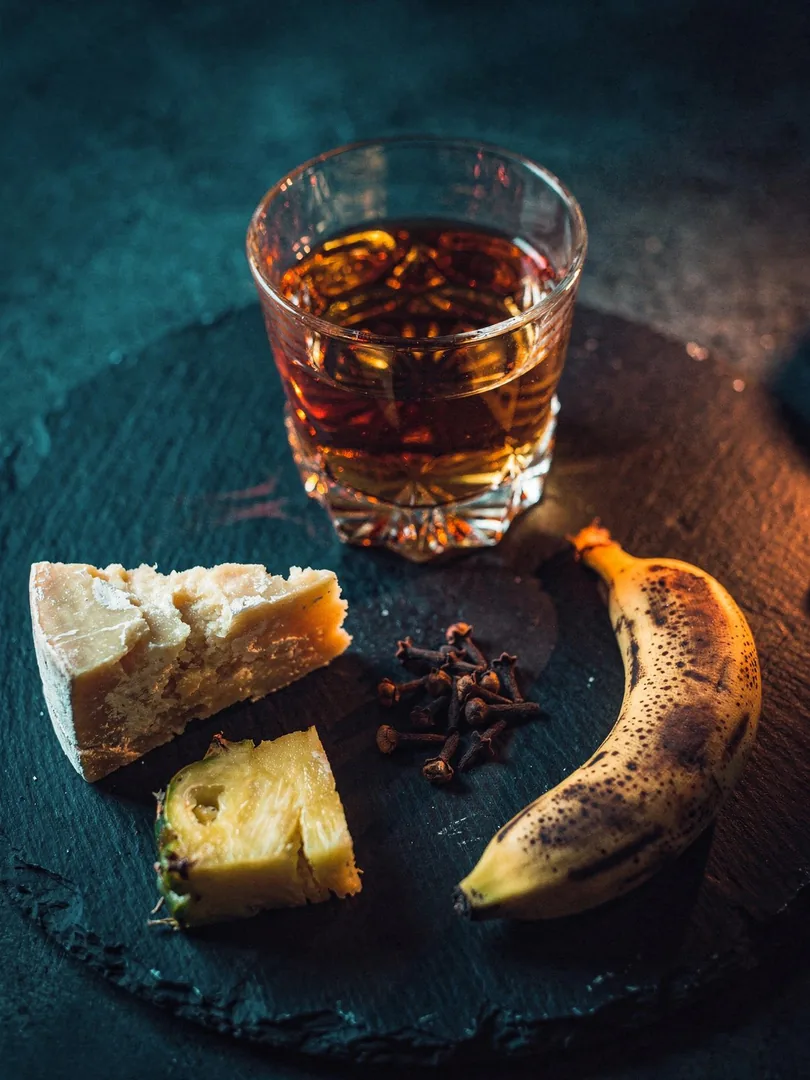
Rum enthusiasts use the term funk to describe the wild, overripe fruitiness found in some rums: banana, pineapple, glue, a hint of cheese or decay. Chemically, it's rooted in a high concentration of esters, acids, and other congeners that stem from long fermentation and are preserved through pot still distillation.
Funk and hogo: where the terms come from
Funk is an English slang term from the rum scene, not a legal or laboratory classification. It emerged among bartenders and rum enthusiasts to describe a smell for which there was no elegant word. It refers to a fruitiness that goes beyond ripe, paired with slightly dirty, fermented notes. The term comes up most often with rum from Jamaica.
An older term is hogo. It derives from the French haut goût, literally 'high taste.' Originally, haut goût referred to the strong flavor of well-hung game. In English rum vocabulary, this became hogo, describing the distinctive, almost animalic character of heavy rums. Both words describe impressions, not measurable quantities.
The chemistry behind funk
Esters form the core. Ethyl acetate smells fruity in small amounts, but like nail polish remover in large ones. Isoamyl acetate brings banana, ethyl butyrate pineapple, and ethyl hexanoate recalls green apple. Together, they create the typical impression of overripe fruit. The higher the ester count, the more concentrated this impression becomes.
Added to this are free acids that haven't converted into esters. Butyric acid smells of rancid butter or cheese, isovaleric acid of sweat, propionic acid of sharp sourness. On their own, they would be unpleasant. But in tiny amounts amid many esters, they give rum depth, much like a well-aged cheese or properly hung meat.
Higher alcohols, once called fusel oils, and aldehydes round out the picture. Acetaldehyde recalls green apple or nuts. The ratio matters most. The same compound can seem pleasant in one rum and off-putting in the next, depending on what surrounds it.
Where does funk come from? Fermentation, still, cask
The groundwork is laid during fermentation. Long fermentation times, wild microbes, dunder, and at some houses muck all deliver acids in large quantities. From these, together with alcohol, esters form—some already in the vat, others in the hot still.
The method of distillation is then decisive. A pot still, or a pot still with retorts attached, distills at comparatively low strength and lets many heavy congeners pass into the distillate. A tall multi-column still strips most of them out. That's why a bacteria-rich fermentation can still yield a light rum if it passes through a column—though the reverse doesn't work.
In the cask, funk continues to evolve. Young distillates often seem raw and sharp. Over time, further esters form, the wood contributes vanilla and spice, and sharp edges soften. An aged Jamaican rum therefore carries its funk differently than a white overproof.
Funk beyond Jamaica: Grand arôme, Demerara, Clairin
Jamaica is the best-known example, but not the only one. Grand arôme from Réunion or from Le Galion in Martinique also results from long fermentation with vinasse and reaches similar intensity, often with notes of olives and leather. In Guyana, the specification for Demerara Rum distinguishes a heavy class with more than 300 g/hL r.A. of congeners and over 50 g of esters, distilled in pot stills, including the wooden stills of Port Mourant and Versailles.
Haiti's Clairin, meanwhile, is often made from wild-fermented juice or syrup and distilled in small stills. Many describe it as earthy, salty, and vegetal. This is a different kind of wildness, one that comes more from the fresh raw material than from high-ester fermentation. Tasting these styles side by side reveals that funk isn't a single aroma, but an entire family.
Funk is a style, not a flaw—but not every smell is funk
Anyone smelling a very funky rum for the first time may easily mistake it for spoiled. It isn't. Funk is the intended result of a particular production method. Genuine faults do exist, though. A pronounced vinegar tang, rotten sulfur notes, or a musty smell like a damp cellar are not part of the style—they point instead to a fermentation that went wrong, or problems in the cask.
Balance makes the difference. Good funk stays fruity and lively, even when it's wild. How to identify and sort these notes in the glass is described in more detail in the tasting section.