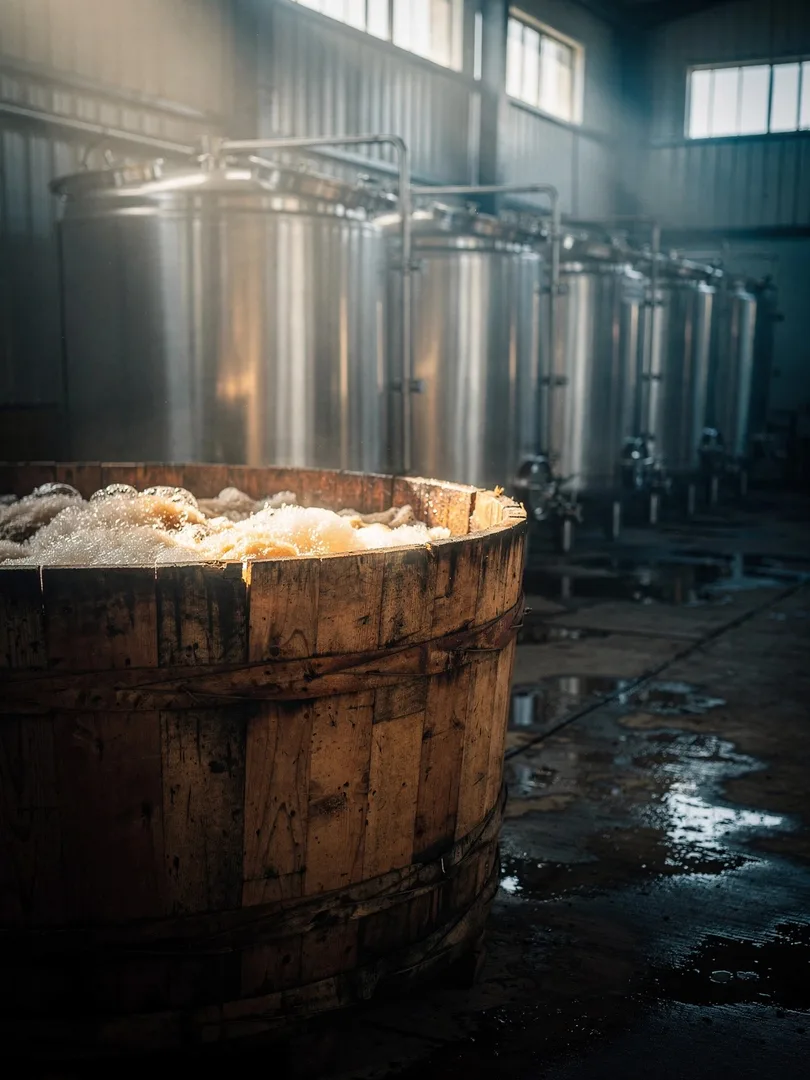
Vat shapes fermentation
Open, closed, wood, steel: fermentation vats and their influence
Fermentation vats help decide which microbes enter the ferment and how warm it gets. Open wooden vats let wild yeasts and bacteria join in, encouraging a heavy style. Closed, cooled steel tanks keep fermentation clean and predictable, which is what lighter rum needs.
Open fermentation vats: the environment ferments along
In an open vat, the fermenting liquid sits exposed beneath the roof of the fermentation house. Yeasts and bacteria from the air, the walls, and the dust can fall in at any time. During the vigorous main fermentation, a blanket of carbon dioxide protects the surface fairly well. As fermentation slows, this protection thins out, and air and microbes gain easier access.
For distilleries with a house style, this is intentional. Over the years, the same microbes settle into the fermentation house and vats, becoming part of the signature character. The AOC Martinique explicitly requires open vats for Rhum agricole, made from a material that does not react with the juice, with a maximum capacity of 500 hectoliters. According to trade press and geographical indication documents, Hampden in Jamaica and the Le Galion sugar factory also work with open vats.
The downside is obvious. Open fermentation is harder to control. A hot day, one fly too many, or an unfavorable strain of bacteria, and a batch can develop vinegar or spoilage notes.
Wood or steel: which material for the fermentation vat?
Wood is porous. Yeasts and bacteria continue to live in its cracks and fibers even after thorough cleaning. Each new batch is thus inoculated a little by the previous one. The literature notes that the fission yeast Schizosaccharomyces pombe is found particularly in the wooden fermentation vats of the Caribbean. According to reports from the distillery, Hampden ferments in cedar wood vats.
Stainless steel is the opposite. It can be fully cleaned and disinfected, releases nothing, and absorbs nothing. Every fermentation starts from zero, and only the added yeast does the work. For distilleries that need the same light rum every day, this is the logical choice. Many large operations therefore use closed steel tanks.
There are also vats made of concrete, coated steel, or, in earlier times, masonry. What matters is less the material itself than whether it harbors microbes and how well it holds temperature.
Fermentation temperature: why tropical heat drives fermentation
Yeast generates heat as it ferments. In a large vat in the Caribbean, this heat adds to the already high ambient temperature. If it gets too hot, the yeast comes under stress. It then produces more higher alcohols and other heavy compounds, and in the worst case, it dies off before the sugar is fully consumed.
The specification for Demerara Rum from Guyana cites a fermentation temperature of about 32°C. Anyone wanting cooler, more even fermentation needs technology. Closed tanks often have cooling jackets or internal cooling coils through which water flows. With open wooden vats, the usual options are to keep the vats small, ferment in the shade, and schedule work around the time of day.
Vat size, hygiene, and style
Size matters too. In small vats, heat disperses outward faster, and the surface area is larger relative to the volume. More contact with the air means more influence from the environment. Large closed tanks behave more evenly, but they're also less forgiving if something does go wrong.
Ultimately, the vat should match the still and the desired style. A distillery producing light rum from a multi-column still would hardly use open wooden vats, since the column strips out most of those aromas anyway. A distillery making heavy pot-still rum, on the other hand, would lose its character with sterile steel tanks. Anyone visiting a distillery can often tell from the fermentation house alone what kind of rum will end up in the bottle.