Jamaica's protected origin
Jamaica Rum: the geographical indication of 2016
Jamaica Rum has been a geographical indication under Jamaican law since 2016. It requires distillation in Jamaica and maturation on the island in oak casks of up to 250 liters. After distillation, only water and caramel coloring are permitted, which rules out sweetening.
What does the Jamaica Rum geographical indication require?
The name was registered in 2016 with the Jamaica Intellectual Property Office, the island's agency for intellectual property. It's administered by the Spirits Pool Association. As raw material, the rules allow sugarcane in the form of molasses, juice or syrup, along with water, yeast and fermentation nutrients. Distillation takes place in Jamaica. Maturation also takes place there, in oak casks with a maximum capacity of 250 liters. As in the EU, the minimum strength is 37.5% ABV.
The most important clause concerns what happens after distillation. From that point on, only water, to adjust the drinking strength, and caramel coloring for color are permitted. Sugar, syrup and flavorings are therefore excluded. A rum bearing the Jamaica Rum geographical indication is thus unsweetened. By comparison, the EU allows up to 20 grams of sugar per liter, and Guyana's Demerara rule permits the same amount.
Pot still or column: what the Jamaica rule leaves open
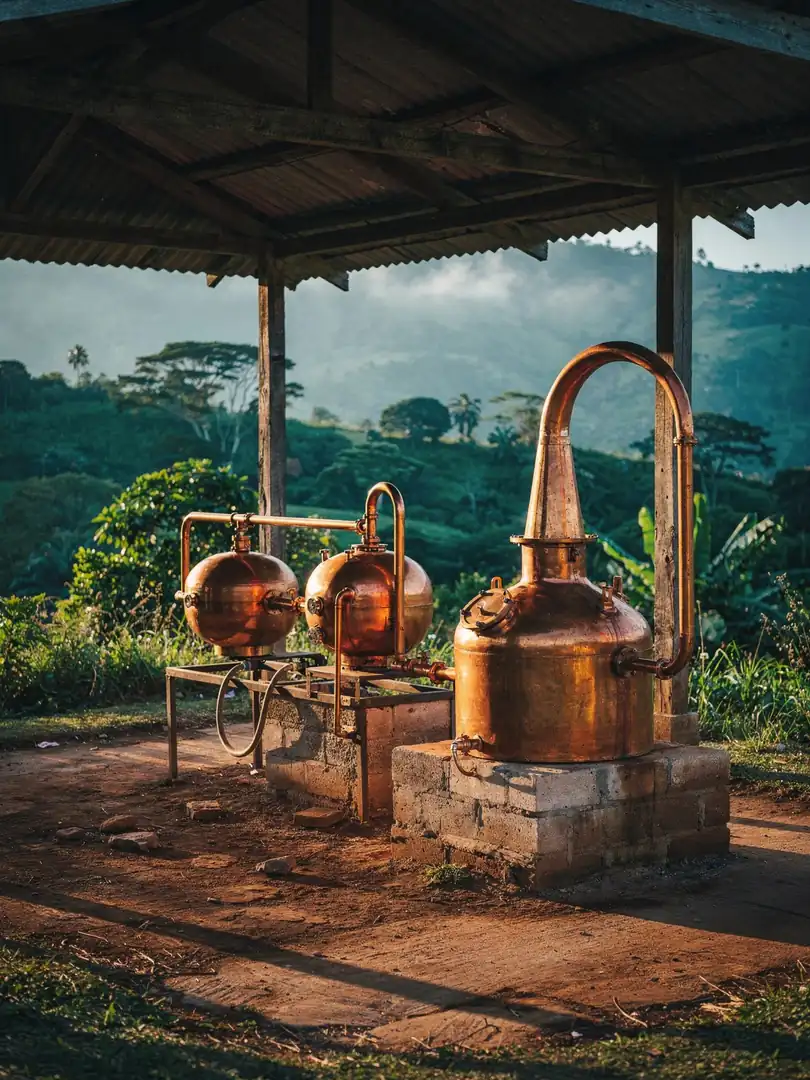
When people think of Jamaica, many picture heavy rums with banana, pineapple and glue-like notes from the pot still. The geographical indication does not mandate this style. Both the pot still and the continuous column still are permitted, as are blends of the two. Dunder, the stillage from earlier distillations, is likewise not required. Hampden works with dunder and muck pits, while Worthy Park has no dunder pit.
The well-known ester classes such as Common Clean or Continental Flavoured are historical trade designations used by the distilleries, not a government standard. They describe how aroma-rich a distillate is, measured in grams of esters per hectoliter of pure alcohol. The details are explained in the themed journey "Fermentation & Esters". Legally, something else matters here: a Jamaica Rum may be light or heavy, as long as it was distilled and matured on the island and remains unsweetened.
Why isn't Jamaica Rum in the EU register?
In the EU register eAmbrosia, you'll search for the name in vain, as of October 2026. The geographical indication is a Jamaican protected right. It binds producers on the island but isn't administered through the EU register. For a bottle on a shelf in Germany, the EU's rum definition therefore applies in every case. What "Jamaica" means on a label is best read together with the name of the distillery.
Jamaica's neighbors have taken somewhat different paths. Guyana has registered Demerara Rum and Guatemala its Ron de Guatemala in the EU register, and Cuba has applied for protection. On Barbados, a dispute over a dedicated origin rule has dragged on for years (Station 7). Jamaica thus sits in the middle: protected nationally, with clear rules on place, cask and sugar, but without its own entry in the EU register.
The dispute over Jamaica's rules
The debate hasn't quieted down since 2016. The full specification isn't publicly available. In 2024 and 2025, discussions in Jamaica centered on whether the rules should be loosened and how much column-still rum a rum bearing the origin name should be allowed to contain. The newspaper Jamaica Gleaner took up the topic in a November 2024 editorial on "authentic" Jamaican rum.
At its core, this is a question that affects many origin rules: should a protected name safeguard a place or a style? The current rule protects the place and the unsweetened nature of the rum, while leaving room on the question of distillation method. Those seeking the heavy, aroma-rich style should therefore pay attention to the distillery and the still. What's fixed, though, are the three core points: no sweetening, maturation on the island, casks up to 250 liters.