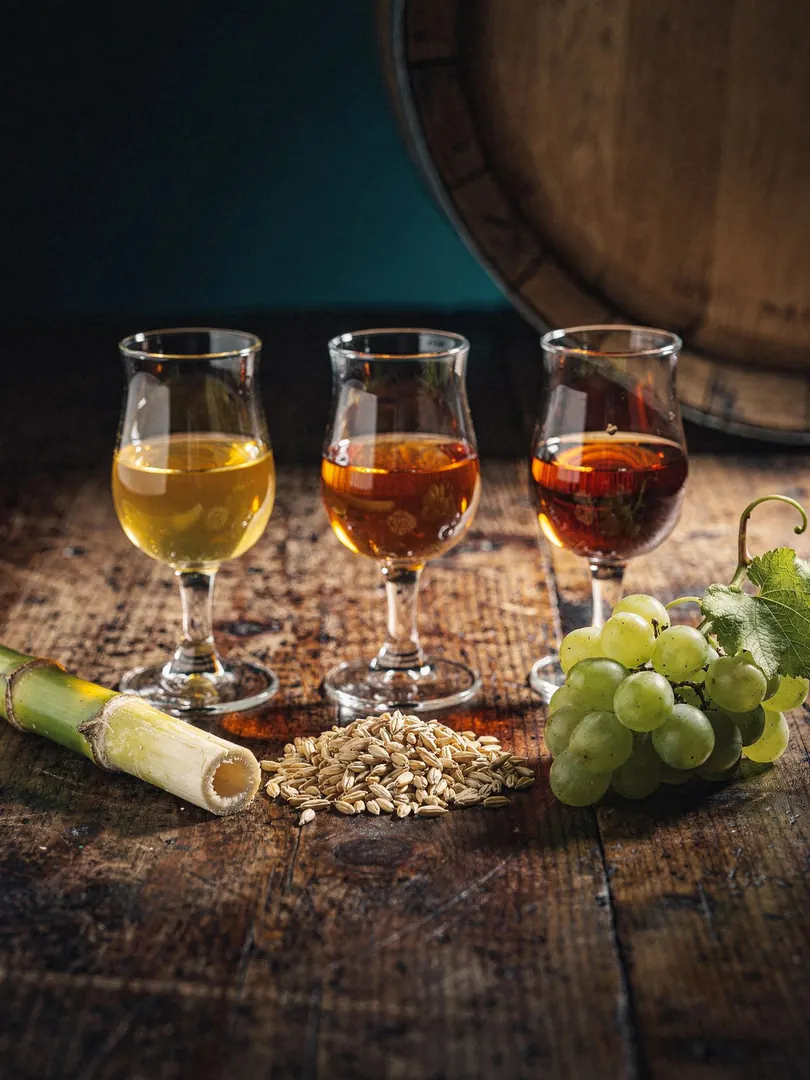
Three spirits compared
Rum, Whisky, Cognac: What's the Difference?
Rum, whisky, and Cognac differ first and foremost in their raw material: rum is made from sugarcane, whisky from grain, Cognac from wine from the Cognac region. Add to that different stills, aging requirements, and rules on sweetening. These differences shape the flavor far more than color does.
Raw material: sugarcane, grain, or grapes
Each spirit starts with a different source of sugar. Sugarcane delivers it ready-made, as juice or molasses, and the yeast can get to work immediately. Grain for whisky, on the other hand, contains starch, which must first be converted into sugar during malting and mashing. For Cognac, wine is fermented first, mainly from the Ugni Blanc grape variety. It's thin and high in acid, better suited to distilling than drinking.
These raw materials shape the aromas. Rum brings notes of sugarcane, molasses, banana, or fresh grass. Whisky tastes of grain, malt, and bread, and of smoke when peated malt is used. Cognac shows grapes, blossoms, and dried fruit. A young, unaged spirit reveals its raw material most clearly. The longer a distillate rests in the barrel, the more wood and oxidation come to the fore, and the three spirits grow closer together in flavor.
Distilling: pot still, column, and Charentais still
Rum enjoys the greatest freedom when it comes to distilling. It may come from pot stills or columns, in the EU up to just under 96% ABV. Scotch malt whisky is traditionally distilled twice in copper pot stills, grain whisky in columns. EU whisky is capped at 94.8% ABV. Cognac is distilled twice in the Charentais still, a copper pot with an onion-shaped head, and may reach a maximum of 72.4% ABV.
The lower the distillation strength, the more aroma remains in the distillate. That's why Cognac turns out fruity and layered, even though it's made from a fairly neutral wine. Rum shows the widest range of all: from nearly neutral Ron distilled at high strength in columns to heavy Jamaican rum from the pot still. Whisky usually falls somewhere in between. The still, therefore, often tells you more about the flavor than the category on the label.
Aging: mandatory for whisky and Cognac, optional for rum
This is where the biggest legal difference lies. In the EU, whisky must age for at least three years in wooden casks of no more than 700 liters. Cognac needs at least two years in oak: VS stands for this minimum, while XO has meant at least ten years since 2018. For rum, by contrast, the EU prescribes no aging at all. It may be sold white and unaged; only certain countries and regional rules require cask time, such as Puerto Rico or Venezuela.
Climate also plays a role. Whisky usually ages in cool warehouses, as in Scotland, where around two percent evaporates per year. In tropical rum warehouses, it's often around eight percent. Rum therefore picks up wood flavor faster, but also loses volume faster. The often-cited rule of thumb that one tropical year equals three European years is just that—a rule of thumb, not a fixed chemical ratio. Age statements across different spirits therefore can't be compared one to one.
Sugar and color: what's allowed in rum, whisky, and Cognac?
The three also go their separate ways when it comes to additives. Whisky may not be sweetened at all in the EU; only caramel coloring for color adjustment is permitted. Since 2021, rum may contain up to 20 grams of sweetening products per liter to round out the flavor. Cognac may, within the limits of its appellation rules, be rounded out to a limited degree with sugar, coloring, and oak extract. None of the three is required to declare such additives on the label.
For the drinker, this means: rum is the most diverse of the three, but also the least uniform. There's a bigger gap between an unsweetened Jamaican rum and a soft Solera Ron than between two Cognacs. Whisky lovers often find an easy entry point in English-style blends, while Cognac lovers may gravitate toward aged rhum agricole or Barbancourt from Haiti. More than the category, it's the raw material, the still, and the label that reveal what to expect in the glass.