Density and Lab Analysis
Measuring Sugar in Rum: Hydrometer, Lab Analysis, Monopoly Lists
Sugar in rum is determined in two ways: through lab analysis, as practiced by the state monopolies of Finland and Sweden, or using a hydrometer, which measures apparent alcohol content. The gap between this reading and the labeled ABV reveals dissolved substances, usually sugar. Only lab analysis delivers true precision.
Why Dissolved Sugar Fools the Hydrometer
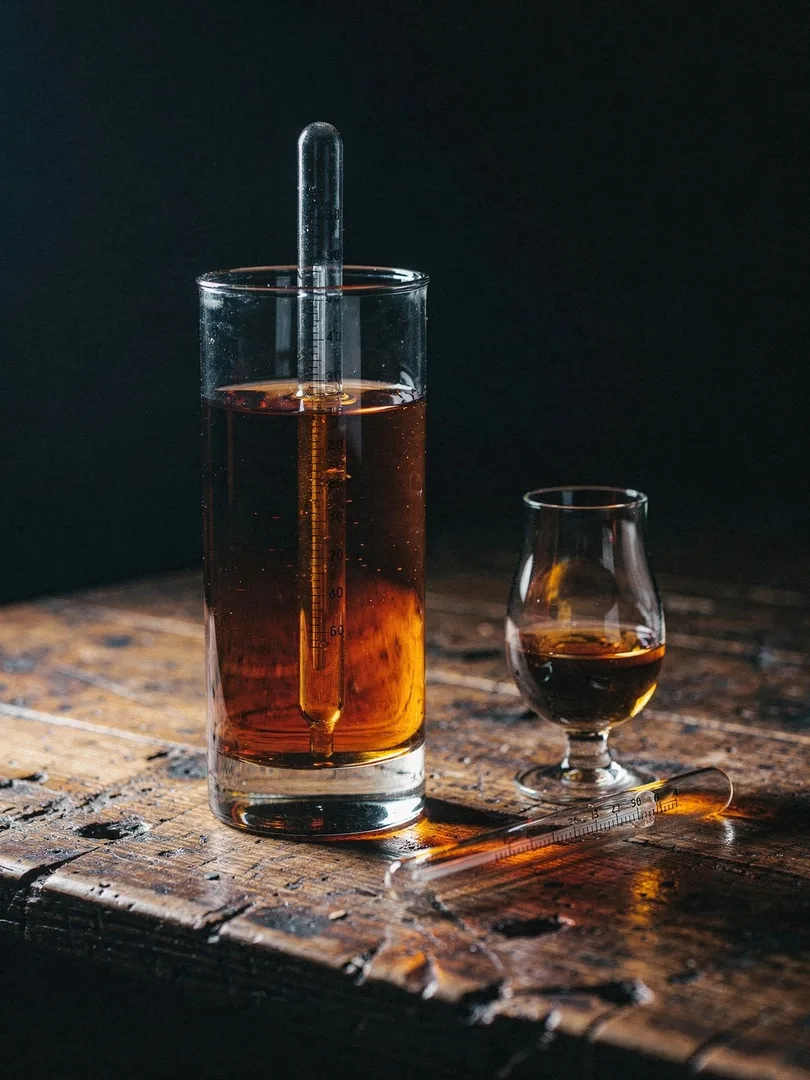
A hydrometer, known in technical terms as an aräometer, is a glass floating device with a scale. It sinks into a liquid only as far as the liquid's density allows. Alcohol is lighter than water, so the device sinks deeper in high-proof rum than it would in plain water. At 20°C, the scale reads directly in percent ABV, as long as the liquid consists only of water and alcohol.
Dissolved sugar makes the liquid heavier. The hydrometer then floats higher and shows a lower alcohol reading than is actually present. This discrepancy is called obscuration, literally meaning 'darkening.' Customs authorities have long dealt with this issue and use dedicated tables to correct for it in alcohol measurement. Rum enthusiasts turned the effect around: if the discrepancy comes from sugar, it can be used to estimate the sugar content.
The Hydrometer Test: How Rum Enthusiasts Estimate Sugar
The method was popularized by Danish rum enthusiast Johnny Drejer, who has published measurements since 2013. He tested his approach against rums that had already been analyzed by state labs in Finland and Sweden and found a close match. The process is simple: measure the apparent alcohol content at exactly 20°C, compare it to the ABV stated on the label, and convert the difference into grams of sugar per liter using a reference table.
Such tests, combined with lab data, have produced extensive lists over time. The English-language site The Rum Project built a collection covering over 700 tested rums, drawing on data from the Finnish monopoly Alko, Swedish analyses, and hydrometer measurements from multiple rum enthusiasts. Blogs like The Fat Rum Pirate publish their own test series as well. For buyers who can't find a sugar declaration on the bottle, these lists have long served as the only point of reference.
How Accurate Is the Hydrometer Test?
The method gives estimates, not laboratory values. Its biggest problem is the label itself. The stated alcohol content may deviate slightly from the actual value within narrow limits, and even a small deviation shifts the result by several grams. Then there's temperature. If the rum is a few degrees too warm or too cold, density changes more than it would from a bit of sugar. Without a precise thermometer, the test is worthless.
The hydrometer also measures everything dissolved in the liquid, sugar as well as other substances. Caramel coloring and extract compounds from the cask also increase density, noticeably so in very long-aged rums. A value of a few grams therefore doesn't necessarily point to added sugar. Conversely, a reading close to zero suggests an unsweetened rum, provided temperature and label are accurate. The test becomes meaningful with clear-cut values or multiple measurements of the same bottling.
Lab analyses: what Alko and Systembolaget publish
Laboratories work more precisely. They chemically determine individual sugars and can distinguish sucrose, glucose, and fructose. The Finnish monopoly Alko and the Swedish state retailer Systembolaget publish sugar values for their ranges. Many of the figures circulating in forums and articles about rum come from these sources. One example is the range of roughly 19 to 25 grams per liter that Alko's analyses found for Zacapa Solera 23.
Even lab values apply only to the batch tested. Recipes change, especially since the EU limit introduced in 2021, and a value from ten years ago says little about a bottle on shelves today. Lists therefore offer a general direction, not a guarantee. Anyone wanting to judge sweetness for themselves should taste the rum diluted with a little water. Sugar often comes through more clearly that way than in an undiluted glass, where the alcohol can mask a lot.