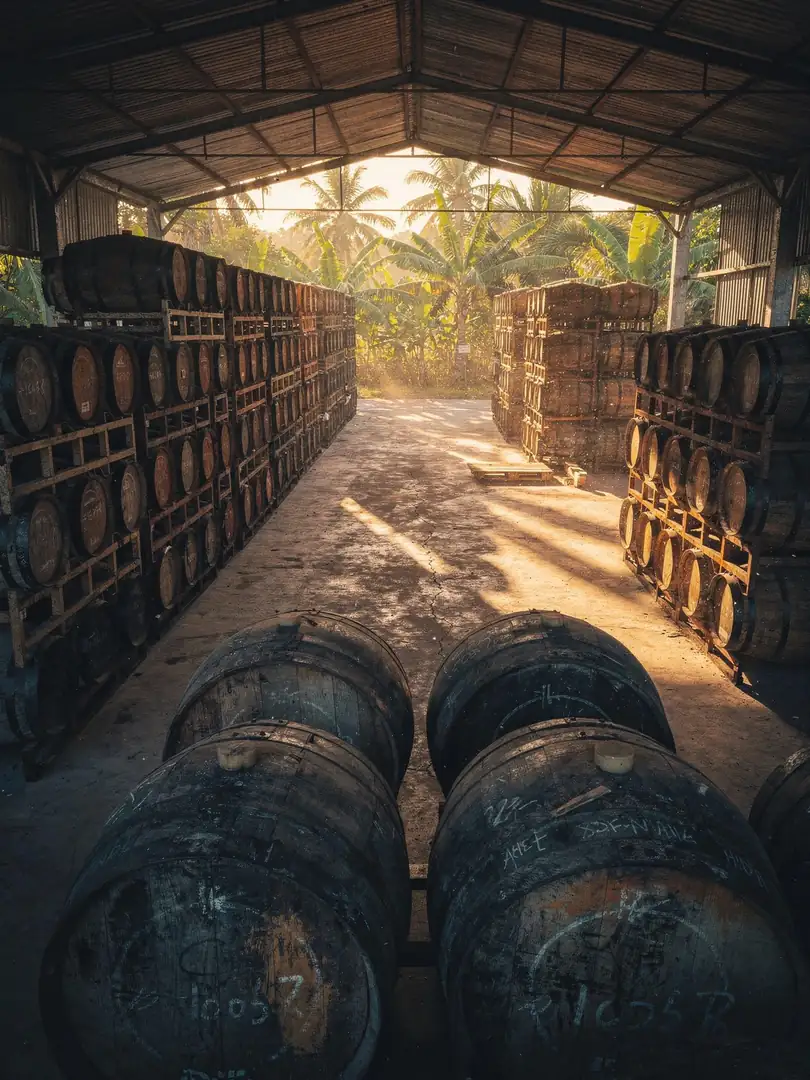
Bourbon cask, tropical heat
Cask & Climate
Hot and humid, that's how rum ages on Trinidad. Angostura, according to the company, ages its rum in ex-Bourbon casks made of American oak, charred on the inside. The wood releases vanilla, caramel, and toasted notes and takes the edge off the distillate. Because the casks already held Bourbon once, their wood acts more gently than that of new casks.
In the tropics, wood works faster than in cool Scotland, but it demands a price too: trade press reports often cite around eight percent annual evaporation for the Caribbean, compared to roughly two percent in Scotland. This loss is called the angels' share. Hence the rule of thumb that one year in the tropics counts as three years in Europe, a marketing phrase that doesn't actually hold up chemically.
According to the house's own account, the name Angostura 1919 goes back to a fire in the state rum warehouse in 1932: charred casks that had been filled in 1919 were rescued at the time. The 1824, by contrast, carries the year of the bitters recipe and, according to the producer, consists of casks selected by the master blender that have rested for at least twelve years.
Caroni, too, shows what ageing can do. When Velier acquired the stocks, the casks were still resting on the island. Later, the house transported its Caroni casks to Guyana, where they continued to age for several more years at Demerara Distillers. A rum that has rested in two countries bears the signature of both places, and that is part of what makes it special.
What number is allowed on the label? The EU register has no separate age rule for Trinidad; the general requirement applies: only the age of the youngest component in the blend may be stated, and the ageing must have taken place under the tax supervision of a member state or under equivalent control. An age statement therefore tells you what the bottle contains at minimum, not the average.