Bottle or Tank
The Second Fermentation
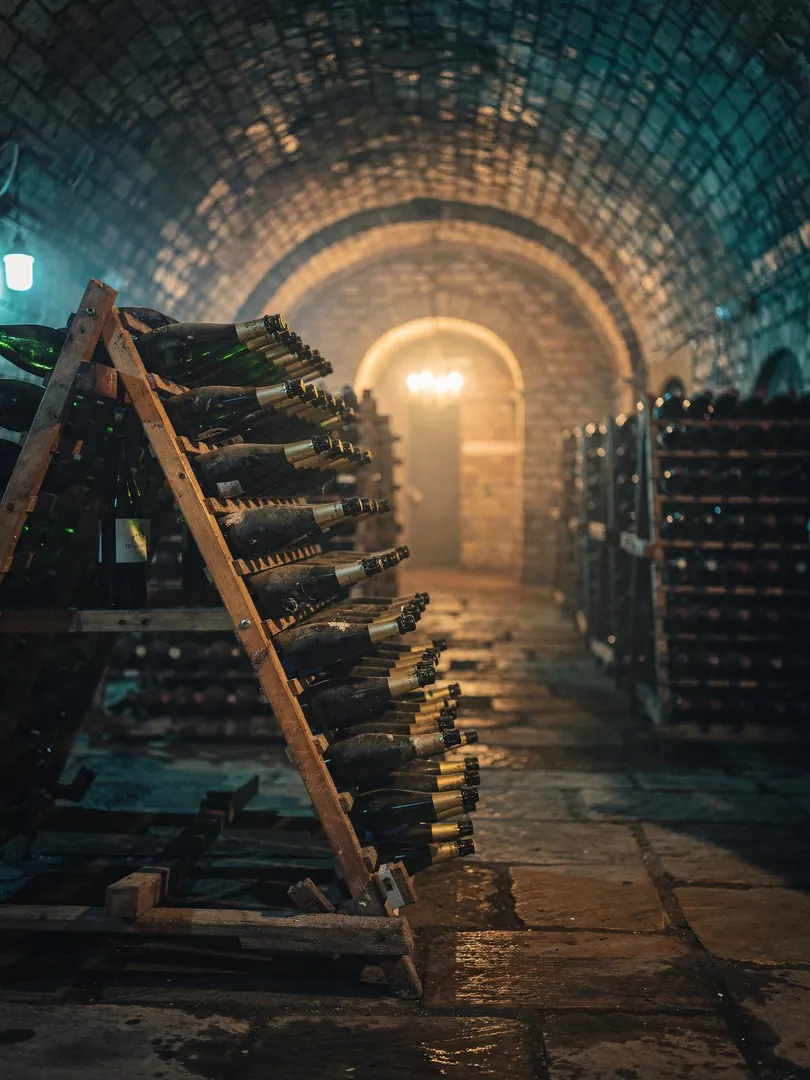
The law spells out how Winzersekt gets its bubbles: through traditional bottle fermentation. Sugar and yeast are added to the base wine, a process called tirage. The bottle is sealed with a crown cap, and as the sugar ferments, carbon dioxide forms with nowhere to escape, dissolving into the wine instead.
As a rough guideline, industry sources cite about 24 grams of sugar per liter and around 20 grams of yeast per hectoliter. That produces roughly six bars of pressure. By law, Sekt must have at least 3.5 bar at 20 degrees Celsius. This is what separates it from Perlwein (semi-sparkling wine), which may only reach one to two-and-a-half bar.
It's also possible without a bottle. In tank fermentation, the second fermentation happens in a pressurized tank; afterward the wine is filtered and bottled under counter-pressure. For Qualitätsschaumwein, six months of production time is enough. Most large-brand Sekts are made this way, since it's fast and consistent.
In between sits the transfer method. The Sekt ferments in the bottle, is then emptied under pressure into a tank, filtered, and rebottled. This may be labeled "bottle-fermented," but not "traditional bottle fermentation." The ancestral method, known as Pét-Nat, is something else again: a single fermentation that finishes off in the bottle.
In the Sekt capital, Schloss Vaux, by its own account, relies on bottle fermentation with Riesling. That the region is also a place of learning for this craft is thanks to Geisenheim: the university there built a teaching and experimental Sekt cellar under Prof. Hermann Bauer, considered a foundation for spreading Winzersekt across Germany. Under § 18(8) of the Wine Ordinance, the entire processing of Sekt must, as a rule, take place at the same operation; exceptions require authorization.
Rheingau Riesling Winzersekt BrutBottle fermentation · Riesling
- Time on lees
- 9–24 Months
- Sugar
- 3–11 g/l
- Alcohol
- 11–12 % vol
Citrus peel, green apple, quince; fine bead, dry freshness, subtle minerality.