Cuvée and Harvest
Base Wine & Cuvée
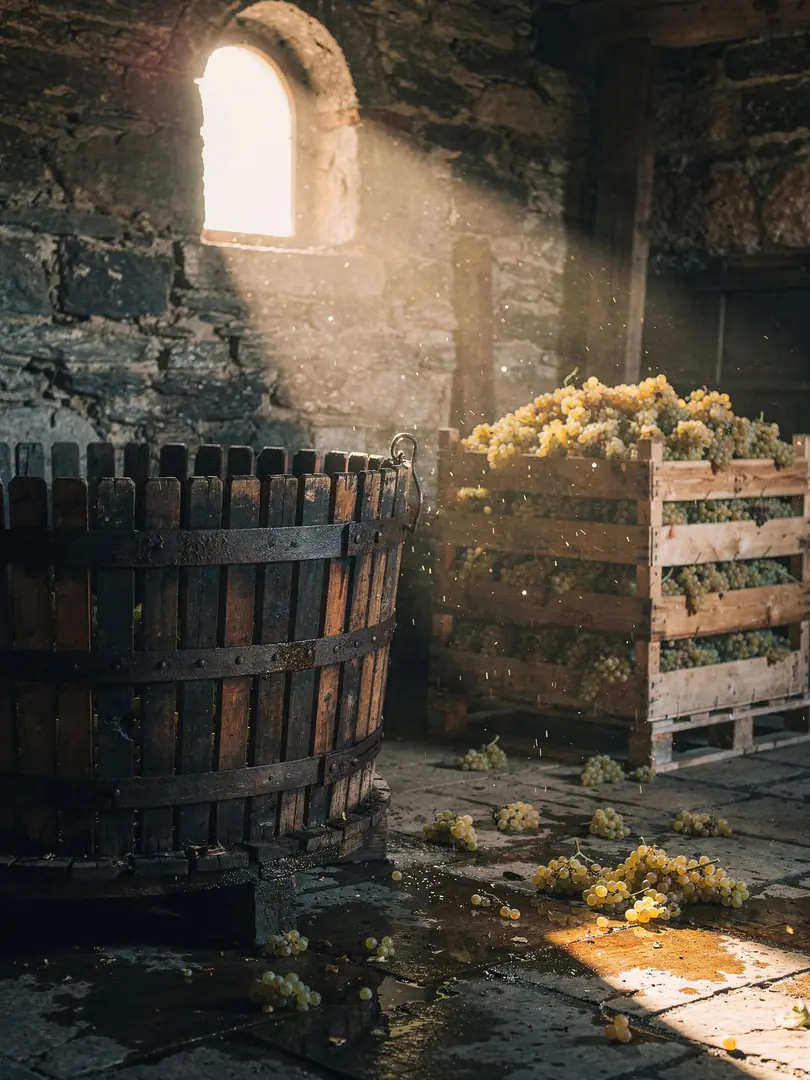
What makes a wine suitable as a base wine for Sekt? Around Freyburg an der Unstrut, winegrowers harvest these grapes earlier than for a still wine, while acidity is still high and sugar content low. The result is a lean, rather tart wine that offers little pleasure as a still wine but is exactly right as a Sekt base.
Legally, the bar is low: the cuvée, meaning the blend of base wines, needs a minimum total alcohol content of 9 percent ABV. The dosage added at bottling, which later kicks off the second fermentation, may raise the alcohol by no more than 1.5 percent ABV. A Sekt b.A. must reach at least 10 percent ABV actual alcohol.
On the terraces, harvesting is usually done by hand, since machines struggle to get through. Grapes from vineyards with a gradient of 30 percent or more may be labeled “Steillage” (steep slope) on the label, even for Sekt b.A.
Large brands like Rotkäppchen-Mumm blend their cuvées from many base wines so that the bottle tastes the same every year. Legally, the base wines may come from any origin. Only when the label reads “Deutscher Sekt” must they come from Germany, and “Sekt b.A.” requires a single designated growing region.
With a winegrower's Sekt, it's the other way around: the grapes must come from the producer's own estate, and both grape variety and vintage must appear on the label. A vintage Sekt thus reflects how that particular year turned out, while a non-vintage branded Sekt aims above all for consistency. Reserve wines from earlier harvests help smooth out variation.
Blanc de Noirs—white Sekt made from red grapes pressed like white wine—is explicitly permitted in Germany. The same goes for a Rotling Sekt made from a mix of red and white grapes, provided the base wine itself would qualify as Rotling.