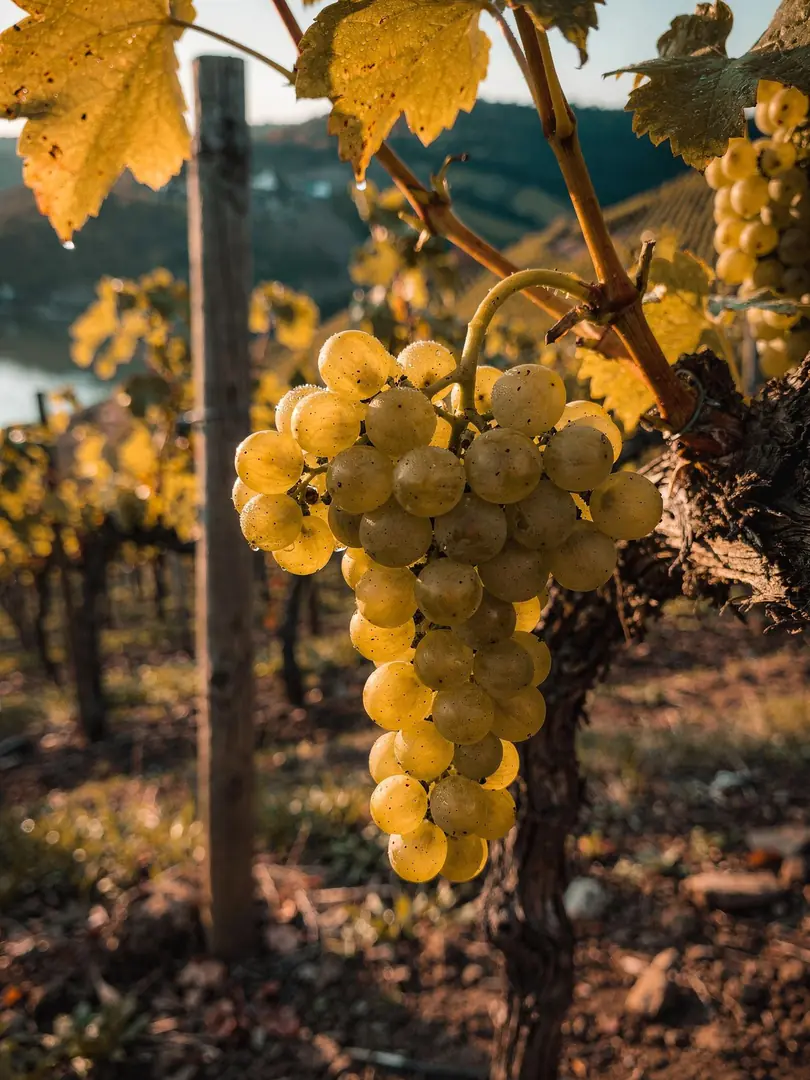
Weissburgunder in the Lead
Grape Varieties
Which grape varieties go into Sekt from Saale-Unstrut? The region is planted mainly with Weissburgunder and Müller-Thurgau, alongside Riesling, Silvaner, and Auxerrois, and there are also red varieties such as Blauer Zweigelt and Dornfelder.
Weissburgunder, known abroad as Pinot Blanc, is the variety most associated with the area. It brings fruit without overpowering aromas and copes well with cool sites—exactly what's needed in a base wine meant to handle a later dosage and extended aging.
Like Weissburgunder, Auxerrois belongs to the Pinot family. The Freyburg-Unstrut Winzervereinigung bottles an Auxerrois Sekt that, according to the cooperative, recalls apple and peach and is intended as an aperitif.
Riesling brings high acidity that lingers in the Sekt and gives it tension. Müller-Thurgau, by contrast, produces milder, lighter wines and is widely planted in Germany. In a blend, it can contribute the leaner component.
Red grapes can be pressed like white wine, meaning without skin contact, resulting in a pale wine. A Sekt made this way may be labeled Blanc de Noirs in Germany. Such single-variety Sekts, however, are mainly found among individual winegrowers.
Anyone checking the back label of a winegrower's Sekt will find the grape variety, since wine regulations require it to appear alongside the vintage. A branded Sekt usually doesn't list it: it's a blend in which the grape isn't the focus, but rather a consistent taste.