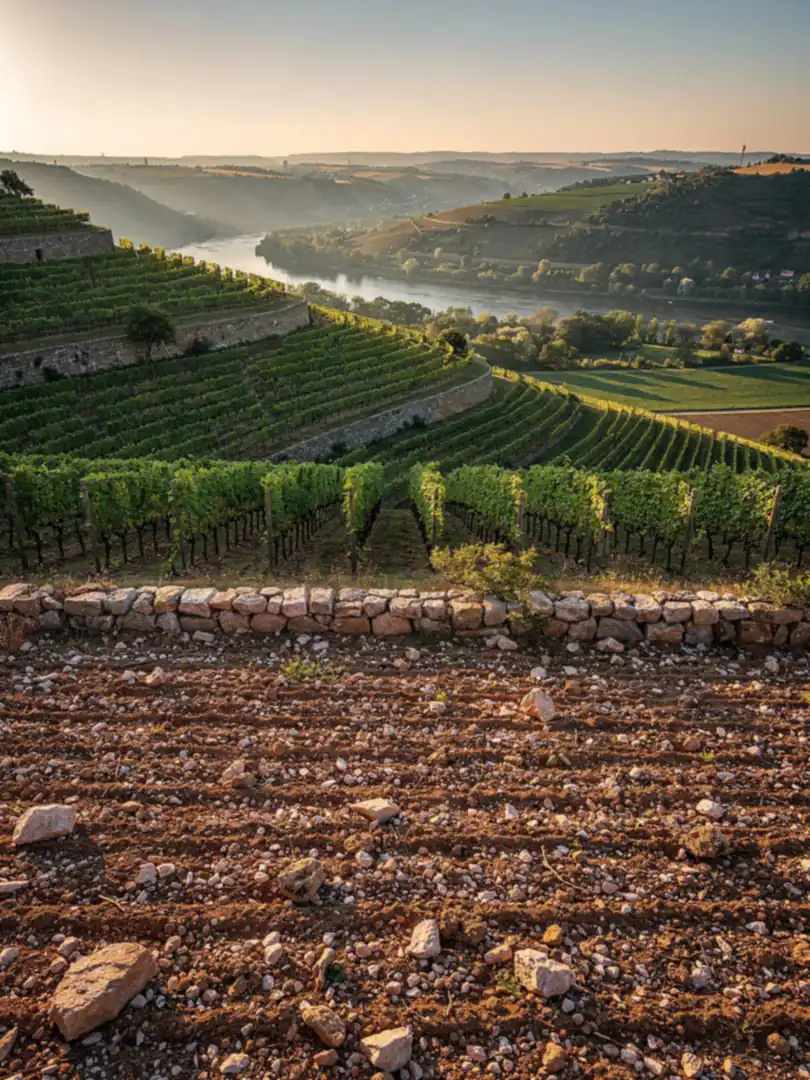
Shell Limestone and Terraces
Soil & Climate
What kind of soil lies beneath the wines of the Saale and Unstrut? Mostly shell limestone and red sandstone, with vines often growing on terraces in the narrow river valleys. The region is among the northernmost quality wine areas in Europe, and that's exactly what makes it interesting for sparkling wine.
On the terraces, south-facing slopes capture the sun, and the dry-stone walls slowly release that warmth in the evening. But in the end, something else matters most for Sekt: acidity. The cooler the ripening period, the more acidity remains in the berries, and a base wine with crisp acidity better carries the later dosage and long lees aging.
Driving from Freyburg an der Unstrut toward Naumburg an der Saale, you can see the terraces rising up the valley slopes. One of the well-known sites is the Freyburger Schweigenberg. According to the winegrowers' association, it mainly produces Weissburgunder and Silvaner. Wine has been grown between Naumburg, Freyburg, and Memleben for more than a thousand years.
Add to this that the region lies in the rain shadow of the Harz mountains and is comparatively dry. That helps keep the grapes healthy, and for Sekt they need to be healthy rather than overripe, since overripe berries bring alcohol instead of freshness.
Because the Sekt later spends months aging on the lees, cellar temperature matters more to it than whether the cellar is carved into rock. Every lees aging process needs steady coolness, whether it takes place in a vault or in a temperature-controlled tank room.
The Freyburg-Unstrut Winzervereinigung farms around 380 hectares by its own account, nearly half of the region's vineyard area. How the grapes are harvested there therefore strongly shapes what later ends up in the glass as Sekt from Saale-Unstrut.