Slate and Acidity
Soil & Climate
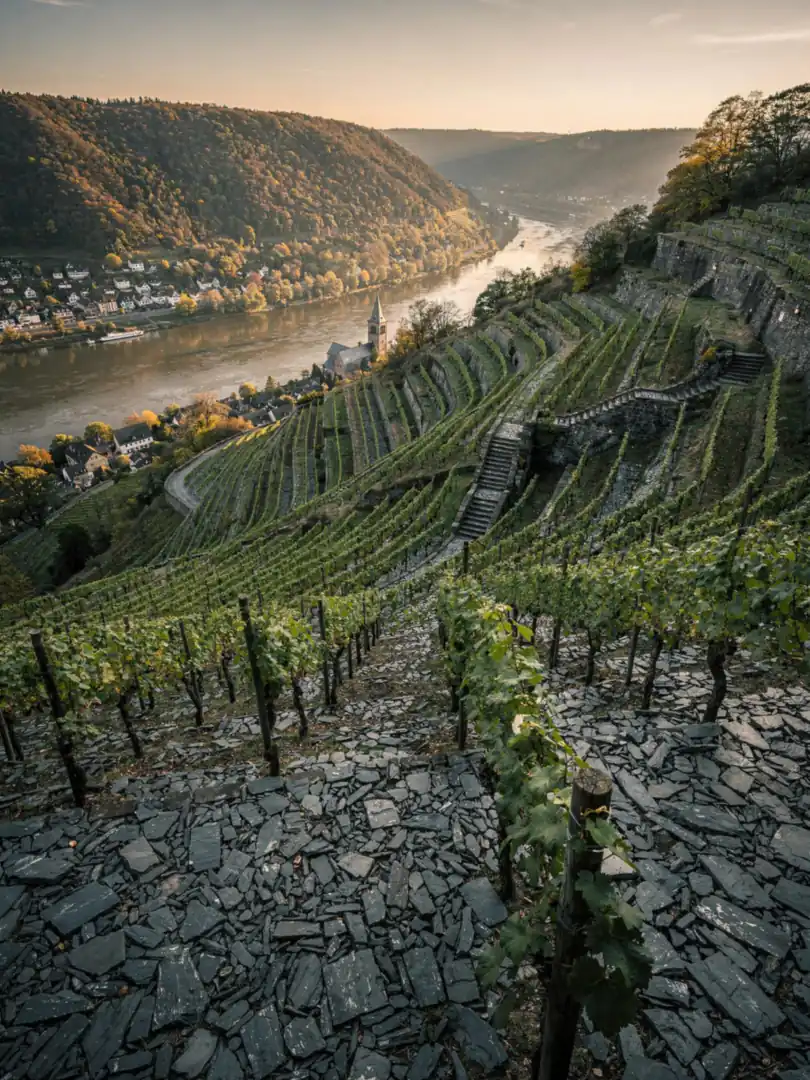
The soil of the Mosel is predominantly slate, a dark, splintery rock that absorbs heat during the day and releases it slowly at night. The Agritiushof winery cites Devonian slate as the foundation of its Riesling Crémant. For sparkling wine, this means the grapes ripen evenly while still retaining their acidity.
Vineyard names ending in '-lay' indicate slate slopes. One merchant describes the Scharzhofberger Riesling Sekt Brut from Bischöfliche Weingüter Trier as showing pear, apricot and yellow apple, along with a salty, mineral note. That salinity is the contribution of the slate.
Steep slopes make the use of machinery impossible. The grapes for Mosel sparkling wine are therefore often picked by hand, which fits neatly with the rules for Crémant, which must be hand-harvested. Germany expressly permits the name Crémant for Sekt b.A.
The label may state 'Steillage' (steep slope), even for Sekt b.A., if the grapes come from vineyards with a gradient of at least 30 percent—that is, a 30-meter change in elevation over 100 meters of distance. An award-winning Winzersekt from the 2022 vintage states this openly: Mosel, Riesling, Steillage, dry, 12 percent alcohol.
The cool climate is the real advantage for sparkling wine production. Sparkling wine needs grapes that are picked early and bring plenty of acidity. On the Mosel, Riesling ripens late, retains its acidity, and reaches the press with moderate alcohol levels. Sekt b.A. requires a minimum of 10 percent alcohol, a level the base wines reach with ease.