Rhine and Taunus
Soil & Climate
A Sekt house doesn't need its own vineyard right outside the door, and the houses in Biebrich and Schierstein proved this early on. In 1877, Söhnlein signed a contract for base wines from the Prince of Metternich's Schloss Johannisberg. The craft lies in selecting the right lots, not in the soil beneath one's own walls.
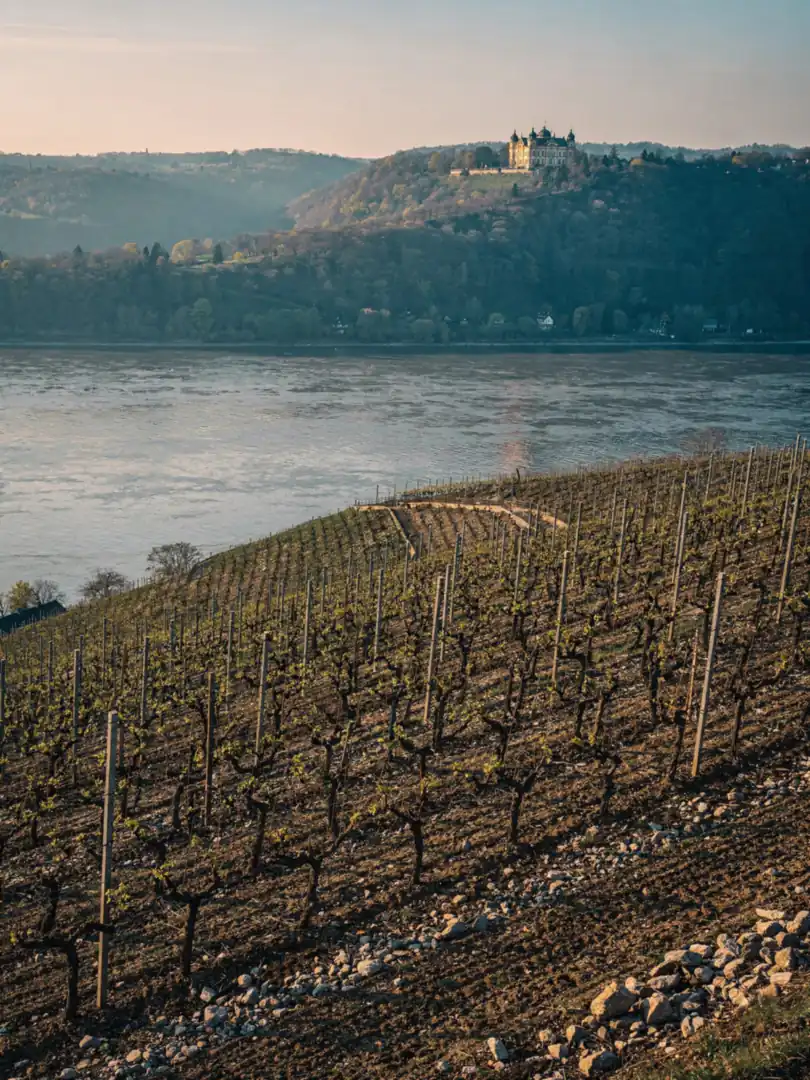
Still, the landscape shapes the Sekt made here. Wiesbaden sits at the eastern edge of the Rheingau, right where the Rhine bends westward. To the north, the Taunus mountains block cold winds, while to the south the river spreads out, storing warmth and reflecting light from its surface onto the slopes.
This combination is ideal for sparkling wine. It calls for base wines with high acidity and low alcohol, which is why the grapes are picked earlier than for still wine. A cool year, which might frustrate some winemakers, gives the Sekt producer exactly the crisp acidity that will later balance the sweetness of the dosage.
In the Rheingau, loess, loam and quartzite lie side by side depending on the slope. Loess and loam tend to produce softer wines, while stonier quartzite often yields firmer ones. A cellar master blending lots from several sites uses this variation much as a painter uses colors.
Schloss Johannisberg sits on a rise above the Rhine, its slopes facing south toward the river. According to tradition, the Spätlese style was born here in 1775, when the messenger carrying permission to begin the harvest arrived late. Söhnlein deliberately sought out the Rieslings from this castle for Sekt production—a variety that retains its acidity in this particular site.