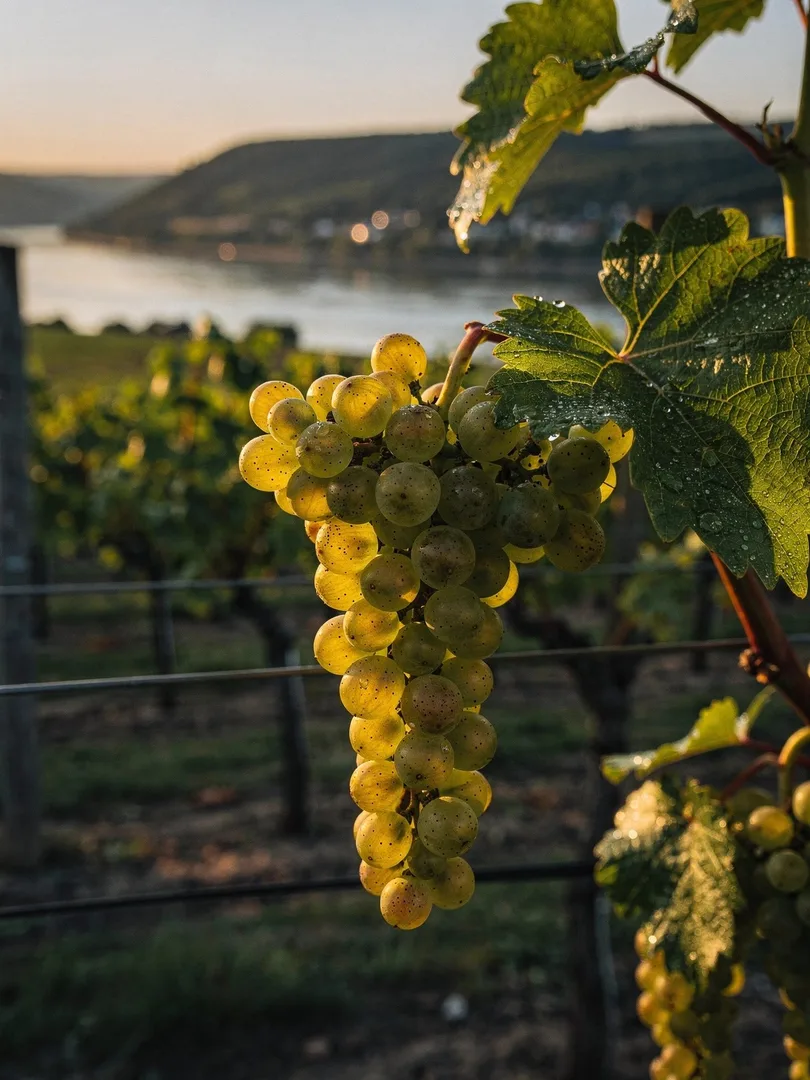
Riesling and Burgundy Varieties
Grape Varieties
Riesling Sekt from the Rheingau has a long tradition at Söhnlein, since the Rheingold brand was built on Johannisberg Riesling. The variety brings plenty of acidity along with citrus and green apple aromas, and it stays lean when picked early—exactly the qualities a base wine for sparkling wine needs. The Rieslings that Söhnlein turned into Sekt in Schierstein came from Schloss Johannisberg; the Fürst von Metternich brand still commemorates that contract today.
German law does not prescribe specific grape varieties for Sekt. Besides Riesling, Weissburgunder (Pinot Blanc), Spätburgunder (Pinot Noir) and Schwarzriesling—known as Meunier in France—are all permitted. Red grapes pressed like white wine produce Blanc de Noirs, a term that may also appear on a Sekt label.
The group now thinks well beyond the Rhine. Since 2008, Henkell Freixenet has owned the Italian house Mionetto, whose Prosecco is made from the Glera grape. The variety has carried this name since 2009, when Prosecco became strictly a designation of origin, and Glera must make up at least 85 percent of any Prosecco DOC.
Freixenet, part of the group, produces Cava, traditionally based on Macabeo, Xarel·lo and Parellada, which together account for roughly 82 percent of Cava's vineyard area. So under one roof stand Rheingau Riesling, Venetian Glera, and Catalan Macabeo.
Why all this diversity? A brand meant to taste the same every year needs base wines that blend well together. Crisp, relatively neutral varieties carry a house's signature style better than grapes with strong individual character, which tend to want the spotlight all to themselves in the glass.