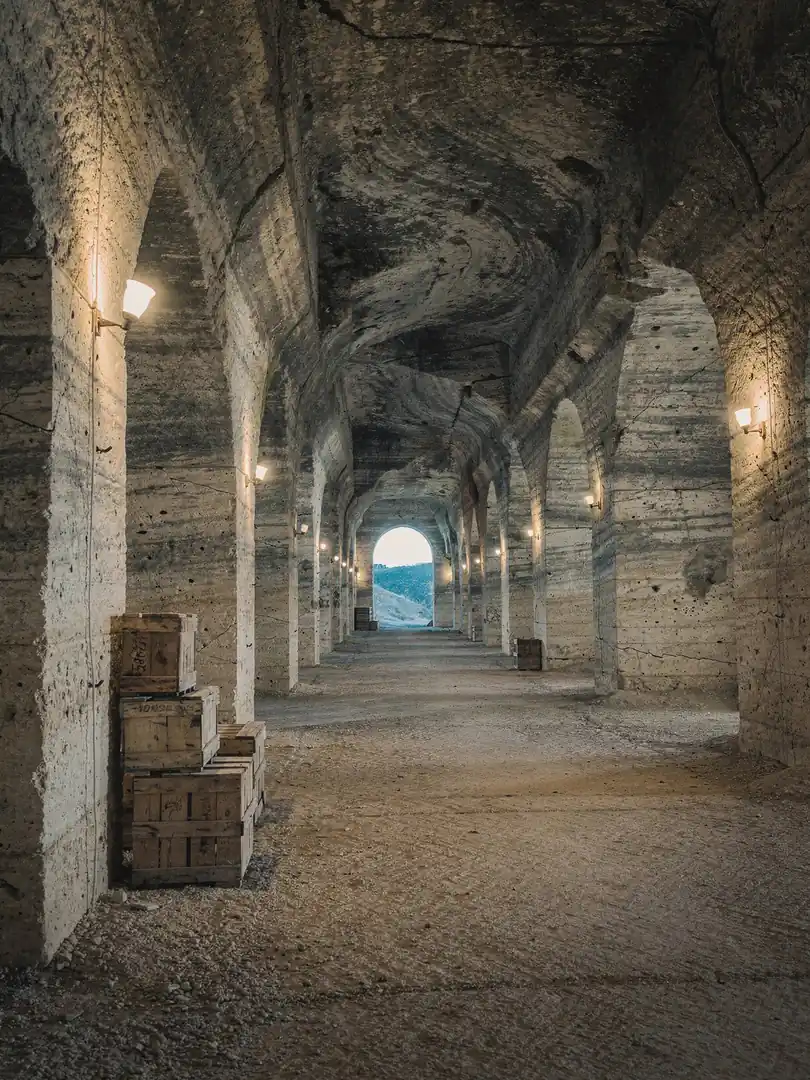
Limestone, coolness, quarry
Soil & Climate
For winegrowing, Burgundy sits at the northern edge of what's feasible, and that works in sparkling wine's favor. The specifications describe viticulture under strong climatic pressure: vines grow only in the most favorable spots, where slopes retain warmth and the soil drains water away. The grapes ripen fully yet keep their acidity, without which a sparkling wine would taste heavy and flat.
In the north, along the Yonne around Auxerre and Saint-Bris-le-Vineux, the subsoil is mostly Jurassic limestone, with older Triassic rock appearing in places. The valley floors yield little, so the vines grow on the slopes of the valleys carved into the limestone by the Yonne and its tributaries.
The Châtillonnais, the northernmost tip of the Côte-d'Or around Châtillon-sur-Seine, clings to the valleys of the Seine and its tributaries. There the vines face southeast on hard limestone, across some 250 hectares in around twenty villages. Nearly all of it goes into Crémant; still wine is the exception here, with Champagne lying just over the ridge.
Far to the south, in the Côte Chalonnaise near Rully, it's noticeably warmer. There the grapes ripen earlier on slopes of limestone and marl, and the sparkling wines are allowed a touch more roundness than in the cool north. This shift between areas explains why two bottles bearing the same name can taste so different.
Beneath Saint-Bris-le-Vineux lie old quarries, from which limestone was cut since the Middle Ages for churches and abbeys, according to local sources including the Abbey of Pontigny. Today the temperature there stays around 12 degrees year-round. A mushroom farm moved in during 1927, and since 1972 Crémant bottles have aged there: a cellar climate carved from rock, with no technology required.