Juice Instead of Wine
Base Wine & Blending
For sweet Clairette de Die, there's no base wine in the usual sense, because the starting point isn't finished wine but grape juice. This is the biggest difference from Champagne or Crémant, where a dry still wine is made first. Here, the only fermentation begins in the tank and finishes in the bottle.
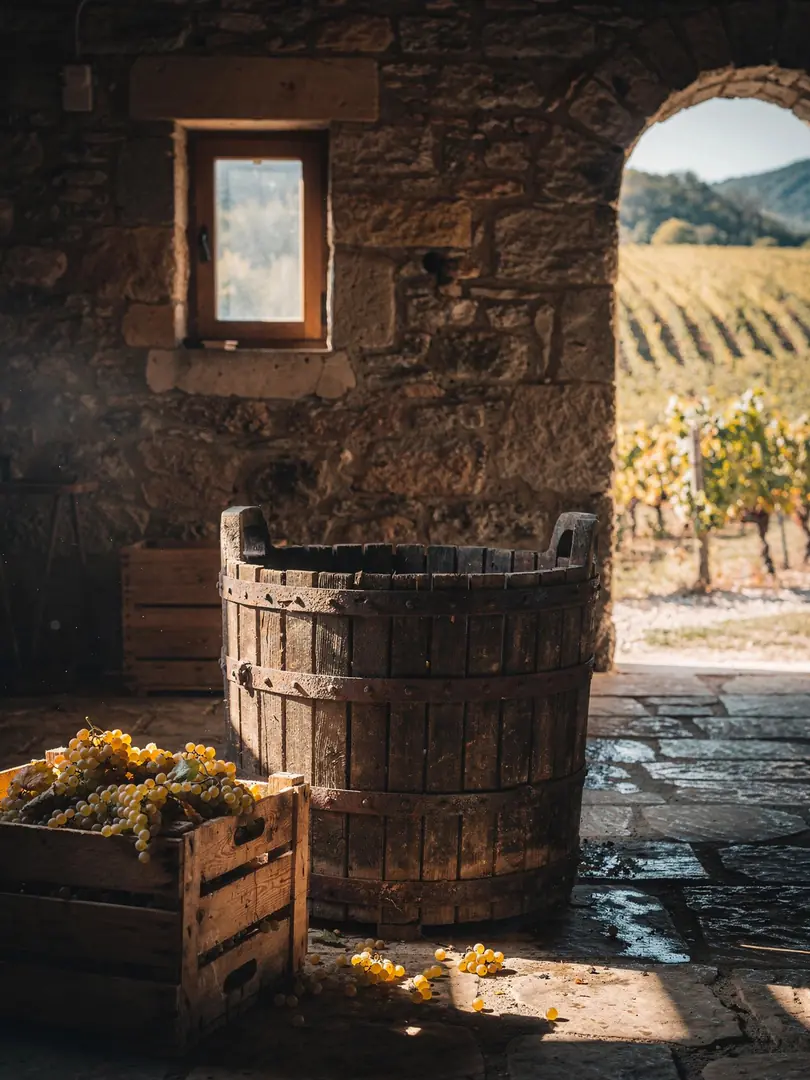
Harvesting is done by hand, required for all wines of the appellation. The grapes are pressed, and the juice is filtered to reduce the amount of yeast remaining in the must. The regulations describe it this way: fermentation is controlled through cold and slowed by removing part of the yeast.
Here, "blend" mainly refers to mixing different musts. At least three-quarters must come from Muscat à petits grains, with the remainder usually Clairette. There are no reserve wines from older vintages, since every bottle comes from the juice of a single harvest. Sales may begin no earlier than March 1st of the year following the harvest.
Crémant de Die and the dry Clairette de Die follow the classical method. Here, a fully fermented wine made from Clairette comes first, then receives an addition of sugar and yeast—the liqueur de tirage—before bottling for a second fermentation. For dry Clairette de Die, bottling may not begin until January 1st of the year following the harvest.
Terms like Blanc de Blancs or Blanc de Noirs don't apply here, since the sweet white wine is made entirely without red grapes. It's intended as a young wine of the vintage year, meant to showcase its fresh Muscat aroma.
Behind this lies real craftsmanship: the cellar master decides when to chill, when to remove yeast, and when to bottle. Bottle too early, and too much sugar remains in the wine; bottle too late, and too much of it has already fermented away.