Chalk and Cellars
Terroir & Climate
According to common estimates, around 110 kilometers of cellar passages run beneath the Avenue de Champagne, holding nearly 200 million bottles. Walking along the street, you're literally walking over millions of bottles. The tunnels were dug by hand into the chalk, spanning several levels. The cellars of Pol Roger alone stretch roughly seven kilometers beneath Épernay, across three levels.
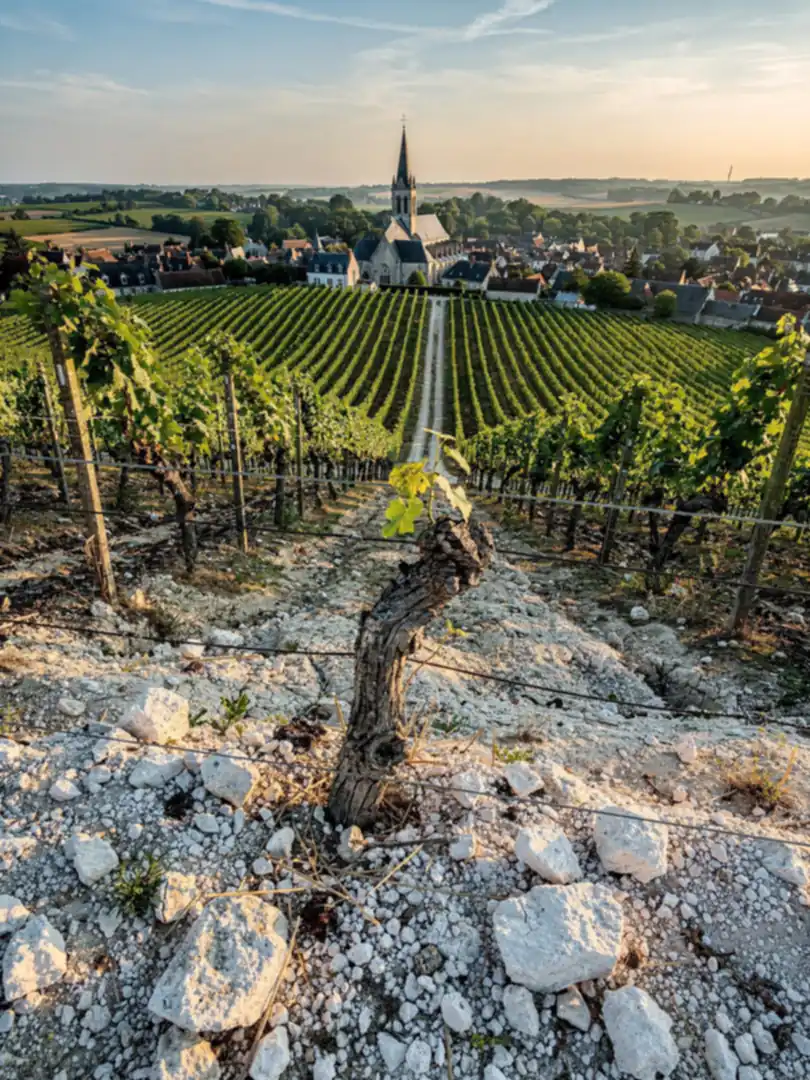
Chalk is a soft, porous limestone. It soaks up rain like a sponge and releases the water slowly to the vines during dry summers. In the cellar, it keeps temperature and humidity steady, at around 10 to 12 degrees Celsius, without any heating or cooling. This is ideal for a second fermentation in the bottle, since it proceeds slowly and without fluctuation.
Around Épernay, three growing zones meet. To the south begins the Côte des Blancs, where Chouilly, Cramant, Avize, and Oiry are classified as Grand Cru. In the Vallée de la Marne, west of the town, Dizy, Cumières, and Mareuil-sur-Ay rank as Premier Cru, as does Pierry. North of the town, the slopes around Aÿ rise up.
In Champagne, Grand Cru and Premier Cru classifications apply to entire villages, not to individual vineyard sites as in Burgundy. That's why a house typically blends grapes from many different places rather than bottling a single parcel. It explains why, along the Avenue, it's the house style that counts, not the vineyard.
Champagne's climate sits close to the limit at which grapes can still ripen reliably. Summers stay mild, and spring frost is a constant threat. This costs yield, but it gives the grapes acidity, and a sparkling wine needs that acidity to stay fresh after years in the cellar.