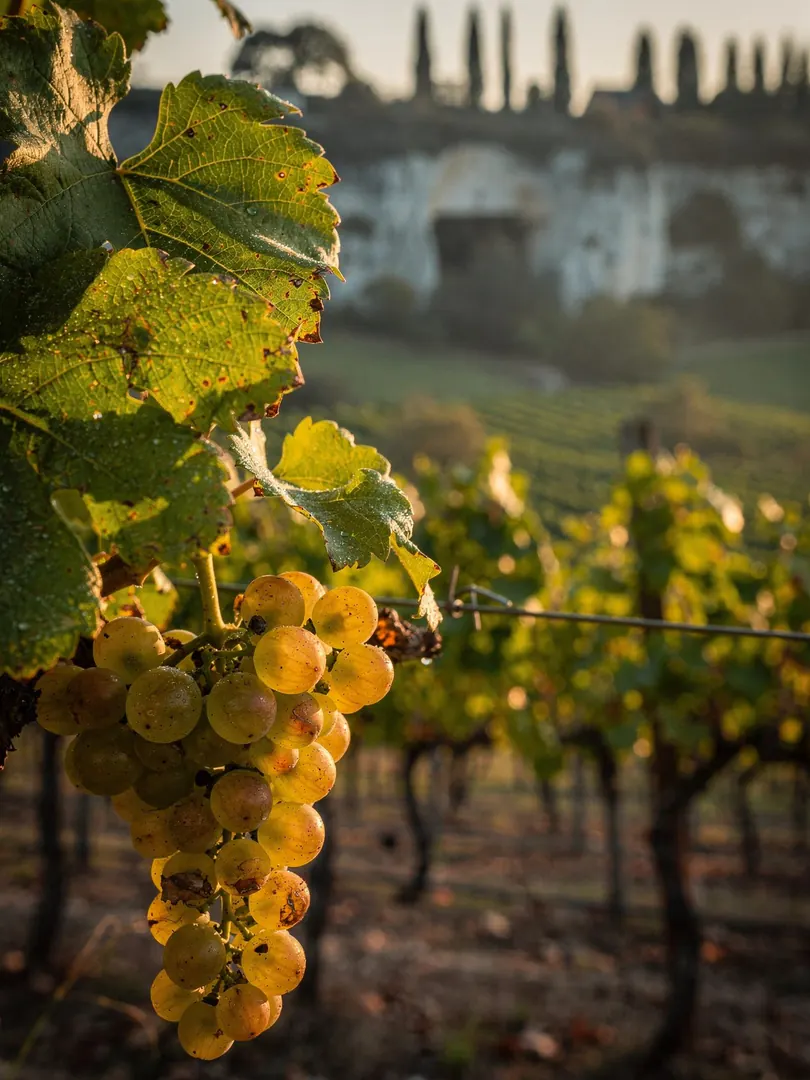
Chenin, and nothing else
Grape Varieties
Chenin blanc is also known as Pineau de la Loire in the Touraine, and it's the sole focus in Vouvray and Montlouis. In Montlouis it's the only permitted variety. The rulebook for Vouvray mousseux also allows Arbois, a minor variety known locally as Menu Pineau, but practically everything in the vineyard is Chenin, and you can taste it too.
Why does Chenin suit sparkling wine so well? It retains plenty of acidity even at full ripeness, and acidity is the backbone that keeps a sparkling wine fresh. A Chenin base wine smells of quince, apple, chamomile and honey, sometimes with a whiff of wet wool, and most of that carries through after the second fermentation. That same acidity explains why Chenin ages so well: the wine tends to grow finer with the years rather than tired.
Chenin ripens late and very unevenly. In the same vineyard you'll find green and overripe grapes hanging side by side, which is why growers often pick in several passes. For sparkling wine, they harvest early, while acidity is still high and sugar levels remain low.
For Vouvray pétillant, the appellation requires a minimum of 136 grams of sugar per liter of must. That translates to roughly 8% alcohol by volume in the finished wine, and shows just how early the harvest for sparkling wine falls compared with sweet still wines.
Yields are capped: 52 hectoliters per hectare for still wine, 65 for sparkling wine in Vouvray. For Montlouis Pétillant Originel, the limit matches the still wine at 52 hectoliters.
Depending on the vintage, Chenin can be vinified dry, off-dry or sweet; for sparkling wine, producers choose the drier style. Red varieties are nowhere to be found here. Other Loire sparkling wines, such as Crémant de Loire, blend Chenin with other grapes, but here Chenin stands alone in the glass.