Moscato Bianco Only
Grape Varieties
One hundred percent Moscato bianco, as the law demands, and the list has no room for a second variety. In France the grape is called Muscat blanc à petits grains, in Germany Gelber Muskateller, and in Piedmont it's also known as Moscato di Canelli.
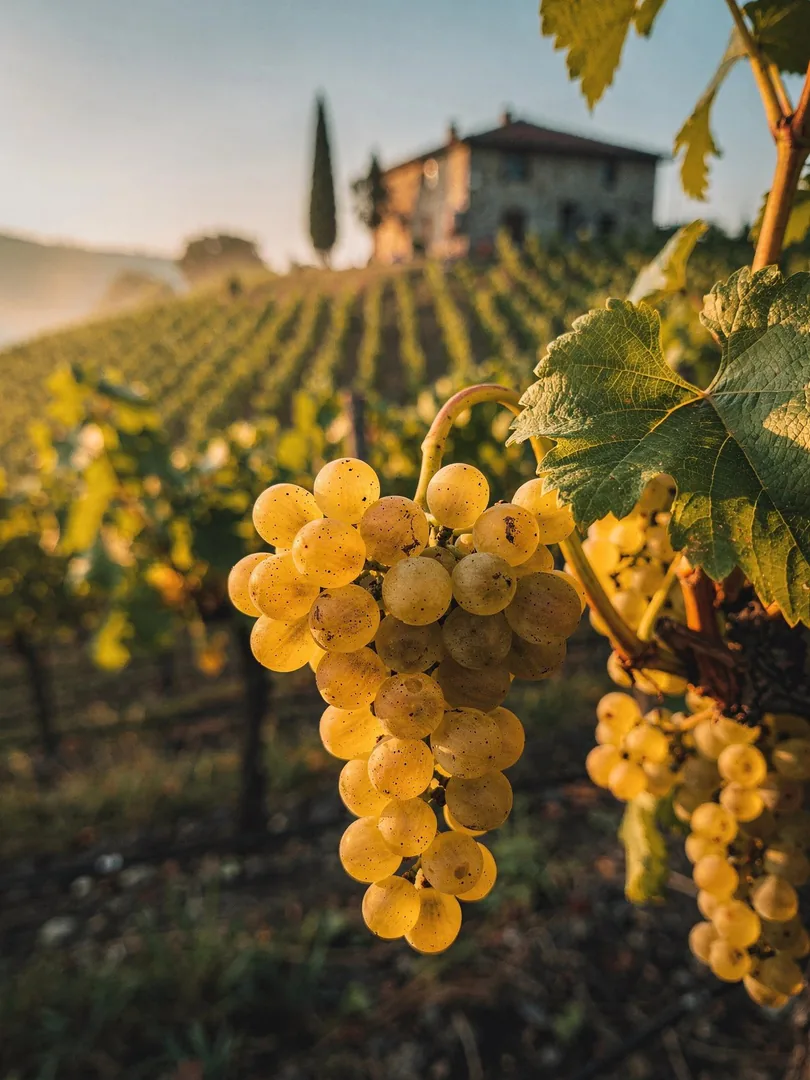
Its berries are small, golden-yellow, and thin-skinned, and the grapes already smell of muscat, elderflower, and orange peel while still on the vine. The scents come from aromatic compounds in the terpene family, such as linalool and geraniol, which also occur in flowers and citrus fruits. They survive fermentation, which is exactly what makes the wine so easy to recognize. Because the variety stands alone on the label, wines from the same vintage differ mainly through vineyard site and the cellar master's touch.
Legally, Asti is classified as an aromatic quality sparkling wine. This category only permits must from certain aromatic varieties, and in Asti it is exclusively Moscato. So when you pour a glass, you're smelling the grape itself, with no oak and no yeasty notes in between.
Yield is capped at 100 quintals per hectare, equivalent to ten tonnes. That sounds like a lot, but for a variety with small berries and an intense aroma, it's a standard limit that keeps the aroma from becoming diluted. The variety ripens early, and in the region just a few days can determine sugar content and aroma: picked too late, the wine turns heavy; picked too early, it stays green.
The variety suits sparkling wine because its appeal doesn't depend on long aging. With Champagne, depth only develops after years on the lees; with Moscato, by contrast, the aroma is already there in the grape from the start. It fades over time, which is why Asti belongs among the sparkling wines meant to be drunk young.