Early and Gentle
Base Wine & Harvest
When are grapes picked for Sekt? Earlier than for still wine, while sugar levels remain low and acidity stays high. The base wine needs to stay lean, with modest alcohol and lively freshness, since the second fermentation in the bottle will add both alcohol and carbonation.
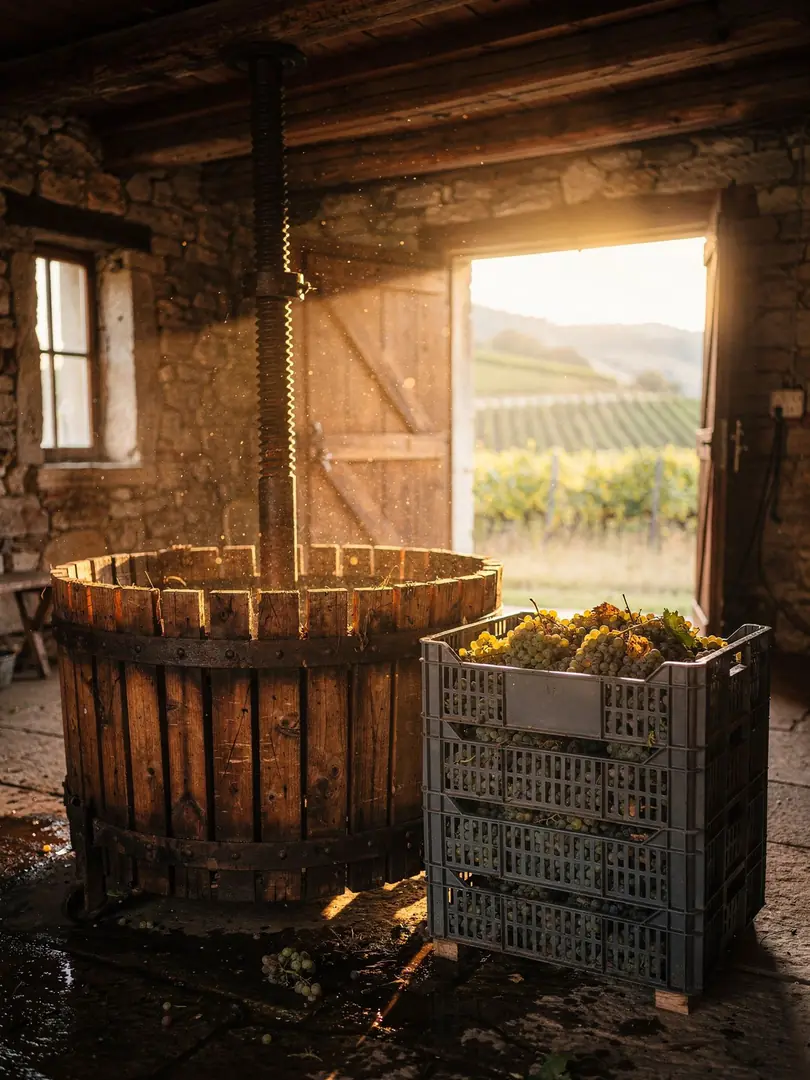
For Reserve and Große Reserve, the regulation mandates hand-harvesting. Grapes are collected in crates no more than 35 centimeters deep, so the lower layers aren't crushed by the weight above. Whole-cluster pressing follows: the grapes go into the press uncrushed, and the juice runs off gently.
Yield is also restricted. Reserve wines may extract no more than 60 percent juice from the harvested grapes, while Große Reserve is capped at 50 percent. Less juice means less tannin and bitterness, but also less volume—which is why these tiers demand greater effort for a smaller return.
A base wine isn't yet Sekt; on its own, it tastes tart and somewhat sharp. Only the cuvée—the blend of several wines—gives it shape and character. For Qualitätsschaumwein g.U., the cuvée must reach a minimum total alcohol of 9 percent. A house like Szigeti, sourcing grapes from contract growers across two provinces, can use this blending process to craft its own distinctive style.
Whether a vintage appears on the label is up to the producer. Esterházy offers a non-vintage Blaufränkisch Sekt alongside a vintage-dated rosé. Szigeti, meanwhile, produces a Blanc de Blancs—a Sekt made entirely from white grapes.