Bottle, Not Tank
The Second Fermentation
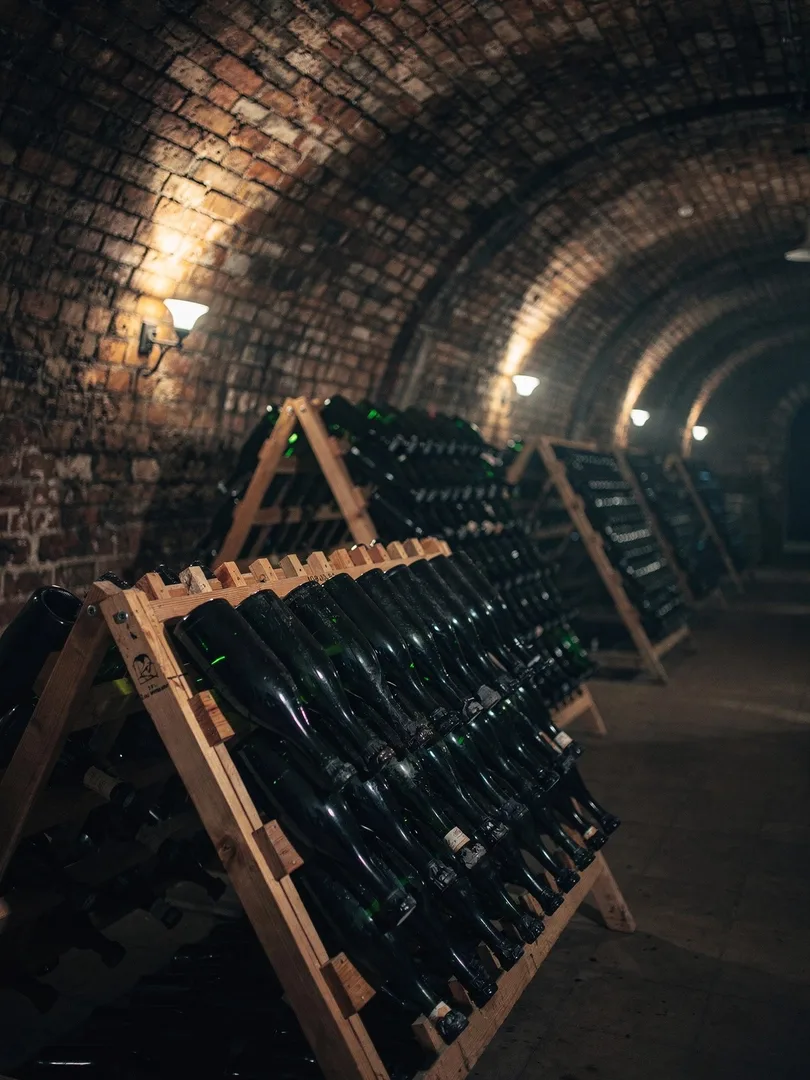
How does base wine become sparkling wine, and what does bottle fermentation mean? Sugar and yeast are added to the base wine, which is then sealed in the bottle with a crown cap. The yeast ferments the sugar, and since the carbon dioxide can't escape, it stays dissolved in the wine. This creates the pressure that later drives the bubbles. The crown cap must withstand it, since the law requires at least 3.5 bar for quality sparkling wine. Fermentation proceeds slowly in the cool cellar, at around 13 degrees, and the yeast settles as a fine sediment against the bottle wall, where it later releases its aromas.
For Reserve and Große Reserve, Austrian regulations require exactly this method as traditional bottle fermentation: the sparkling wine stays in the same bottle from fermentation through disgorgement. Klassik, by contrast, may also be fermented in a pressurized tank and needs only nine months on the lees at minimum. A PDO sparkling wine can therefore come from either tank or bottle, but Reserve and Große Reserve must come from the bottle.
At Bründlmayer, according to the estate, the base wine is bottled with sugar and yeast, rests 18 to 24 months on the lees, and is then hand-riddled and disgorged.
At Steininger, according to the estate, the entire production process, from bottling to disgorgement, takes place in-house. The same idea lies behind the designation Hauersekt, made by the winegrower themselves.
The transfer method wouldn't be sufficient for a Reserve. In this process, the bottle is emptied under pressure into a tank after fermentation, filtered, and refilled—and this may only be labeled "bottle fermented," not "traditional method." The regulations require traditional bottle fermentation for both Reserve and Große Reserve.
Sekt PDO Große Reserve BrutBottle fermentation · Grüner Veltliner or other varieties from one municipality
- Time on lees
- 30–36 Months
- Sugar
- 0–12 g/l
- Alcohol
- 11–12.5 % vol
One municipality, hand harvest, spice and freshness, with brioche and nut notes after years on the lees.