Salt Meets Acidity
Champagne and Oysters: Why It Works
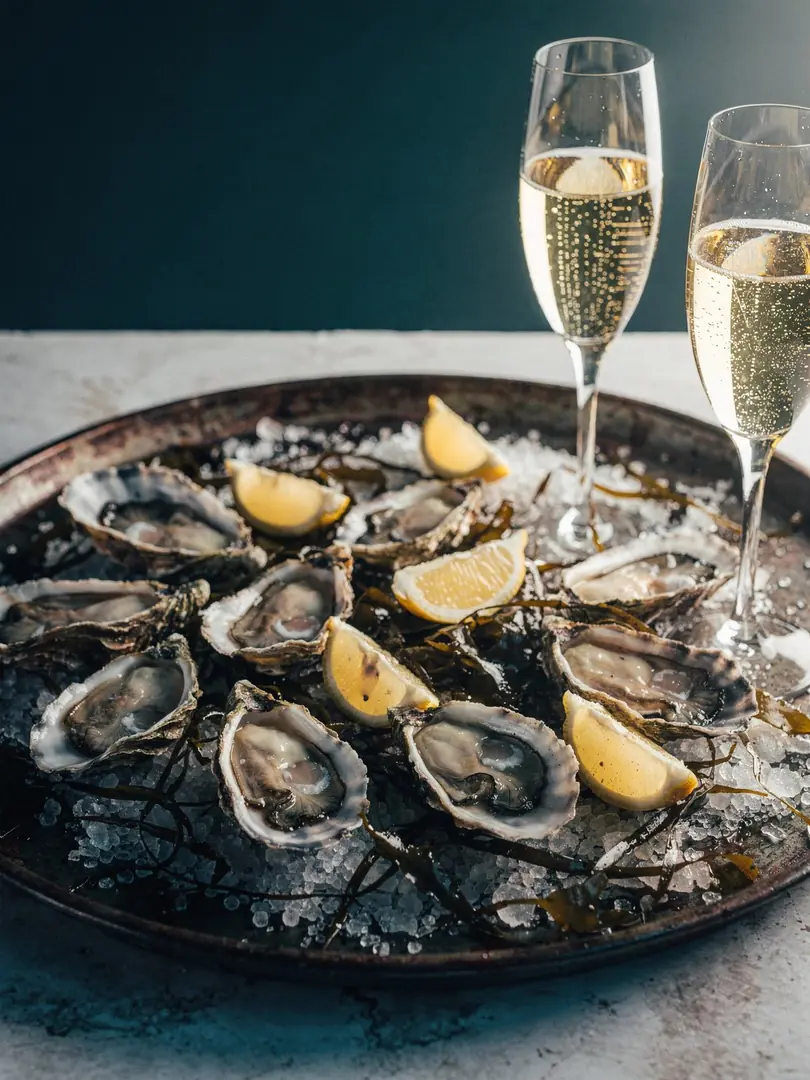
Champagne pairs with oysters because its taut acidity echoes the salt and briny note of the oyster, while the carbonation keeps its creamy flesh feeling fresh. Dry styles like Brut Nature, Extra Brut, or Brut work best, ideally as a Blanc de Blancs made from Chardonnay.
Why Do Champagne and Oysters Go Together?
A raw oyster tastes of seawater, slightly briny, often with a sweet-nutty note on the finish. Its flesh is soft and almost creamy. A dry Champagne answers with acidity that acts like a splash of lemon, and with carbonation that cuts through the creamy sensation. The oyster's salt, in turn, tames the wine's acidity, making it taste rounder than on its own. Both sides win; neither overshadows the other.
Wine lovers like to tell a story rooted in geological history here. The chalky soils of Champagne are deposits from a prehistoric sea, formed from the limestone shells of tiny marine organisms. Whether you can actually taste this origin in the glass, however, is not proven. Mineral notes in wine cannot currently be traced directly back to the soil. Still, the story works well as a metaphor for a successful pairing, and oysters and Champagne appear side by side on countless menus.
White Wine with Fish: What Research Found About Iron
The old rule of drinking white wine with fish has a measurable basis. Researchers led by Takayuki Tamura from the Japanese wine producer Mercian had tasters sample 38 red wines and 26 white wines alongside scallops. The study was published in 2009 in the Journal of Agricultural and Food Chemistry. The more divalent iron a wine contained, the stronger the fishy aftertaste. When the researchers chemically bound the iron, the effect diminished significantly.
For sparkling wine, this means, read with some caution: what matters is the iron content, not color alone, and that's not something you can know when buying a bottle. The study also looked at still wines, not sparkling ones. White sparkling wines, however, have proven themselves with seafood over generations. Those wanting to try a Rosé are better off with shrimp or lobster than raw oysters. Cooked shellfish taste richer and sweeter and can handle more fruit in the glass. Lemon and seasoning on the plate also change the picture. A squeeze of lemon on an oyster heightens the acidity in the mouth, so a very taut Brut Nature can suddenly seem almost too austere. A sauce of shallots and red wine vinegar, a classic French accompaniment, calls for a wine with a touch more fruit.
Which Sparkling Wine for Oysters: Brut Nature, Extra Brut, or Brut?
Sugar is the spoiler with oysters. Even an Extra Dry with 12 to 17 grams of sugar per liter can taste cloying next to the salty flesh. Sparkling wines with little or no dosage, meaning no sugar added afterward, work best. Brut Nature has less than 3 grams and receives no sugar after the second fermentation, while Extra Brut falls between 0 and 6 grams. A classic Brut also works, as long as it stays taut and doesn't feel too full-bodied.
When it comes to grape variety, Chardonnay leads the pack. A Blanc de Blancs, meaning a sparkling wine made entirely from white grapes, usually tastes leaner and more lemony than cuvées blended with Pinot Noir. In Champagne, it comes primarily from the Côte des Blancs south of Épernay. Good alternatives include a Crémant made from Chardonnay, a Cava Brut Nature, or a dry Riesling Sekt. Its robust acidity easily stands up to the oyster's salt.
Lobster, Shrimp, Caviar: Seafood and Sparkling Wine
Cooked seafood calls for more body. Lobster and crayfish taste sweet and rich, especially with butter. Here, a Champagne with longer lees aging or a vintage wine, whose brioche and nutty notes echo the toasted flavors, works well. Grilled shrimp with garlic can handle a robust Cava or a Franciacorta. Mussels in a white wine broth, on the other hand, call for a young, fresh Crémant.
Caviar is considered a classic companion to Champagne, but it's a demanding match. It's very salty and oily, and some wines can taste metallic alongside it. A very dry, fine-beaded sparkling wine with minimal dosage handles it best. Smoked salmon is more straightforward: its fat and smokiness pair well with a Brut Rosé, whose red fruit complements the fish. Sushi with soy sauce and ginger pairs with a fruity Brut, as long as the wasabi stays light.