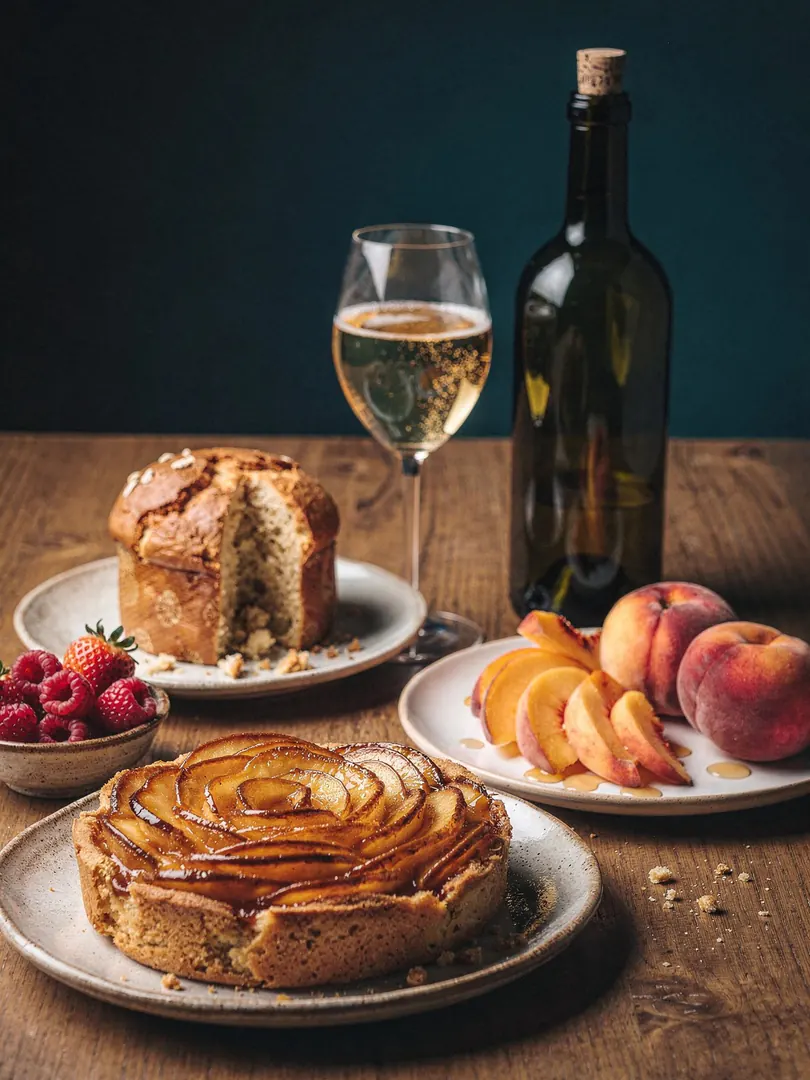
Sweet with sweet
Sweet sparkling wine for dessert: Asti, Demi-Sec, and mild styles
Dessert calls for a sparkling wine that's at least as sweet as the dish: a Demi-Sec with 32 to 50 grams of sugar per liter, a mild sparkling wine with more than 50 grams, or an Asti made from Muscat. A Brut next to cake or mousse, on the other hand, tastes sour and thin.
Why does Brut taste sour with dessert?
Our tongue judges sweetness in relative terms. After a bite of cream cake, it has adjusted to a lot of sugar. The next sip of a Brut with less than 12 grams of sugar per liter seems almost sugar-free by comparison. What's left is the acidity, which suddenly feels sharp and harsh. A wine that tastes balanced on its own loses its fruit next to dessert.
Even so, many guests toast with Brut and cake at weddings and birthdays. That's not a mistake, but it is a missed opportunity. A Demi-Sec or a Muscat Sekt would taste far better with the cake. Anyone who wants to stick with Brut for the toast should choose a less sweet dessert. Berries with little sugar or a lemon tart with plenty of acidity work well with a dry sparkling wine. A sweet bread or an almond biscuit with little sugar also pairs nicely with an Extra Dry.
Asti and Moscato d'Asti: sweetness from a single fermentation
The best-known sweet sparkling wine comes from Piedmont. Asti and Moscato d'Asti are made entirely from Moscato bianco, the same grape known in Germany as Gelber Muskateller. They have an intensely aromatic nose of fresh grapes, peach, and elderflower. Unlike Sekt, they don't undergo two fermentations. The must begins fermenting in a pressure tank, and fermentation is stopped by chilling while plenty of grape sugar still remains.
The sweetness, then, comes from the grape itself. A dosage, meaning an added sugar after fermentation, isn't permitted for this aromatic quality sparkling wine. Asti is a spumante with at least 3 bar of pressure, while Moscato d'Asti is only lightly sparkling, at around 5.5% ABV. Both pair with fruit desserts, panettone, almond pastries, and fresh peaches. Their low alcohol and freshness make them a light choice at the end of a long menu.
Demi-Sec, Doux, and mild: the sweetness levels
Champagne, Crémant, and Sekt also come in sweet styles. Demi-Sec, meaning off-dry, contains 32 to 50 grams of sugar per liter, while Doux or mild means more than 50 grams. There's no 'lieblich' (sweet) category for sparkling wine—that term belongs to still wine. These wines receive a sweeter dosage after the second fermentation. The base wine's acidity remains intact, holding the sweetness in balance. Until the 19th century, Champagne was usually drunk considerably sweeter than it is today. Dry Brut only became dominant later, and sweet sparkling wines moved from the aperitif to the end of the menu.
A Demi-Sec with some age is actually an underrated dessert companion. It pairs with Tarte Tatin, crème brûlée, apple strudel, or fruit tarts with shortcrust pastry. A rosé Demi-Sec complements red fruits like strawberries and raspberries. With fresh strawberries and cream—a classic pairing with Sekt—the rule becomes especially clear. The berries often taste sour next to a Brut, but juicy and fruity next to a Demi-Sec.
Chocolate and sparkling wine: a tricky pair
Chocolate is the toughest test for any sparkling wine. Dark chocolate brings bitterness, fat, and a dry, velvety texture that makes the wine's acidity seem sharper. A Brut always loses this battle. Even a Demi-Sec struggles against a dark chocolate with a high cocoa content. On top of that, the cocoa butter's fat coats the tongue and dulls the wine's fruit.
Milk chocolate works better, as does any dessert where chocolate plays only a supporting role. From Piedmont comes Brachetto d'Acqui, a red, sweet, lightly sparkling wine made from the Brachetto grape, often recommended with chocolate and berries. A sweet red Lambrusco can also work. White chocolate, with its high sugar and fat content, pairs well with a mild sparkling wine or an Asti, whose fruit cuts through the richness. The more fruit a dessert contains, the easier the choice becomes.