Rind, age, salt
Sekt and cheese: Which cheese pairs with sparkling wine?
Sekt and Champagne pair well with soft, white-rind cheeses like Brie or Chaource, long-aged hard cheeses like Comté or Parmesan, and goat cheese. Trickier are pungent washed-rind cheeses and salty blue cheese, which call for rosé or a sweet sparkling wine.
Why do cheese and sparkling wine go so well together?
Cheese brings fat, salt, and protein to the palate, and sparkling wine answers with acidity and carbonation. It's the same mechanism as with fried food, just more refined. With cheese, there's an additional factor that's often underestimated: the tannins in red wine bind with protein and can taste dull or bitter next to cheese. White sparkling wine has almost no tannin, which is why many sommeliers consider it the more reliable companion for a cheese plate.
Mature sparkling wines even share some of their aromas with cheese. Both develop with the help of microorganisms. Cheese ripens through bacteria and mold, while sparkling wine rests on its lees for months or years. The notes of nut, bread, and butter that result can be found in an aged Comté just as much as in a Champagne with long lees aging. The older the cheese, the more maturity the wine may bring to the table as well.
Brie, Chaource, Camembert: soft cheeses with a white rind
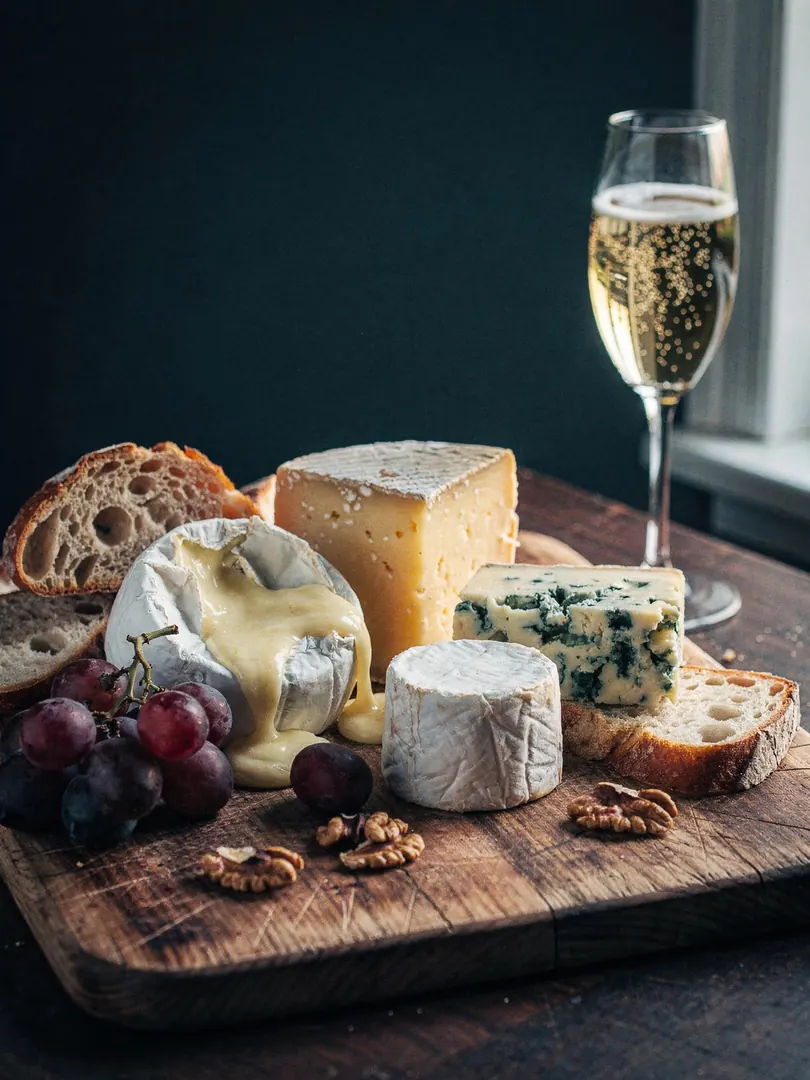
A classic pairing partner comes from just next door. Chaource is a creamy, white-rind soft cheese made from cow's milk, named after a town in the Aube department in the southern Champagne region. Its mild, slightly tangy character and mushroomy rind pair well with a young non-vintage Brut. Brie and Camembert work in a similar way, as long as they're not too ripe.
The riper a white-rind cheese becomes, the more its rind smells of ammonia. This note clashes with the wine's acidity and can make it taste metallic. For a well-aged Brie, a Blanc de Noirs or a rosé is the better choice, since it brings more fruit and body. Double- and triple-cream cheeses like Brillat-Savarin, on the other hand, need plenty of acidity. A taut Blanc de Blancs cuts through the high fat content and keeps the palate fresh. A second cheese from the region is Langres, a washed-rind cheese with a small hollow on top. It smells stronger than Chaource and calls for a Champagne with more body, such as a Blanc de Noirs made from Pinot Noir.
Hard cheese and goat cheese: Comté, Parmesan, and Crottin
Long-aged hard cheeses like Comté, Gruyère, Parmigiano Reggiano, or aged Gouda develop small, crunchy crystals—often clusters of the amino acid tyrosine that form during long aging. The savory, umami character of these cheeses calls for a sparkling wine with depth. Good options include a vintage Champagne, a Franciacorta Riserva with at least 60 months on the lees, or a Winzersekt with long lees aging.
Goat cheese is almost always a good match. Fresh goat cheese tastes tangy and slightly chalky, and harmonizes with the acidity of a Crémant de Loire made from Chenin Blanc. A young Sekt from Sauvignon Blanc works well too. Aged goat cheeses like Crottin turn nutty and more intense, and can handle a Brut with some maturity. Sheep's milk cheese like Manchego pairs with a mature Cava, since both hail from Spain and share a bold, savory character.
Washed-rind and blue cheese: where Brut reaches its limits
Washed-rind cheeses like Munster, Époisses, or Limburger smell intense and taste salty and hearty. A delicate Brut gets lost next to them. With Munster from Alsace, a Crémant d'Alsace is a natural choice, ideally made from Pinot Gris, or a rosé from Pinot Noir. In general, fruit and body help more than finesse with these cheeses. A long-aged, delicate Champagne would be wasted here.
Blue cheese like Roquefort or Gorgonzola is salty and sharp. A dry sparkling wine seems sour and thin next to it. The same logic applies here as with sweet wine and Roquefort: salt and sweetness complement each other. A Demi-Sec, a mild sparkling wine, or an Asti can balance out the sharpness. With a mild, creamy Gorgonzola dolce, an Extra Dry can also work. For a mixed cheese platter, it's best to offer two bottles—a Brut and a sweeter wine. The same order applies to cheese as to the rest of the menu: mild varieties first, bold ones later.