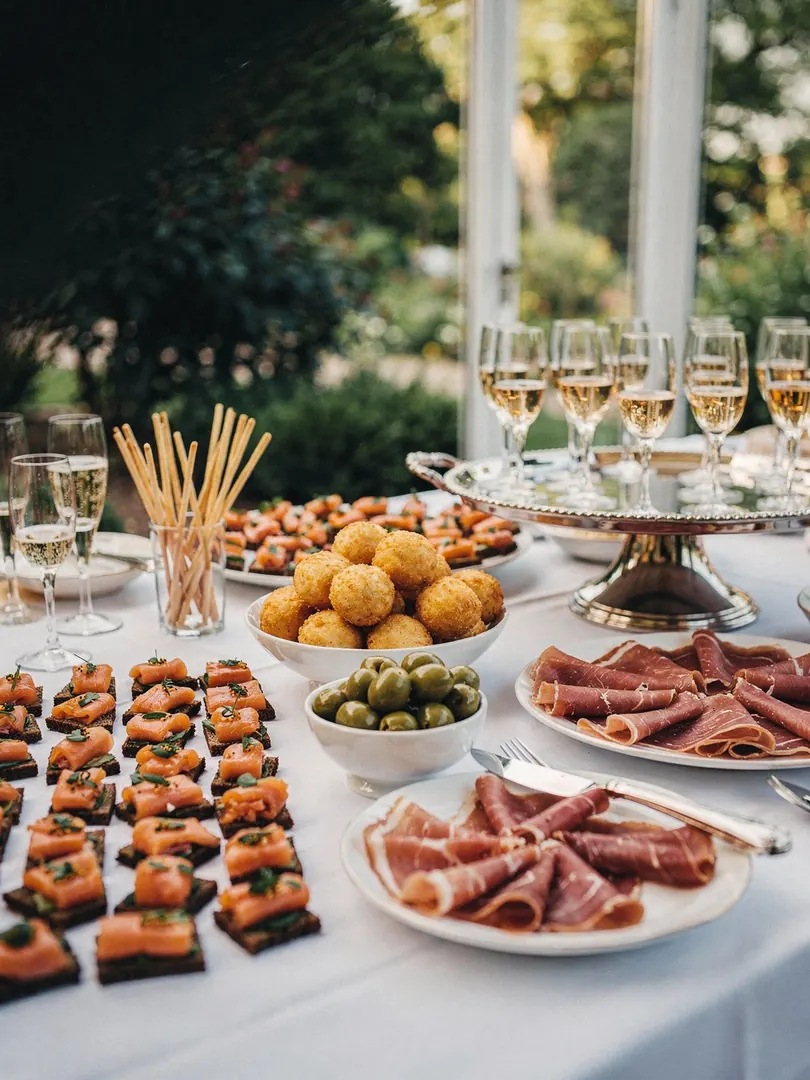
Nibbles for the toast
Sekt reception and aperitif: What canapés pair with Sekt?
A Sekt reception calls for small, salty, slightly rich bites: cheese pastries, salted nuts, olives, smoked salmon on bread, cured ham, and fried snacks. They make a dry Sekt taste more fruity. Sweet treats, heavy garlic, and vinegar, on the other hand, are best avoided for an aperitif.
What is an aperitif, and why serve it with sparkling wine?
The word aperitif comes from the Latin aperire, meaning to open. It refers to the drink that opens the evening before the meal. A dry sparkling wine is especially well suited to this role. It's light and fresh, doesn't fill you up, and can be enjoyed while standing. It still tastes good even if the canapés are only passed around later. In Italy and France, the early-evening aperitif has a long tradition and is part of everyday life. In Germany, most people encounter it mainly as a Sekt reception at celebrations.
At a Sekt reception—say, after a wedding ceremony, before a corporate dinner, or at an art opening—a Brut is usually what's poured. It pairs with most canapés and tastes good even without food. An Extra Dry is a friendlier choice for guests who rarely drink wine, since its slight sweetness softens the acidity. Alcohol-free sparkling wines are now part of any good reception. According to the Association of German Sekt Producers, sales grew by nine percent to 19.1 million bottles between January and November 2025.
Canapés that always work: salty, crunchy, a touch of fat
The basic rule from the kitchen applies on a smaller scale too: salt and fat pair well with acidity and carbonation. Salted almonds, chunks of Parmesan, grissini, and cheese straws are classics for this reason. Then there are gougères—small choux pastry puffs with cheese that originated in Burgundy, where they've long been served alongside wine. They're easy to eat, don't crumble much, and can be prepared well in advance.
Fish on bread is the second reliable group. Smoked salmon on pumpernickel, trout mousse, small cubes of matjes herring, or shrimp skewers all pair with a dry Brut or Blanc de Blancs. Cured ham like Serrano or Parma, salami, and olives bring salt and fat, ideal with a Cava or Crémant. For vegetarian options, small quiches, tempura vegetables, or crostini with goat cheese are a solid choice.
What doesn't work at a Sekt reception
Sweet canapés like petits fours, chocolates, or fruit skewers dipped in chocolate often appear alongside the Sekt at receptions. They don't pair well with a dry Brut, as the sugar makes the wine taste sour. If sweet treats are part of the program, it's better to serve them later with coffee, or to offer a Demi-Sec alongside them. Raw onions, lots of garlic, and strongly dressed salads are similarly tricky, since they linger on the palate for quite a while.
Spicy dips loaded with chili are also tricky at a reception served with sparkling wine, since carbonation and alcohol intensify the burn. Canapés are meant to take the edge off hunger, not fully satisfy it, but there should be enough to go around. If you're welcoming guests for an hour or longer with sparkling wine, make sure there's plenty to eat. Alcohol hits faster on an empty stomach, and according to a small study, carbonation speeds up absorption even further.
Prosecco, Cava, or Sekt: choosing the right sparkling wine for a reception
For a large reception, you need a wine that pleases a broad range of palates and pairs well with lots of canapés. A Sekt Brut made from Riesling or Pinot Blanc, a Crémant, or a traditional-method Cava all fit the bill. They're dry enough for salty bites yet carry enough fruit to be enjoyable on their own. A tank-method Prosecco DOC is more aromatic and softer, and tends to go down well with most guests.
When planning, it helps to use the standard hospitality-industry measure of 0.1 liters (about 3.4 fl oz) per glass. A 0.75-liter (25.4 fl oz) bottle yields six to seven glasses. For a one-hour reception, plan on one to two glasses per guest, though there's no fixed rule. What matters most is that every bottle is well chilled and ready to go. A bottle that only goes into the cooler once the party has started won't be cold in time.