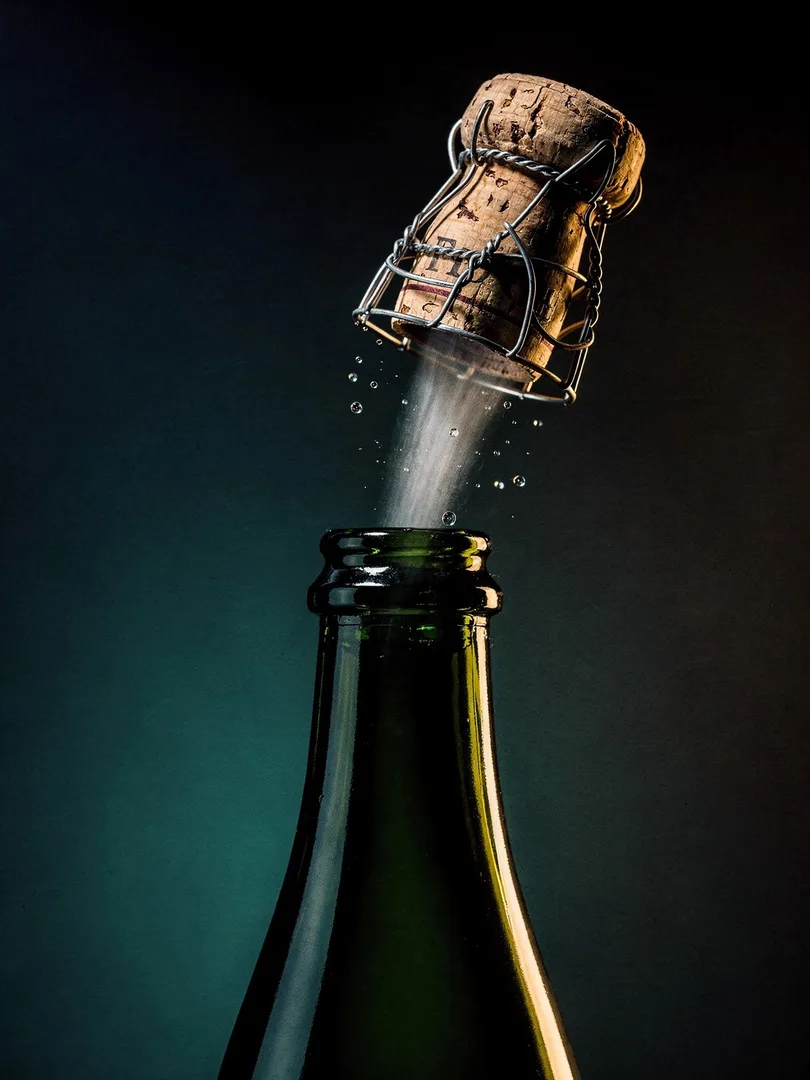
Corks and supersonic speed
How fast does a sparkling wine cork fly?
Depending on temperature and how it's measured, a sparkling wine cork flies out of the bottle at roughly 30 to 45 mph. The gas behind it is far faster still: it briefly reaches supersonic speed and cools so dramatically in the process that tiny crystals of dry ice form.
How fast does a sparkling wine cork travel?
When a bottle is opened, the excess pressure inside pushes against the cork. For Champagne, that's typically around 6 bar, roughly two to three times the pressure in a car tire. A team led by physicist Gérard Liger-Belair from the University of Reims Champagne-Ardenne filmed the opening process with high-speed cameras alongside colleagues from Rennes and published their findings in the journal Science Advances in 2019. In bottles at 20°C (68°F), the cork flew off at just over 30 mph.
A research team at TU Wien arrived at a figure of around 20 meters per second through computer simulation, roughly 45 mph. The values differ because temperature, pressure, and methodology varied between studies. The rule of thumb holds either way: the warmer the bottle, the higher the pressure, and the faster the cork. In practical terms, both figures point to the same conclusion. A cork travels fast enough to cause serious eye injury, which is why ophthalmologists issue warnings every New Year's Eve.
Why does the gas reach supersonic speed?
More fascinating than the cork itself is what follows it. The instant the cork leaves the neck of the bottle, a jet of carbon dioxide and a touch of water vapor shoots out faster than the speed of sound. The Vienna simulation calculated gas velocities of up to 400 meters per second, more than one and a half times the speed of sound. For a brief moment, a shock wave forms.
In their footage, the Reims researchers were able to identify a Mach disk, the term for a stationary shock wave within a gas jet, the kind seen in the exhaust plumes of rocket engines. Even the researchers themselves hadn't expected to find this phenomenon inside a Champagne bottle. According to the Vienna study, the pop you hear is actually made up of two components: the pressure wave released as the cork suddenly breaks free, and the sonic boom of the gas jet itself, not unlike the sound of an aircraft breaking the sound barrier.
What causes the mist when opening a bottle of sparkling wine?
When gas expands suddenly from high pressure down to ambient pressure, it cools dramatically. Measurements from Reims recorded a gas jet temperature of almost minus 90°C (minus 130°F) in bottles at 20°C, while the Vienna simulation calculated temperatures as low as minus 130°C (minus 202°F). At these temperatures, some of the carbon dioxide freezes into tiny dry ice crystals, meaning solid carbon dioxide, while the water vapor in the jet condenses as well.
This is what creates the small plume of mist that rises from the neck of the bottle after opening. When the crystals are extremely small, smaller than the wavelength of light, they scatter mainly blue light, giving the mist a faint bluish shimmer. Almost immediately afterward, the surrounding air warms the gas back up, and the mist dissipates. The entire process takes only a fraction of a second and is almost impossible to observe in detail with the naked eye; only a high-speed camera reveals what's really happening.
Why a loud pop costs you fizz
A loud pop may feel festive, but it comes at the cost of carbonation. The more abruptly the pressure escapes, the more violently the wine foams up inside the neck, and often some of it shoots straight out of the bottle. That's why sommeliers open sparkling wine quietly: they hold the cork firmly in place, turn the bottle rather than the cork, and let the pressure release slowly until all you hear is a soft hiss.
Cold temperatures help here. When well chilled, carbon dioxide stays dissolved in the wine more readily, the pressure on the cork is lower, the cork comes out more gently, and the foam stays in the bottle. A warm or shaken bottle, by contrast, is unpredictable. Never point the opening toward anyone's face, including your own. For a step-by-step guide to opening and pouring sparkling wine, see the chapter on serving.