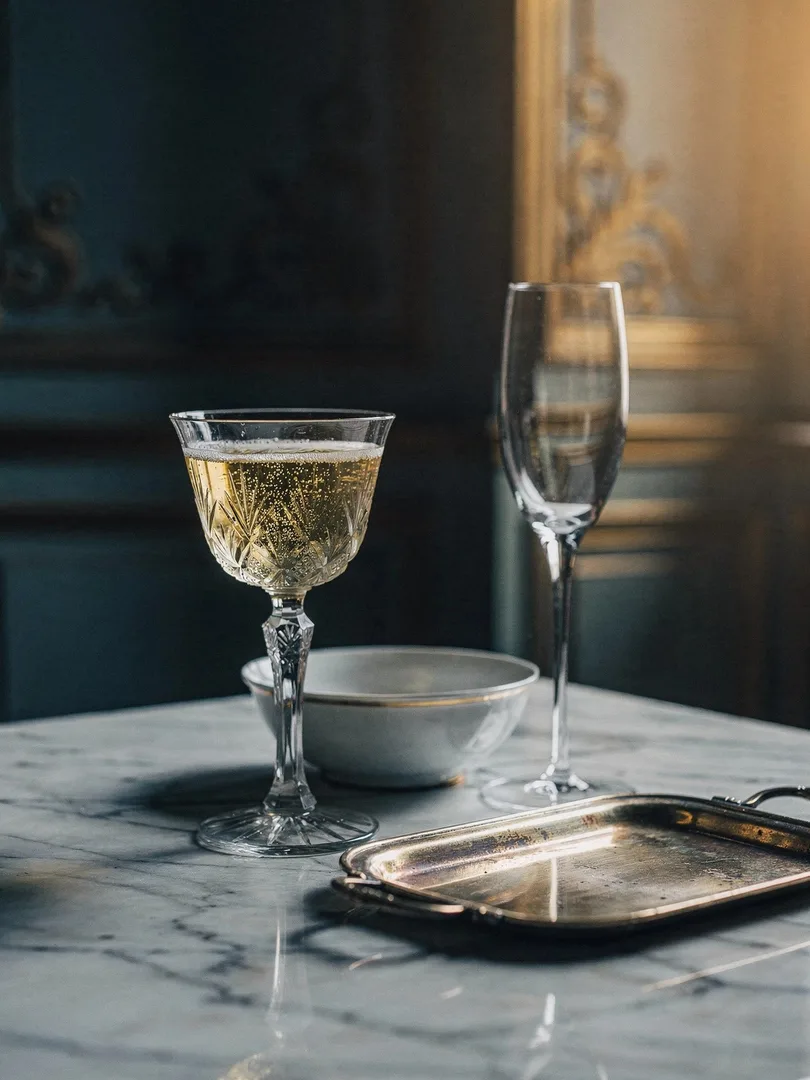
The legend of the champagne coupe
Was the champagne coupe shaped after a breast?
No, the champagne coupe was not shaped after Marie Antoinette's breast. The flat-bowled glass is usually dated to 17th-century England, long before her birth in 1755. What is genuine, however, are porcelain bowls in the shape of a breast, created in the late 1780s for her dairy at Rambouillet.
The champagne coupe and Marie Antoinette: what the legend tells
The story is often told while raising a toast. The wide, shallow champagne glass, known as a coupe in English and French, is said to have been modeled on the breast of a famous woman. Most often the name mentioned is Marie Antoinette, Queen of France. In other versions it's Madame de Pompadour, mistress of Louis XV, or even Helen of Troy from Greek legend. The appeal of the anecdote lies in how it ties together glass, Champagne, and court life in a single image.
None of it is documented. The version involving Helen naturally has no historical basis whatsoever, and for the two French ladies there is no source describing such a glass shape. The very fact that the legend attaches itself to a different woman depending on who's telling it speaks for itself. It clings to famous names, not to documents.
Where does the champagne coupe really come from?
The flat, shallow bowl shape is usually dated to 17th-century England; the year 1663 is often cited. That would make it known roughly a hundred years before Marie Antoinette's birth in 1755, and older even than Madame de Pompadour, who was born in 1721. During the 18th and 19th centuries, the coupe served as a drinking vessel for sweet wines and later for Champagne, which at the time was usually enjoyed considerably sweeter than it is today.
The coupe had its heyday in the 20th century, in the ballrooms of the 1920s and in film scenes featuring Champagne pyramids, where wine cascades down over stacked glasses. Afterward, narrower glasses took over. The coupe never disappeared entirely, though, and today it's making a comeback in bars, especially for cocktails.
What's true about the Marie Antoinette story
Still, there's a kernel of truth to the legend. In the late 1780s, a dairy — a small showpiece farmhouse — was built for Marie Antoinette at Rambouillet near Paris, where the queen and her guests enjoyed fresh milk and dairy dishes. The Sèvres porcelain manufactory supplied a service for the occasion. Among the pieces were drinking bowls shaped like a woman's breast, resting on a base formed by three goats' heads. Examples of these survive to this day.
These bowls, however, were intended for milk, not Champagne, and have nothing to do with the glass champagne coupe. At some point, presumably, someone blended the two stories together: the genuine porcelain breast bowl and the beloved Champagne glass. The result was an anecdote that makes for a far better story than the more sober history of English glassmakers. The idea lives on: in 2014, a London restaurant had a Champagne coupe made in the shape of model Kate Moss's breast, a deliberate nod to the legend.
Coupe or tulip glass: which suits sparkling wine better?
For sparkling wine as it's enjoyed today, the coupe has its drawbacks. Its wide, open surface lets the carbon dioxide escape quickly, and the aromas drift away instead of gathering above the wine. Carrying one through a crowded room also makes spills more likely. The slender flute holds the bead longer but leaves little room for aromas to develop.
For this reason, many sommeliers — and even Champagne houses themselves — prefer a tulip glass or a slender white wine glass: rounded enough to capture the aroma, yet tapering toward the top so that aromas and carbonation don't escape too quickly. For a long-aged Champagne or grower's sparkling wine with notes of yeast and nuts, this is the better choice. The coupe remains a glass for style and nostalgia. Which glasses suit which wines is explained in detail in the chapter on wine glasses.