From Harvest to Cuvée
Base Wine and Cuvée: Early Harvest, Pressing, Blending
The base wine for Sekt and Champagne comes from early-picked grapes with fresh acidity, pressed whole and gently. In Champagne, no more than 2,550 liters of must may be extracted from 4,000 kilograms of grapes. Only through the assemblage of many base wines does the cuvée come together, the blend that will later begin to sparkle.
Why Are Grapes for Sparkling Wine Picked Earlier?
A winemaker producing still wine often waits for ripe, sugar-rich grapes. For sparkling wine, they pick earlier and focus on acidity rather than must weight, meaning the sugar content of the juice. The reason lies in the work still to come: the second fermentation raises the alcohol level once more, and carbonic acid makes any wine feel leaner and sharper on the palate. A base wine with high alcohol and soft acidity would taste heavy and tired as a sparkling wine. Freshness here isn't a stylistic choice, it's the whole structural foundation.
In many regions, hand-harvesting is mandatory, for instance for Champagne, for every Crémant, and for Austrian Sekt g.U. at the Reserve and Große Reserve levels. The grapes need to arrive at the press undamaged. If a berry bursts in the vineyard, the juice starts to oxidize, and with red grapes, color leaches out. That's why they're transported in shallow crates. For Austrian Reserve Sekt, the regulations even specify the maximum stacking height of the crates: no more than 35 centimeters.
How Are Grapes for Sparkling Wine Pressed?
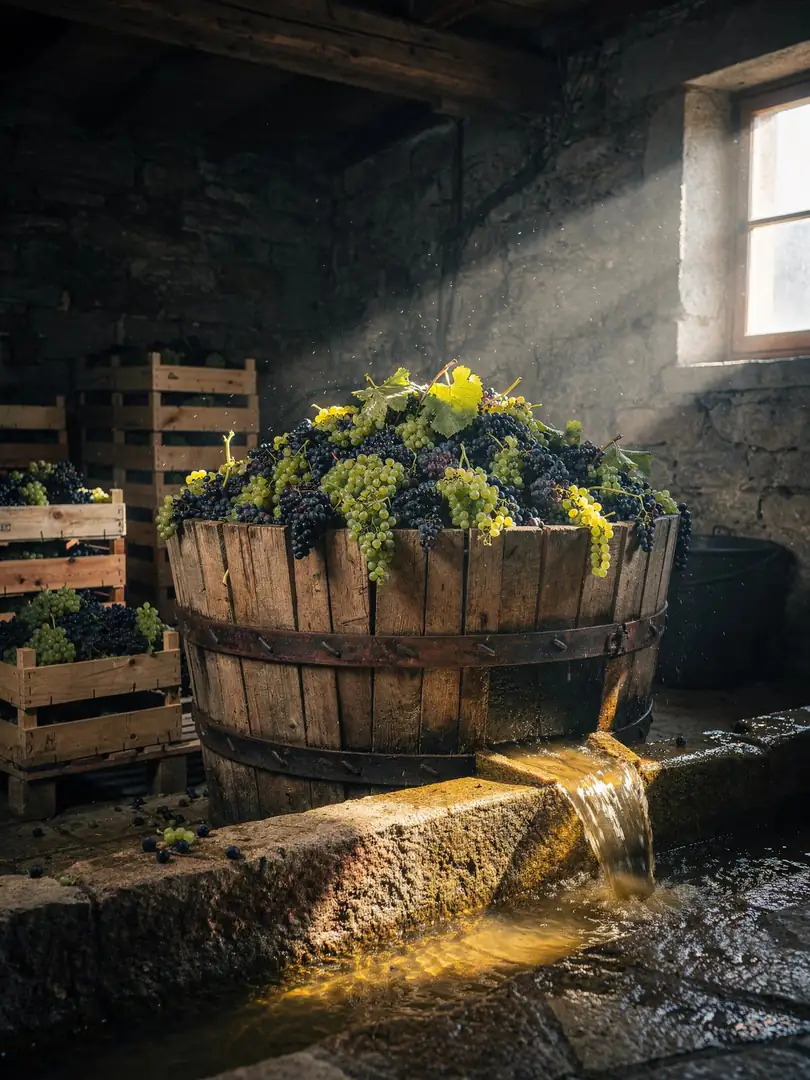
For high-quality sparkling wine, grapes are usually pressed as whole clusters, without being crushed beforehand. Pressure is applied slowly and in stages. This way, the purest juice flows first from the flesh, before tannins from skins and seeds are picked up. This explains why it's possible to extract an almost colorless must from red Pinot Noir grapes. The color sits in the skin, and with gentle pressing, it releases very little of it.
Champagne regulates this pressing precisely. From 4,000 kilograms of grapes, known as a marc, no more than 2,550 liters of must may be extracted. The first 2,050 liters are called the cuvée and are considered the finest fraction, the following 500 liters are called the taille and bring more fruit but less acidity. Whatever would still come from the press after that, the rebêches, goes to the distillery. For Crémant, the limit is 100 liters of must per 150 kilograms of grapes, or two-thirds. Austria's Reserve allows a maximum yield of 60 percent, the Große Reserve 50 percent.
From Must to Base Wine: Settling and the First Fermentation
After pressing, the must is allowed to settle. During this settling stage, called débourbage in French, sediment particles sink to the bottom of the tank over several hours, and the clear juice is drawn off. In Champagne, one to four percent sediment remains behind. Then the must ferments into base wine, which the Champenois call vin clair, meaning clear wine. Whether malolactic fermentation follows afterward is a decision each house makes for itself. In this process, lactic acid bacteria convert harsh malic acid into milder lactic acid.
This decision shapes the style noticeably. Houses that skip malolactic fermentation preserve more sharpness and freshness; their wines often need longer before they become approachable. Others aim for a rounder, creamier character. In cool regions, member states may also allow the alcohol level of the cuvée to be raised, by no more than 3% vol in wine-growing zone A. Sweetening the cuvée, however, is not permitted. Sugar only enters the picture with the tirage dosage for the second fermentation and with the final dosage at the end.
What Is a Cuvée in Sparkling Wine?
The assemblage is considered the most important decision of the year in many wineries. The cellar master tastes dozens, and at large houses far more, base wines from different vineyard sites, grape varieties, and years, and blends them into the cuvée. The goal is a wine that will taste balanced years from now, on the lees. So they must anticipate a result that doesn't yet exist. A base wine that's acid-driven and closed can be exactly the right choice here, because it will carry the long aging well.
To achieve this, many houses hold back reserve wines from older vintages. These even out weaker years and give non-vintage Brut its recognizable house style. Champagne even secures this reserve by rule: a producer may use no more than 80 percent of a vintage's volume as vintage Champagne. For rosé, the cuvée may already contain some red wine before the second fermentation, more on that in the stop on rosé sparkling wine. How houses maintain their style over decades is told in the Champagne journey.