Metodo classico
Franciacorta, Trentodoc, Alta Langa: Italy's bottle fermenters
Franciacorta, Trentodoc, and Alta Langa are Italian sparkling wines with protected origin that, like Champagne, ferment exclusively in the bottle. They share little with Prosecco beyond the country: different grapes, no tank fermentation, and at least 15 to 30 months on the lees.
Metodo classico: what connects Italy's bottle fermenters?
Italy is famous for Prosecco and Asti, both wines made in pressure tanks. Alongside these exists a second sparkling wine tradition that follows the traditional method. In Italy, it's called metodo classico: second fermentation in the bottle, extended lees aging, disgorgement. The grape varieties resemble those of Champagne, above all Chardonnay and Pinot nero, that is, Pinot noir.
The difference from Prosecco therefore comes down to grape variety, method, and time. Glera smells of pear and is meant to go into the glass fresh, while Chardonnay and Pinot nero build up aromas of brioche, nuts, and toast over years on the lees. Italian labels often state Metodo Classico for this, while in Germany the same process is called classic or traditional bottle fermentation. The term méthode champenoise is prohibited outside Champagne.
Franciacorta: sparkling wine from Lake Iseo
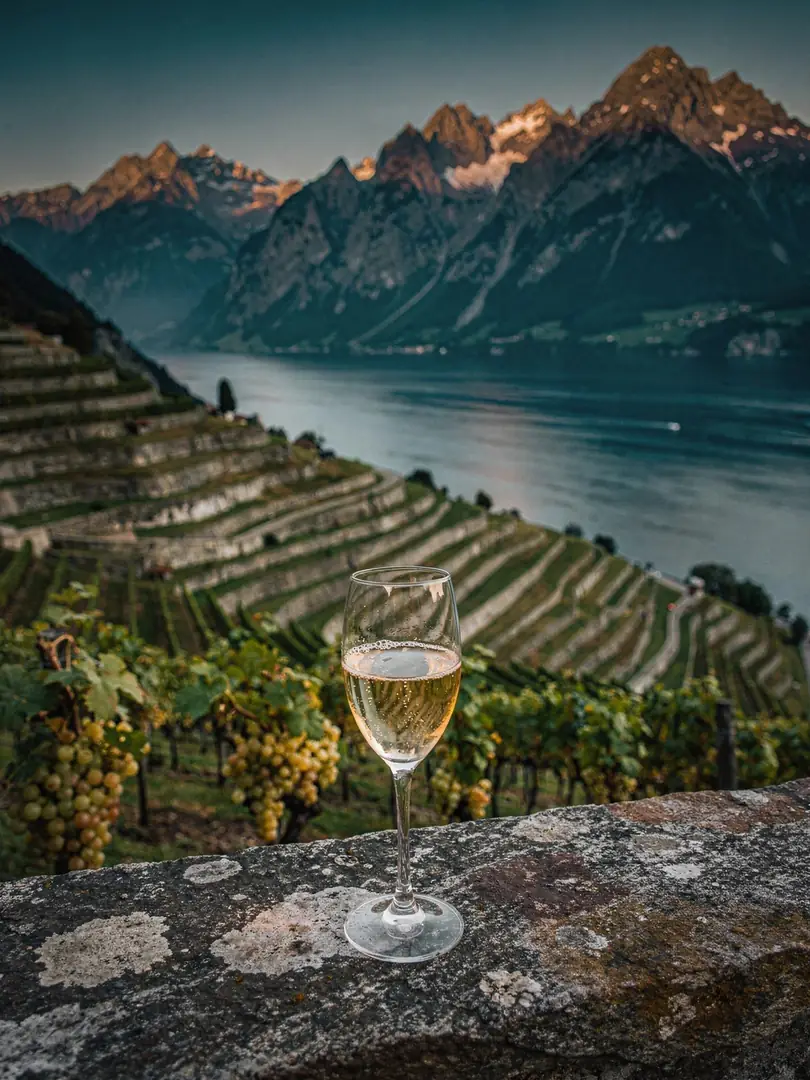
Franciacorta lies in Lombardy, in the province of Brescia south of Lake Iseo. It became DOC in 1967 and DOCG in 1995, and since then the name has stood only for sparkling wine. Permitted varieties are Chardonnay, Pinot nero, Pinot bianco up to 50 percent, and, since 2017, up to 10 percent of the old native variety Erbamat. The region's early history is covered in the wine journey chapter on Lombardy.
The minimum lees-aging times exceed those of Champagne: 18 months for non-vintage, 30 months for Millesimato, meaning vintage wine, and 60 months for Riserva. A specialty is Satèn. It's made only from white grapes, has lower pressure, under 5 atmospheres instead of around 6, and is only offered as Brut. This gives it a creamier, softer mousse. Franciacorta Rosé requires at least 35 percent Pinot nero.
Trentodoc and Alta Langa: sparkling wine from mountains and hills
In Trentino, Trento DOC, marketed as Trentodoc, is considered Italy's first DOC created solely for bottle-fermented sparkling wine, established in 1993. The vineyards lie in valleys and on Alpine slopes, where cool nights preserve acidity. Permitted varieties are Chardonnay, Pinot nero, Pinot bianco, and Meunier. At least 15 months on the lees are required, 24 for vintage wines and 36 for Riserva. The house of Ferrari, founded in 1902 by Giulio Ferrari and owned by the Lunelli family since 1952, accounts for roughly half the volume, according to trade press.
Alta Langa in Piedmont, in the hills south of Alba and Asti, is even stricter. Only Pinot nero and Chardonnay are permitted, every wine carries a vintage, and lees aging lasts at least 30 months. In the province of Pavia, there's also Oltrepò Pavese Metodo Classico, requiring at least 70 percent Pinot nero and either 15 or 24 months on the lees, depending on whether a vintage is stated.
How do Franciacorta, Trentodoc, and Champagne differ?
Stylistically, the three are closely related, with origin shaping the finer details. Franciacorta ages in a milder, lake-influenced climate and often comes across as rounder, with riper fruit. Trentodoc from higher elevations usually shows more tension and a cool, taut acidity. Champagne combines its cool climate with chalk soils and large reserves of older wines that keep the house style consistent year after year.
In terms of volume, the Italian bottle fermenters remain small. Prosecco DOC alone sold around 667 million bottles in 2025, while Franciacorta, according to older figures, farms about 2,200 hectares. For buyers, this means: the term Metodo Classico, together with the origin, reliably sets an Italian bottle-fermented wine apart from Prosecco, while the lees-aging time reveals just how much maturity the wine carries.