Origin and Law
Sekt or Champagne: What's the Difference?
Champagne is a protected designation of origin: it comes from the Champagne region of France, always undergoes a second fermentation in the bottle, and ages for at least 15 months. Sekt, by contrast, is a quality level that initially says nothing about origin or method. Only additions like Sekt b.A. or Winzersekt pin down both.
Champagne: Protected Origin Instead of a Quality Level
The key difference lies in the law, not in the glass. Champagne is a Controlled Designation of Origin (AOC) that may only be applied to sparkling wine from a defined region in northeastern France. The boundaries were set by a law of 6 May 1919, with the AOC following in 1936. The Champagne houses had already banded together to sue imitators in court as early as 1843.
Within these boundaries, strict rules apply. Grapes are hand-harvested, the second fermentation takes place exclusively in the glass bottle, and in the standard sizes from 37.5 to 150 centiliters, the wine is sold in the very bottle in which it fermented. Around 34,200 hectares of vines belong to the appellation. Champagne is either white or rosé, never red.
Sekt: A Quality Level with Open Origin
With Sekt, confusion often starts with the name itself. Many assume it's a German designation of origin, but the word actually denotes quality sparkling wine. It says nothing about which country the grapes came from. A German winery can make Sekt from base wines sourced from other EU countries. Only an origin statement on the label reveals where the wines actually come from.
Additional terms bring more precision. German Sekt is made from base wines of German origin. Sekt b.A. (from a designated region) comes from one of Germany's 13 wine regions, is officially tested, and carries a certification number. Winzersekt goes further still: the grapes and winemaking come from the producer's own estate, the grape variety and vintage appear on the label, and traditional bottle fermentation is mandatory.
Lees Aging and Method: What Happens Differently in the Cellar?
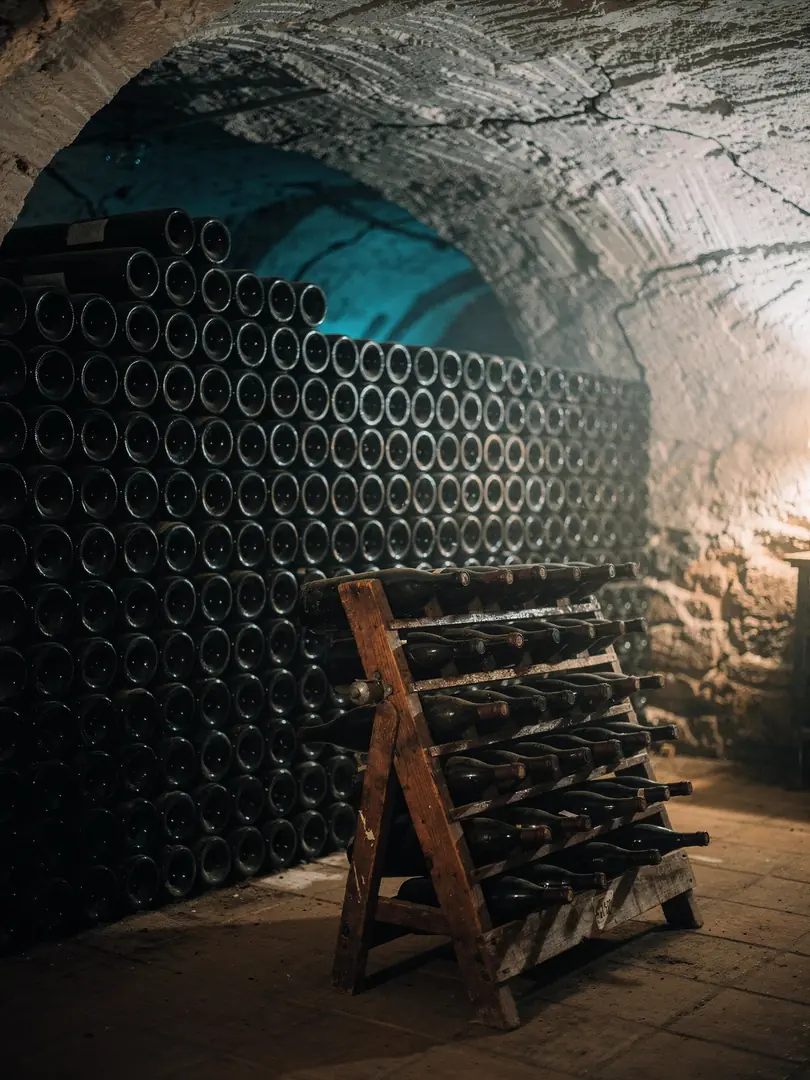
Non-vintage Champagne may not be sold until at least 15 months after tirage, the bottling for the second fermentation. At least 12 of those months must be spent uninterrupted on the lees. Vintage Champagne requires 36 months. During this time, the dead yeast cells break down in a process called autolysis, imparting aromas of brioche, bread, and nuts to the wine.
Sekt may use any approved method. Major branded Sekts are typically made using tank fermentation: the second fermentation happens in a pressure tank, after which the wine is filtered and bottled under counter-pressure. For quality sparkling wine, this requires only six months of production. Many grower and premium Sekts, however, follow Champagne's lead with traditional bottle fermentation. The VDP (Association of German Prädikat Wine Estates) requires its Sekts to rest on the lees for at least 15 months, or 24 months for vintage Sekt.
Grape Varieties and Style: Can You Taste the Difference?
Three grape varieties dominate in Champagne: Chardonnay, Pinot Noir, and Meunier. Eight main varieties are approved, plus Voltis, a disease-resistant variety recently added for climate adaptation. Sekt has no mandatory grape varieties. In Germany, a lot of Riesling goes into Sekt production, alongside Weissburgunder (Pinot Blanc), Spätburgunder (Pinot Noir), Chardonnay, or Muscat. Riesling brings a pronounced acidity and fruit character that's instantly recognizable in the glass.
Blind tasting often fails to separate the two cleanly. A Riesling Sekt made by traditional bottle fermentation with extended lees aging can resemble Champagne more closely than a fresh, tank-fermented Sekt. The name alone, then, says little about quality. Far more telling are the origin, method, and grape variety on the label—and ideally the disgorgement date, marking when the lees were removed.
Where Does the Word Sekt Come From?
Originally, "Sect" in German referred to Sherry. The word traces back to the English "sack," and ultimately to the Latin "siccus," meaning dry. Over the course of the 19th century, it migrated to mean sparkling wine. According to legend, the actor Ludwig Devrient, at the Berlin wine bar Lutter & Wegner, called out for Sekt when he actually meant Champagne. No evidence from his lifetime confirms this story.
What's certain is the influence of politics. After the First World War, the Treaty of Versailles banned German wineries from using the name Champagne, and Sekt became the established term instead. One irony of this history: some of the great Champagne houses, such as Krug from Mainz or Bollinger from Ellwangen, were founded by German emigrants.