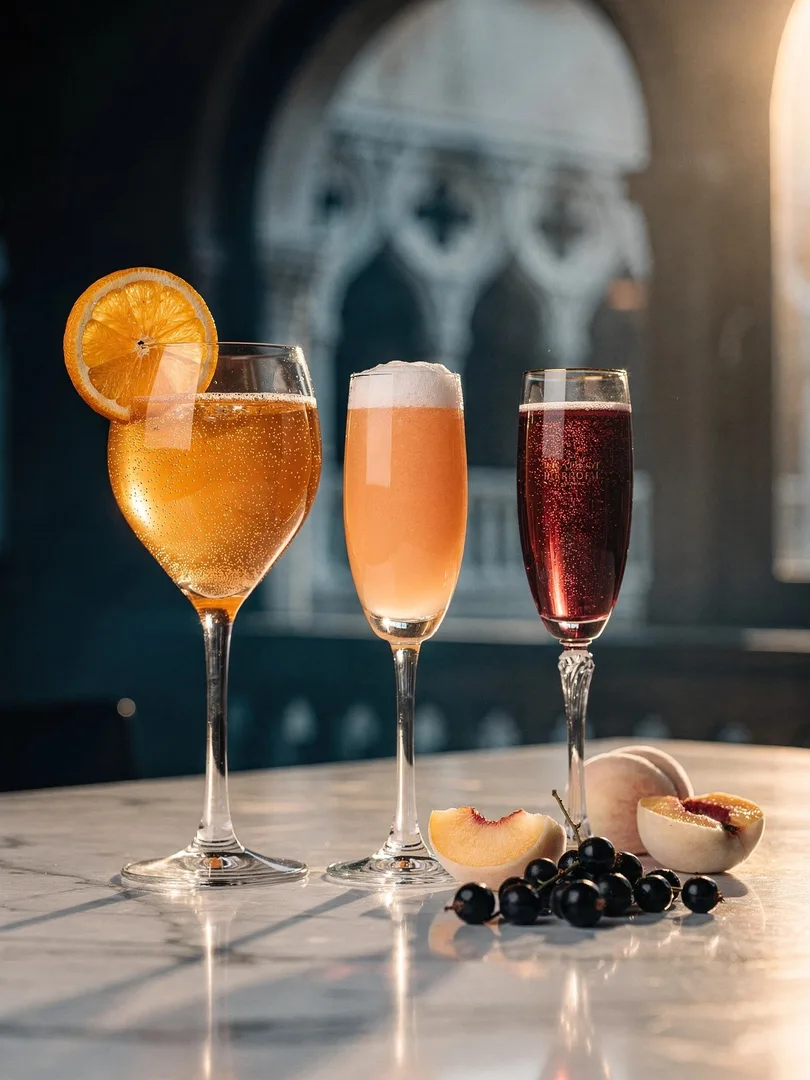
Mixing with sparkling wine
Aperol Spritz, Kir Royal, Bellini: sparkling wine or Prosecco in cocktails?
The original recipes call for Prosecco in the Aperol Spritz and the Bellini, and Champagne in the Kir Royal. Generally, a dry, fruity sparkling wine works best in cocktails, often one from tank fermentation. Sekt or Crémant are good alternatives, while expensive Champagnes with long lees aging tend to get lost in the liqueur.
Sekt or Prosecco for cocktails: what matters
A sparkling wine in a cocktail has to hold its own against liqueur, juice, or bitter flavors. What counts here is fruit, acidity, and carbonation. The delicate notes of brioche and nuts that a Champagne develops after years on the lees nearly vanish next to a bitter liqueur. That's why a fresh sparkling wine with notes of apple, pear, or citrus is usually enough for most mixed drinks.
Sweetness is the deciding factor. Liqueurs and syrups bring plenty of sugar, so a Brut with under 12 g/l of sugar usually works better than a dry (Trocken) sparkling wine. Watch the terminology: for sparkling wine, 'Trocken' (dry) means 17 to 32 g/l, while Extra Dry falls in between at 12 to 17 g/l. A Prosecco Extra Dry feels well-rounded in a Spritz because its slight sweetness softens the aperitif's bitterness.
To keep the carbonation in the glass, all ingredients should be well chilled. In many recipes, the sparkling wine goes into the glass either first or last, depending on the drink. Stir briefly and gently—never shake. Shaking leaves you with a flat drink topped by a foam that collapses within seconds.
Aperol Spritz: Prosecco, Aperol, and soda
The Aperol Spritz combines two stories from the Veneto region. The aperitif Aperol was developed by brothers Luigi and Silvio Barbieri in 1919 in Padua, with less alcohol than the bitter competitors of its time. The Spritz itself, according to popular lore, dates back to the 19th century, when the Veneto belonged to Austria. Soldiers are said to have diluted the strong local wine with a splash of water.
The International Bartenders Association lists the official recipe as 9 cl Prosecco, 6 cl Aperol, and a splash of soda water. This gave rise to the well-known rule of thumb: three parts to two parts to one. Prosecco DOC is the natural choice here, since Glera brings plenty of fruit and little acidity. A dry Sekt made from Riesling works just as well, giving the drink a bit more edge and freshness.
Kir Royal and Bellini: classics from Burgundy and Venice
The Kir takes its name from Félix Kir, a canon and, for many years after World War II, mayor of Dijon. At receptions, he served white wine made from the Aligoté grape with a splash of Crème de Cassis, a liqueur made from blackcurrants. When Champagne is used instead of the still wine, the drink is called Kir Royal. A Crémant de Bourgogne is a fitting, geographically apt match, also being bottle-fermented.
The Bellini was invented, according to the company, by Giuseppe Cipriani in 1948 at Harry's Bar in Venice. He blended white peach purée with Prosecco and named the delicate pink drink after the Venetian Renaissance painter Bellini. The purée gives the drink body and fruitiness. A sparkling wine that's too low in acidity or too sweet can quickly feel flabby here; a Brut keeps it fresh.
Mimosa, Hugo, and non-alcoholic variations
Even simpler is the Mimosa, made from orange juice and sparkling wine—known in the UK as Buck's Fizz, with a higher proportion of sparkling wine. The Hugo is said to have been invented in South Tyrol in the 2000s. It blends elderflower syrup, mint, lime, Prosecco or Sekt, and soda water. In both drinks, lively acidity is what matters most, as it carries the juice or syrup.
All these classics can also be mixed without alcohol. Non-alcoholic sparkling wine provides the carbonation but is often sweeter than a Brut. In that case, it's worth going easier on the syrup or liqueur substitute. If you're serving a cocktail with sparkling wine, keep in mind that sweet, cold mixtures can mask the taste of alcohol almost entirely. A Spritz, despite this, still contains wine and aperitif—meaning a noticeable amount of alcohol.
The same principle that applies to pouring sparkling wine on its own applies to each of these drinks. The glass is held at an angle, the sparkling wine runs down the side, and it's never poured in a high arc onto ice or juice. Ice cubes and pieces of fruit act as nucleation points for bubbles and can make a drink foam up strongly. Pouring slowly and stirring only briefly at the end keeps more carbonation in the glass—and with it, the freshness that mixing with sparkling wine is really all about.