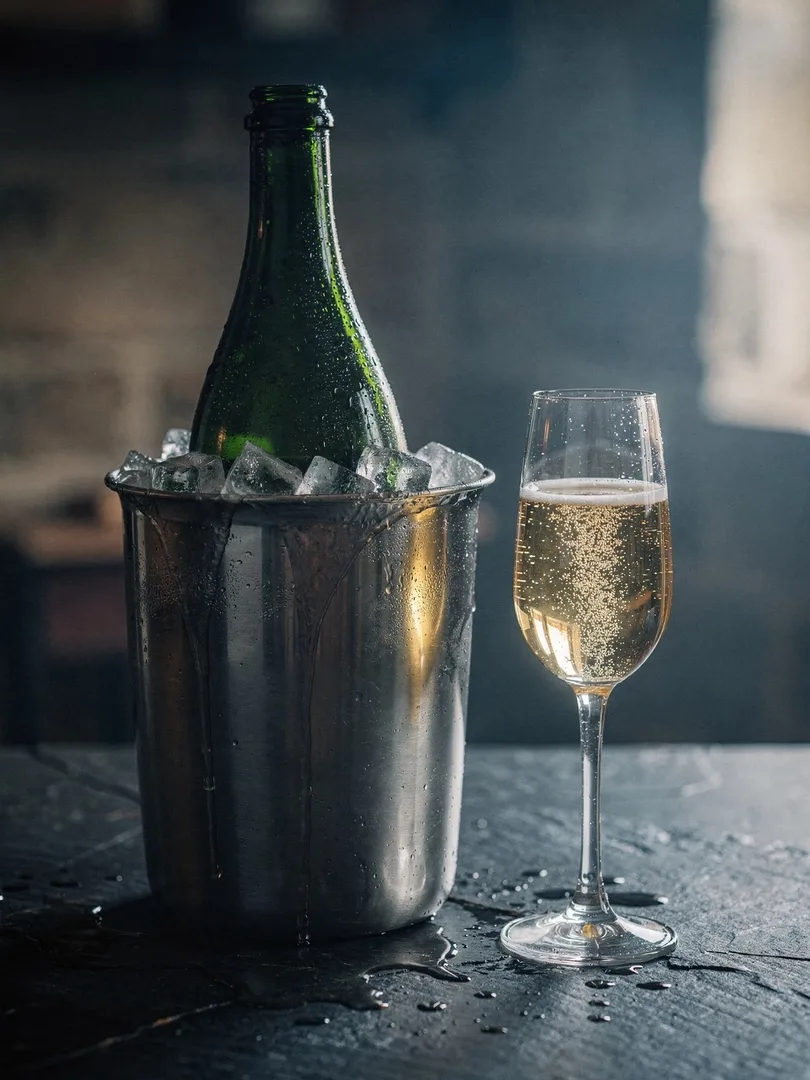
Cold, Not Icy
At What Temperature Should Sekt and Champagne Be Served?
Sekt and Champagne are served at 8 to 10 °C, as recommended by the Comité Champagne; vintage Champagne can go up to 12 °C. Lighter, fruitier sparkling wines like Prosecco can take it colder, with the Prosecco consortium recommending 6 to 8 °C.
What Temperature Does to the Carbon Dioxide
Cold keeps carbon dioxide in the wine. The colder the sparkling wine, the more gas stays dissolved, the more gently it bubbles, and the longer it stays fresh. Gérard Liger-Belair and his team at the University of Reims measured this in 2010. They poured a Champagne with 11.4 g/l of dissolved CO₂ at 4, 12, and 18 °C and determined the loss. The warmer the wine, the more carbon dioxide was lost during pouring alone.
Warm sparkling wine quickly feels clumsy as a result. The mousse fades, the alcohol becomes more noticeable, and the dosage tastes sweeter. But too cold is just as wrong. A wine that arrives in the glass almost icy locks away its aromas, and the subtle notes from aging on the lees, like brioche or nuts, get lost. The range of 8 to 10 °C is therefore a compromise between freshness and aroma.
Temperature for Champagne, Sekt, Prosecco, and Crémant
Young, fruity sparkling wines made by tank fermentation can be served cooler. Prosecco, Asti, and many branded sparkling wines rely on fruit and freshness rather than yeasty notes. For these, the lower end of the range works best - the 6 to 8 °C recommended by the Prosecco consortium. With aromatic Muscat-based sparklers like Asti, the chill emphasizes the grape's fruitiness and keeps the sweetness in check.
Bottle-fermented wines with longer lees aging can handle a bit more warmth. Non-vintage Champagne, Crémant, Cava, and growers' Sekt pair well with 8 to 10 °C. For vintage Champagne, which must age at least 36 months from bottling for its second fermentation, the Comité recommends up to 12 °C. At this temperature, an aged wine reveals depth, toasty notes, and spice. A robust Blanc de Noirs made from Pinot Noir can also often handle a degree or two more than a lean Blanc de Blancs.
Chilling Sparkling Wine Quickly: Ice Bucket, Fridge, or Freezer?
The Comité Champagne names two approaches. Either the bottle goes into an ice bucket half-filled with water and ice 30 minutes before serving, or it sits for a few hours beforehand in the bottom shelf of the fridge. The water is the real trick with the ice bucket. It surrounds the bottle completely and conducts heat away much faster than ice cubes alone, which leave air gaps between them.
The freezer is only a last resort. The bottle cools unevenly there, and forgetting about it risks freezing the wine, which expands and puts stress on both cork and glass. A handful of salt in the ice water lowers the temperature further, since salt water doesn't freeze until below 0 °C. Chilling in the fridge takes longer, but it's reliable. The fridge door, though, is the worst spot for it, since it's usually the warmest part.
Sweeter Sparkling Wine Colder, Mature Wine Warmer: The Fine Details
Cold dampens the perception of sweetness. A Demi-Sec with 32 to 50 g/l of sugar, or a mild sparkling wine with over 50 g/l, tastes fresher and more balanced at 6 to 7 °C than at 10 °C. A Brut Nature under 3 g/l, on the other hand, can taste hard and edgy if served too cold, since the acidity dominates on its own. Here it pays to let the glass sit for a few minutes.
The moment the wine is poured, it starts to warm up, noticeably within just a few minutes in a warm room. That's why it's better to pour smaller amounts more often, keeping the bottle in the ice bucket in the meantime. Holding the glass by the stem keeps your hand from warming the wine. A bottle that's already gotten too warm belongs back in water and ice, not in the freezer.