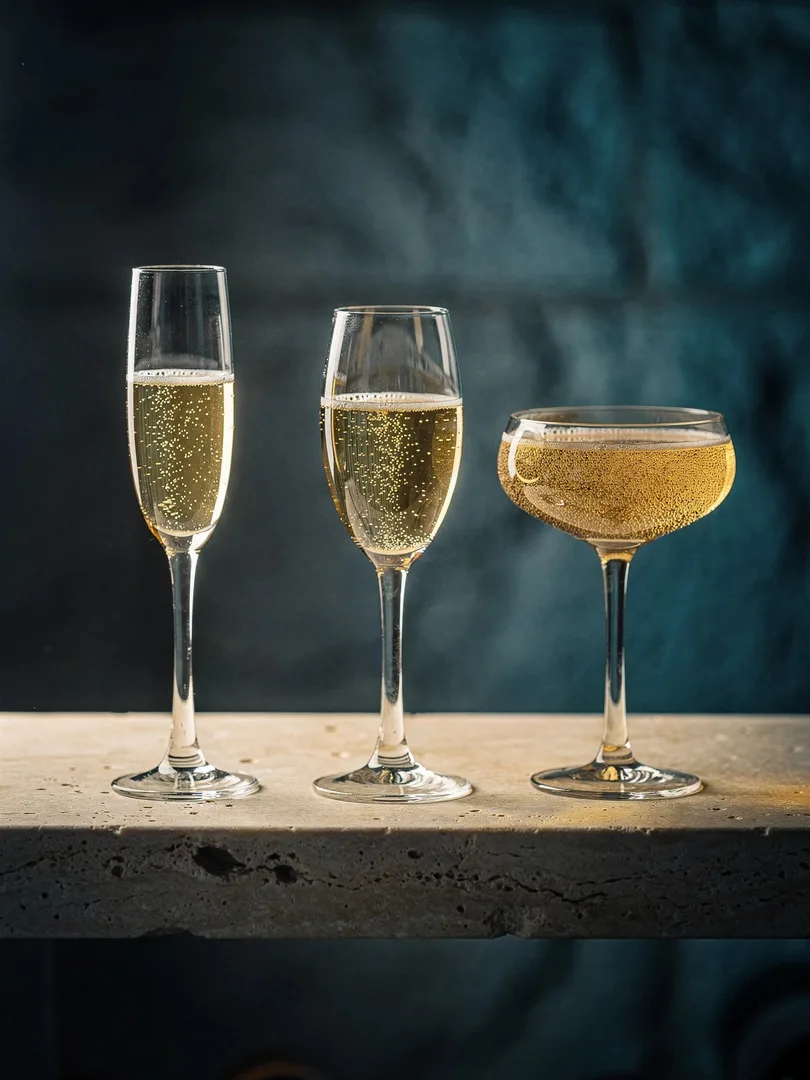
Tulip Over Flute
Flute, Tulip, or Wine Glass: Which Glass for Sparkling Wine?
A tulip glass or a slender white wine glass works best for sparkling wine and Champagne. The rounded bowl gives the aroma room to develop, while the slightly narrowed opening keeps it contained. The narrow flute shows off the bubbles beautifully but captures little aroma, while the flat coupe loses carbon dioxide the fastest.
Which Glass for Sparkling Wine? What the Shape Does
A sparkling wine glass has two jobs that pull in opposite directions. It should keep the carbon dioxide in the wine as long as possible while also carrying the aroma up to the nose. Both depend on surface area. The larger the surface between wine and air, the faster the gas escapes. The more space left above the wine, the more aroma can gather before it dissipates.
The bubbles actually help with this. When they burst at the surface, they fling tiny droplets upward that carry aromatic compounds with them. The team led by Gérard Liger-Belair at the University of Reims has filmed and measured this process for years. A glass with some curve and a slightly tapered rim captures this cloud of aroma. A glass with a wide opening lets it escape into the room, while a very narrow one leaves it hardly any space.
The Champagne Flute: Lovely Bubbles, Little Aroma
The tall, narrow flute was long the standard glass for sparkling wine and Champagne. Its advantage lies in appearance. The bubbles rise in a long column, and the small surface area keeps the carbon dioxide in the wine well. For a young, fresh sparkling wine from tank fermentation, built around fruit and zip, it's not a bad glass at all.
For sparkling wines with extended lees aging, though, it's too narrow. A vintage Champagne, a Cava Gran Reserva, or a mature growers' Sekt only reveal their notes of brioche, nuts, and toast once they get air and space. In a flute, the aroma gets pressed against the narrow rim, and your nose ends up almost in the foam. Many sommeliers and Champagne houses have therefore switched to the tulip glass or a white wine glass instead.
The tulip glass is the compromise between both worlds. At the bottom, it's narrow enough for the bubbles to rise in a column. In the middle, it widens out, and at the top, it narrows slightly again. This gives the wine enough room to release its aroma, while keeping those aromas hovering above the glass instead of drifting off to the side. If you only keep one type of glass in your cupboard, use a medium-sized white wine glass for sparkling wine. It's closer to a tulip than most people realize.
The Champagne Coupe: Why It Loses Its Fizz
The flat coupe glass, called coupe in French, is the glass of films and Champagne towers. The story that its shape was modeled on Marie Antoinette's breast is a legend without proof. Technically, the coupe is the least favorable glass. The wine lies flat and wide, its surface area is large, and above it there's barely any room for the aroma to collect.
Liger-Belair and colleagues compared the flute and the coupe in 2012 in the journal PLoS ONE. Using infrared cameras, they made the rising carbon dioxide above the glass visible. In the coupe, dissolved carbonic acid was lost faster than in the flute, while above the flute more gas remained that could tickle the nose. Those who love the coupe for nostalgic reasons are best off pouring a young, fruity sparkling wine into it and refilling often.
Mousse point, dish soap, glass thickness: small details with big effects
Bubbles don't form on smooth glass. They need nucleation sites where gas can collect, usually tiny fibers from cloths or dust. That's why some sparkling wine glasses have a mousse point at the base, a spot roughened with a laser. There, an even stream of bubbles forms, rising through the center of the glass and keeping the perlage going for a long time.
Dish soap residue has the opposite effect. A film of fat or surfactant on the glass wall causes the foam to collapse and dampens the perlage. That's why glasses for sparkling wine are best rinsed with hot water afterward and polished with a lint-free cloth. Thin, clear glass has another advantage: the wine warms up more slowly in it than in thick-walled glasses, as long as you hold the glass by the stem.